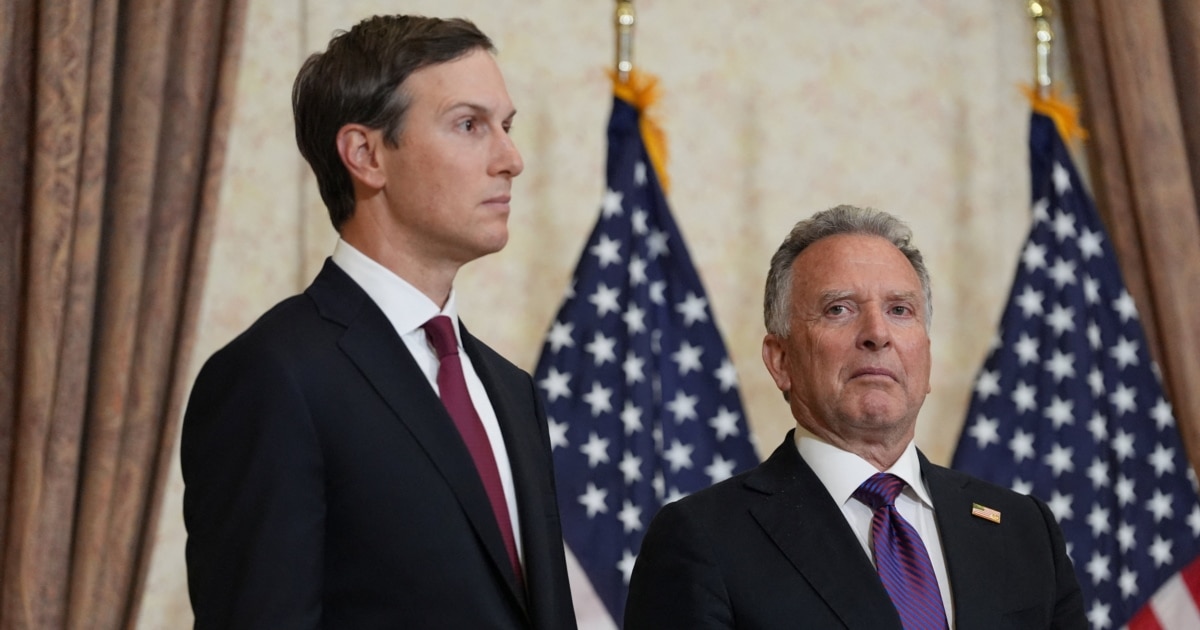
Zelensky Holds Talks with Trump Envoys Steve Witkoff and Jared Kushner in Renewed Push for Diplomacy
Ukrainian President Volodymyr Zelensky said on July 22 that he spoke with Steve Witkoff and Jared Kushner, representatives linked to former U.S. President Donald Trump, in what he called an important discussion aimed at strengthening diplomacy and advancing approaches toward peace. The talks, reported by Axios and confirmed by Zelensky, came ahead of a planned July 23 meeting in Manila between U.S. Senator Marco Rubio and Russian Foreign Minister Sergey Lavrov.
By Clémence Desjardins
1,139 views
Ukrainian President Volodymyr Zelensky confirmed on July 22 that he had spoken with Steve Witkoff and Jared Kushner, two close associates of former U.S. President Donald Trump, in discussions that Zelensky described as significant for diplomatic efforts aimed at moving closer to peace. The initial report on the conversations was published by Axios, citing U.S. sources, and Zelensky later publicly acknowledged the exchanges.
Zelensky characterized the meeting as an effort to reinforce diplomatic channels and advance talks toward a cessation of hostilities. He described the conversation as "дипломатияны күчөтүү, тынчтыкка жакындоону талкуулаган маанилүү сүйлөшүү" and said that Ukrainian and American teams remained in close contact and would continue to work on the issues under discussion. He did not provide further details about concrete proposals or any immediate outcomes from the call.
The talks took place on the eve of a meeting expected on July 23 in Manila between U.S. Senator Marco Rubio and Russian Foreign Minister Sergey Lavrov. Rubio had indicated that he intended to raise the war in Ukraine during his discussions with Lavrov. The timing of the Zelensky conversation with Witkoff and Kushner, senior figures associated with Trump, appears to have been coordinated with broader diplomatic activity involving U.S. lawmakers and Russian officials.
Moscow had previously indicated it would be prepared to receive Witkoff and Kushner. Russian Deputy Foreign Minister Sergey Ryabkov said their proposed trip to Russia was on the agenda but that the timing had not been fixed. In late May, Zelensky had suggested he was hopeful that Witkoff and Kushner would visit Kyiv within two weeks; that anticipated visit did not take place.
Earlier rounds of mediation involving U.S. intermediaries led to talks between Ukrainian and Russian delegations in February, but plans for further trilateral discussions were delayed after a sharp escalation in violence and tensions in the Middle East. In June, Donald Trump publicly said that a resolution of hostilities between the United States and Iran could create an opening to address the war in Ukraine; subsequent exchanges of strikes in July between the United States and Iran further complicated the regional security picture and the broader diplomatic environment.
Analysts say renewed contact involving unofficial or party-affiliated envoys can signal an attempt to widen negotiation channels or test interest in compromise without committing governments to specific concessions. For Ukraine, any credible process that could reduce fighting would carry major humanitarian implications, potentially easing civilian suffering and displacement. For Russia and the United States, the engagement illustrates how diplomatic activity on the Ukraine war is intertwined with other international crises and domestic political networks.
At this stage, officials have offered only limited information about the substance of the July 22 conversations. Zelensky’s confirmation underscores Kyiv’s willingness to explore multiple avenues to advance diplomacy, while Moscow’s statements and the timing of related meetings in Manila suggest that contacts on the conflict remain fluid and subject to shifting geopolitical pressures. Observers caution that without clear frameworks, guarantees and transparency, sporadic talks may be unlikely to yield immediate breakthroughs but could shape the contours of future negotiations.