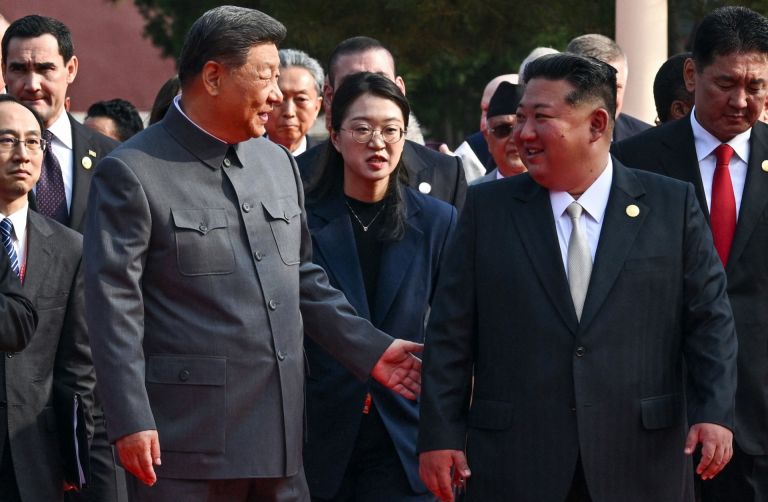
Xi’s Visit to Pyongyang Marks a Potential Thaw in Long-Frozen China–North Korea Relations
Chinese and North Korean state media announced that President Xi Jinping will visit Pyongyang from June 8-9 at the invitation of leader Kim Jong Un, a step that analysts say signals a belated thaw in bilateral ties. The summit follows recent diplomatic activity between the two capitals and comes as North Korea’s nuclear program continues to advance, raising questions about the meeting’s implications for economic engagement and regional security.
By Alexander Walter
843 views
Chinese and North Korean state media announced on June 5 that Chinese President Xi Jinping will visit Pyongyang at the invitation of North Korean leader Kim Jong Un from June 8-9. Neither government specified the agenda for the two-day visit. The rare summit of the two leaders is being read by analysts as a notable step toward repairing long-dormant high-level contact between Beijing and Pyongyang and as a potential opening for renewed, if cautious, political and economic engagement.
The visit follows a recent uptick in diplomatic activity between the two capitals. Kim Jong Un traveled to Beijing in September to attend a military parade alongside Xi, marking his first trip to China since January 2019. Chinese Foreign Minister Wang Yi also visited Pyongyang in April 2026, a trip observers interpreted as preparatory diplomacy likely intended to lay the groundwork for Xi’s visit. Taken together, these engagements reflect a pattern of reinvigorated bilateral contact after years in which summit-level interactions were rare.
Analysts characterize the timing and visibility of the summit as significant for multiple reasons. For Beijing, restoring routine high-level ties with Pyongyang helps shore up influence over its neighbor, preserve stability on the Korean Peninsula, and position China as an indispensable interlocutor on regional security matters. For Pyongyang, the meeting yields international legitimacy and the prospect of increased economic cooperation at a time when the North faces ongoing pressure from sanctions and the need to sustain its economy.
The summit also takes place against the backdrop of continued development of North Korea’s nuclear weapons program. While neither side outlined specific topics in their announcements, the broader context makes security issues — including the trajectory of Pyongyang’s weapons capabilities and the role of external actors in managing or responding to them — a likely area of mutual concern. Observers caution that any diplomatic thaw is unlikely to translate immediately into major policy shifts on denuclearization but could influence the strategic calculations of regional powers and Washington.
One important implication of the Xi-Kim meeting is its potential signaling effect for U.S.-North Korea relations. Some analysts see the summit as an early indicator that Pyongyang and Washington could be moving, however tentatively, toward some form of engagement, whether direct or indirect. Beijing’s renewed high-level contact with Pyongyang could facilitate coordination or messaging about possible steps forward, but it could also complicate U.S. efforts if China and North Korea find ways to deepen bilateral economic ties that dilute the impact of sanctions.
Economic engagement is expected to be modest rather than transformational. Given the constraints of international sanctions, domestic economic priorities in China, and Pyongyang’s own priorities, any immediate expansion in trade or investment is likely to be limited in scope. Nevertheless, even small increases in commerce, infrastructure cooperation, or development assistance could carry symbolic weight and help normalize relations after a period of cooler ties.
The summit is therefore significant more for what it signals than for what it immediately produces. A high-profile visit by Xi to Pyongyang revives a pattern of summits that served in the past to reaffirm strategic understandings and set the tone for bilateral relations. While concrete agreements announced at the close of the meeting may be modest, the reestablishment of leader-level dialogue heightens the prospects for tighter China–North Korea coordination on regional diplomacy and raises questions about how Washington, Seoul and Tokyo will respond to any shift in Beijing’s approach toward Pyongyang.
As the visit concludes, observers will be watching closely for official statements, joint communiqués, or concrete measures that indicate the scope of cooperation Beijing and Pyongyang intend to pursue. The summit underscores the enduring centrality of the China–North Korea relationship to Northeast Asian security dynamics and will be assessed by regional states and international actors for its potential to reshape short-term diplomatic and economic trajectories on the peninsula.