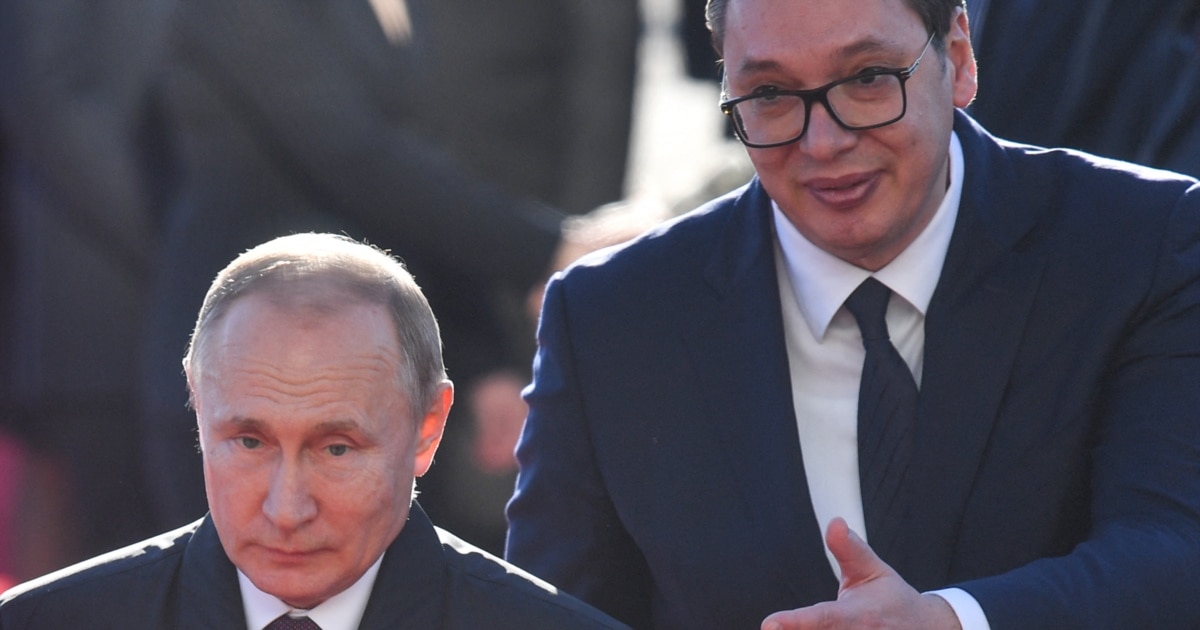
Why Putin Never Slept in Belgrade: Experts Trace Worsening Serbia–Russia Ties
Analysts say relations between Belgrade and Moscow have cooled since Russia’s 2022 invasion of Ukraine, punctuated by accusations that Serbia supplied arms to Ukraine and by sharp public criticism from Russian officials. The strains touch diplomacy, security, energy and public opinion — and leave unresolved whether Moscow will continue to tolerate Serbia’s balancing act between East and West.
By Alexander Walter
815 views
Belgrade — Relations between Serbia and Russia have entered a visibly chillier phase since 2022, driven by a series of diplomatic spats, public recriminations and competing strategic interests, two Serbian experts told the Radio Free Europe/Radio Liberty program Most. Jelica Minić and Branka Latinović, both members of the Forum for International Relations at the European Movement in Serbia, mapped the trajectory of tensions and warned of growing Russian impatience with Belgrade’s attempt to balance ties with both Moscow and the European Union.
The most acute rupture began last year when the Foreign Intelligence Service of the Russian Federation publicly accused Serbia of delivering weapons to Ukraine through intermediary countries. According to the experts, such accusations were the culmination of earlier, subtler signals of discontent from Moscow that had gone unheeded by Belgrade. Last year’s reaction from Moscow was notably blunt: not only intelligence officials, but also prominent Russian political voices levelled harsh and insulting language at Serbia and at its president, Aleksandar Vučić.
Maria Zakharova, the director of the Information and Press Department of Russia’s Ministry of Foreign Affairs, became one of the most vocal critics, using particularly severe rhetoric directed at Vučić. By contrast, Foreign Minister Sergey Lavrov offered more measured public statements. The two experts interpret this divergence as a deliberate division of roles in Moscow’s messaging—an approach mirrored domestically by equally sharp and more moderate Serbian voices.
Trust between Moscow and Belgrade, the guests said, began to erode decisively after Russia’s full-scale invasion of Ukraine in 2022 and Serbia’s votes at the United Nations General Assembly condemning the aggression. Serbia initially voted in favour of one such resolution and later shifted to abstention after Vučić described the vote as a mistake. The issue of arms deliveries resurfaced publicly last May, when Serbian officials acknowledged economic pressures that complicated an immediate halt to munitions exports, and said that some sales occurred via intermediaries such as the United States, Spain and the Czech Republic.
Domestic political actors and shifting roles have also played into the malaise. Ana Brnabić, the president of Serbia’s National Assembly, has spoken more critically of Russian ties, explicitly rejecting characterizations of the bilateral relationship as a fraternal one and noting limited trade links. Aleksandar Vulin, long perceived as a staunch Moscow ally within the Serbian political scene, has largely disappeared from public view. Meanwhile, Milorad Dodik of Republika Srpska is seen as cultivating closer personal access to Russian President Vladimir Putin; Moscow meets with Dodik frequently, and he often acts as a conduit for messages between Belgrade and Moscow. Experts caution, however, that while Dodik may enjoy visible proximity to Putin, Vučić remains of greater strategic importance to Moscow because Serbia is Russia’s principal lever of influence in the Western Balkans.
Russia has also used targeted interventions to support Vučić at moments of domestic political pressure. During the large March 15 protest last year, a Russian security service statement confirmed that a Long Range Acoustic Device (LRAD) was not used by Serbian police against demonstrators — a narrow assertion that Vučić subsequently cited to challenge accusations against his government. Observers point out that the statement was careful and limited: it confirmed only that LRAD was not employed, not that no acoustic or crowd-control devices of any kind were used. The episode illustrates how Russian agencies can shape narratives in Serbia while leaving broader questions about influence and intelligence activity unanswered.
Energy and economic ties further complicate relations. Gazprom’s refusal — contrary to expectations under prior agreements — to sell its majority stake in Serbia’s oil company NIS to Belgrade has been perceived by some in Serbia as Moscow’s way of keeping pressure on the government. Experts warn that Serbia’s dependence on Russian energy makes the country vulnerable and that the unresolved ownership question around NIS is a tangible source of leverage. At the same time, Russia’s investment in pro-Russian media and propaganda in Serbia sustains strong public sympathy for Moscow, making it politically costly for Serbian authorities to pivot decisively toward the EU.
Public attitudes remain strongly pro-Russian, the analysts say, and well-funded Russian media outlets in Serbia continue to shape domestic perceptions. Breaking that information hold would require a concerted political decision and a public information campaign comparable in scale to Serbia’s earlier outreach that accompanied visa liberalisation — an effort that once shifted public opinion dramatically in favour of the European Union.
A telling symbolic detail, the experts observed, underscores the asymmetry of the relationship: Russian President Vladimir Putin has visited Serbia four times but reportedly never spent the night in Belgrade, returning to Moscow late the same day. On one occasion, after attending a military parade in Belgrade, he flew on to Slovenia to overnight — a protocol choice that observers read as a signal of distance.
The conversation on Most closed with a pointed question: is Moscow growing less willing to tolerate Vučić’s balancing act between East and West? While analysts identify clear signs of frustration from Moscow, including public scolding, intelligence accusations and economic pressure, they stopped short of predicting a definitive break. What is clear, they say, is that the relationship is no longer the monolithic “brotherhood” often invoked in Serbian political rhetoric, and that the unfolding dynamic will shape Serbia’s domestic politics, energy security and regional role for the foreseeable future.