Where Malta's desalination brine meets marine life
By Martin Bertrand
827 views
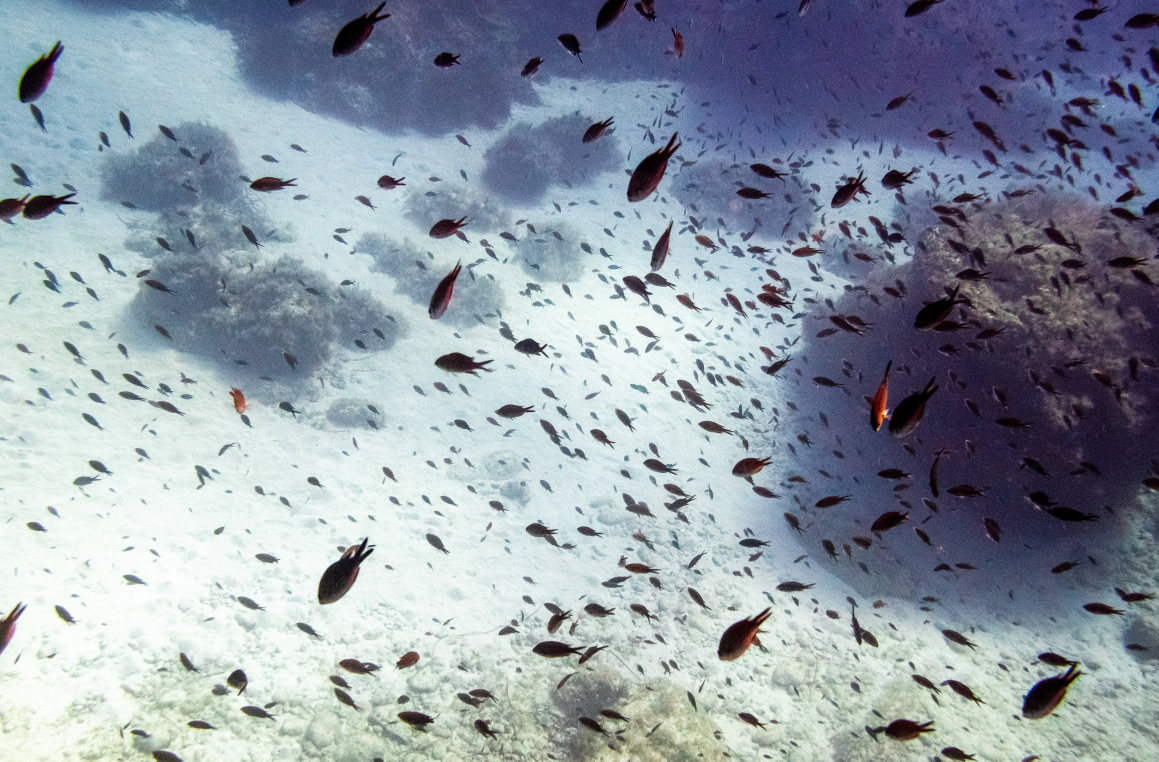
Photo: Underwater view of a large school of damselfish above a pale seabed near the Ghar Lapsi desalination plant on Triq Lapsi in Is-Siggiewi, Malta, February 8, 2026. In the Mediterranean coastal waters, this well known diving site still supports abundant marine life, and the presence of Chromis chromis near the outfalls may be linked to hypersaline discharge drawing zooplankton downward while currents disperse part of the released water and limit some effects on the local ecosystem
At Pembroke, on Malta's northeastern coast, the rocks below the desalination plant are an unusual yellow-gold. Underwater, another phenomenon is even more disconcerting. A transparent veil appears to bend the sea, blurring the view without making the water cloudy. The closer the discharge, the stronger the distortion.
In Malta, desalinating seawater is not a matter of comfort but necessity. Groundwater cannot meet the demands of the archipelago, where roughly 70% of the drinking water produced by the public Water Services Corporation comes from reverse osmosis. Yet producing freshwater means returning something else to the Mediterranean: concentrated brine, sometimes accompanied by substances used to treat the water.
When the water changes
The strange underwater veil at Pembroke has a name: a halocline. Alan Deidun, a marine scientist at the University of Malta and Malta's Ocean Ambassador for United Nations, explains that highly saline water is denser than the sea around it. As the discharge sinks, the boundary between water masses creates the shimmering optical effect, almost like a lens suspended beneath the surface.
The consequences of brine extend beyond what divers can see. Robin Degron, former director of Plan Bleu, a Mediterranean environmental research centre, explains that concentrated discharges can alter the physical and chemical conditions of coastal waters, including their salinity, temperature and chemical composition. Residues from water treatment may add to the pressure on seabed organisms. Marine vegetation is particularly vulnerable when changes in salinity or temperature exceed what individual species can tolerate. Posidonia meadows, which provide habitat for numerous Mediterranean species, are among the ecosystems sensitive to such changes. Currents can lessen the effects of a discharge by dispersing it, so conditions vary considerably from one coastline to another.
At Pembroke, the golden colour of the rocks raises another question. In an exchange about the site, Degron pointed to possible residues of antiscalants, biocides and dechlorination agents, as well as occasional heavy metals. Such substances may favour brown or yellow bacterial-algal films and deposits of degraded organic matter. These mechanisms could contribute to the unusual colouring, although the composition of the deposits on these particular rocks has not been established.
Where the brine meets fish
At Għar Lapsi, on Malta's southwestern coast, the desalination plant's discharge pours directly over the cliff's rocks. It runs in white, foaming streams and collects in small pools, where surfaces already yellowed in places take on greenish tones. This is also a wellknown diving site. Beneath the surface, large schools Mediterranean damselfish (Chromis chromis) move through the water in remarkable numbers. Deidun has a possible explanation. These fish feed on zooplankton and usually remain in mid-water rather than venturing up to the surface, where predators may be waiting. As hypersaline brine sinks, it could carry zooplankton down with it. "Probably it's taking down with it zooplankton from the surface of the water," he says. The fish may then be taking advantage of food brought into their path.
The contrast is striking at Portomaso, in the dense urban and tourist landscape of St Julian's Bay. Beside the Hilton hotel, which operates its own desalination installation, large fish gather around an outlet in the basin of the luxurious marina. To visitors strolling among the yachts, the scene seems almost decorative, part of an idyllic waterfront. Yet this is also where industrial water is returned to the harbour. The hotel's environmental permit records both desalination brine and seawater used for cooling at the same discharge location.
A closer look at the posidonia
Elsewhere around St Julian's, the water can be murky, and sections of the posidonia meadows appear covered with pale, almost white patches. Deidun identifies these as epiphytes: algae and small animals that settle on seagrass leaves and can add stress to the plants. "I don't know if these are directly linked to the outflow from the desalination plants," he says. Warmer water, for example, can also encourage epiphytes to proliferate, as observed near the cooling-water outlet of the Delimara power station.
A study commissioned by the Water Services Corporation and completed by AquaBioTech Group in February 2024 examined the marine environment around the public outfalls at Għar Lapsi, Pembroke and Ċirkewwa. It recorded differences between surveyed habitats, while variations in depth and currents complicated comparisons. The researchers recommended monitoring these environments over several years. Environment minister Miriam Dalli says marine discharges are regulated by Malta's Environment and Resources Authority through environmental permits and monitoring requirements.
For Deidun, another useful source of information would be the results of analyses performed on the effluents themselves. Alongside their high salt concentration, he suggests examining whether nutrients, metals or other treatment-related substances are present. Knowing exactly what these discharges contain could help explain what happens beneath the surface, from Pembroke's golden rocks to the pale leaves of posidonia.