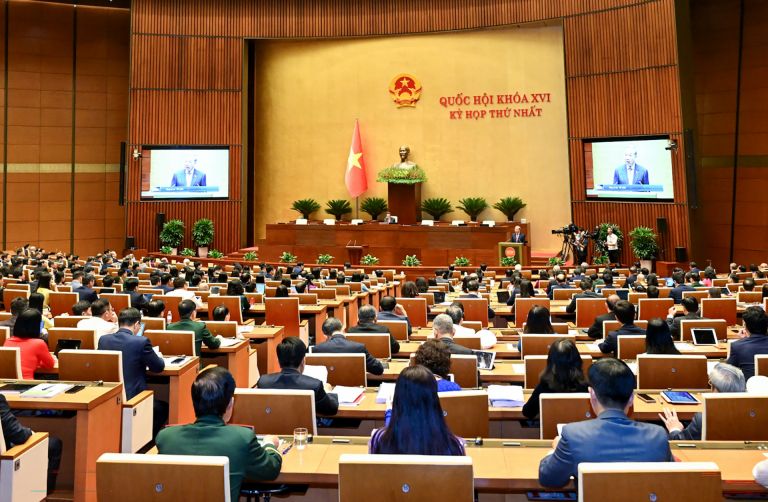
Vietnam Consolidates Power as To Lam Assumes Dual Role of Party General Secretary and State President
Vietnam's National Assembly on April 7 unanimously approved a leadership reshuffle that places Communist Party General Secretary To Lam in the presidency while elevating Le Minh Hung to prime minister. The appointments complete the country's top political lineup for the 2026–2031 term and mark a historic merging of party and state authority intended to sharpen policy coordination, even as analysts warn of heightened risks from weakened institutional checks.
By Alexander Walter
881 views
Vietnam's top leadership was finalized on April 7 when the country's National Assembly unanimously elected Communist Party General Secretary To Lam as state president and appointed Le Minh Hung as prime minister for the 2026–2031 legislative term. The vote completed the slate of senior appointments at the outset of the new cycle and marked a notable concentration of authority: Lam now holds both the apex party position and the formal head-of-state role.
Le Minh Hung, previously head of the Party Central Organization Commission and a former central bank governor, takes charge of the government as prime minister. His elevation to the premiership transfers responsibility for day-to-day administration and economic management to a figure with an institutional background in financial governance and party organization. The pairing of Lam and Hung thus places party leadership and executive management under closely aligned leadership, completing the top tier of Vietnam's political hierarchy.
In his inaugural remarks, To Lam highlighted continuity in key state priorities, stressing the need to maintain political stability, to strengthen national defense and security, and to pursue rapid, sustainable economic development. Those statements outline the themes that the new leadership intends to prioritize and signal a governance approach that places a premium on stability and security alongside economic growth objectives.
Prime Minister Le Minh Hung set out accompanying priorities for the government's work, emphasizing institutional reform, administrative streamlining and building a modern government oriented toward services. His stated agenda points to an effort to improve the efficiency and responsiveness of state institutions, reduce bureaucratic obstacles, and modernize public administration to better meet citizen and business needs.
The twin appointments are significant because they merge party and state authority in a single individual—a configuration that departs from more divided power arrangements and underscores a shift toward more centralized, top-down governance. Proponents argue that such a structure can improve policy coordination and execution by reducing institutional fragmentation and ensuring clearer lines of authority between the party leadership and the state apparatus.
However, that centralization carries risks. Analysts caution that concentrating power in fewer hands can reduce the effectiveness of institutional checks and balances, increasing the likelihood of implementation distortions. Without robust independent oversight or internal corrective mechanisms, policy decisions may be executed more rapidly but with less scrutiny, potentially producing unintended consequences in areas from economic management to social policy.
The appointments close the book on the initial phase of leadership selection for the 2026–2031 term and set the political and administrative tone for the period ahead. Observers will be watching how the Lam–Hung tandem translates stated priorities into concrete policy measures, how effectively the new government implements administrative reforms, and whether centralization yields the intended gains in coordination without undermining accountability.
For domestic and international audiences alike, the change invites questions about how Vietnam will balance its twin objectives of stability and development, and how the consolidation of authority will affect the country's economic policymaking, bureaucratic performance and broader governance dynamics in the years to come.