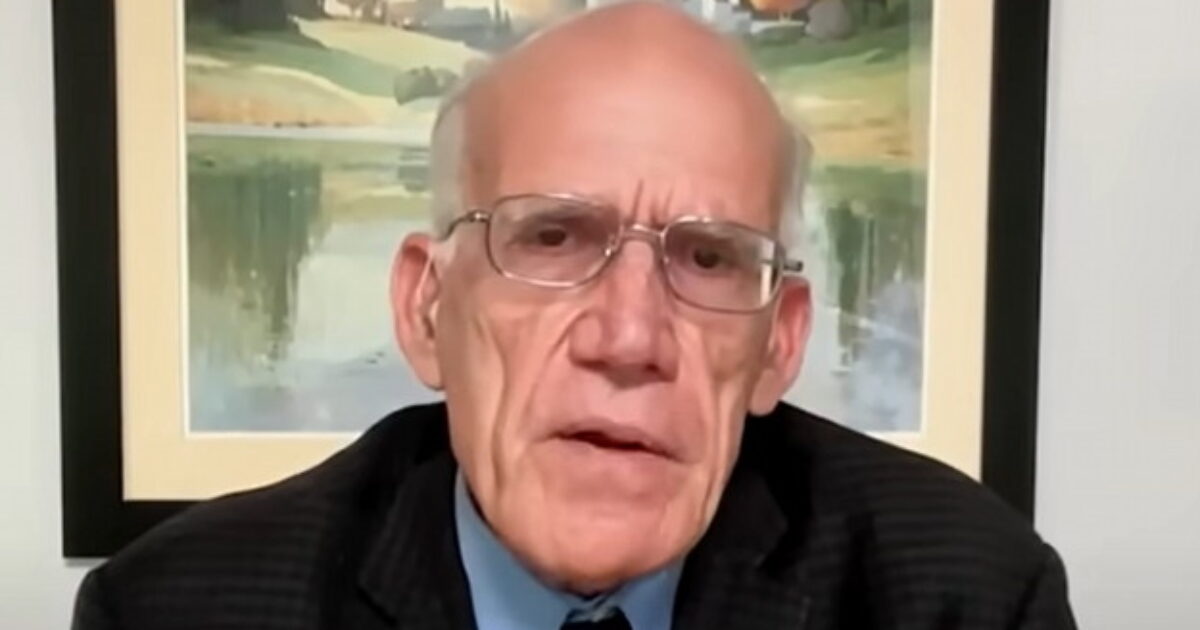
Victor Davis Hanson Compares Trump to Winston Churchill While Defending Operation Epic Fury Against Iran
Conservative historian Victor Davis Hanson told FOX News viewers that President Trump is playing a role analogous to Winston Churchill by warning of the Iranian threat after other leaders failed to act. Hanson argued that prior U.S. presidents promised to confront Iran but did not follow through, and he criticized Democrats and international actors for underestimating the regime's pattern of deception and sudden attacks.
By Mike LaChance
871 views
Conservative historian and scholar Victor Davis Hanson framed the U.S. campaign against Iran in historical terms during an appearance on FOX News this week, likening President Donald Trump's posture toward Tehran to Winston Churchill's warnings about Nazi Germany before World War II. Hanson used the comparison to argue that the current U.S. response — including the action referred to as Operation Epic Fury — represents a break from a long pattern of American leaders who pledged to confront Iran but ultimately did not do so.
Hanson invoked Churchill's prewar role to underscore what he described as a failure of others to recognize an emerging threat. “In 1939 Churchill had warned everybody about the threat of fascism on the continent…nobody listened to him,” Hanson said. He continued by noting Churchill's isolation even after hostilities began: “Then after the war broke out, nobody called on him and then finally he came in and from May 10th of 1940 he was saying to everybody, these people want to take over the continent.” Hanson summarized Churchill’s stance as “the voice in the wilderness,” and suggested President Trump is occupying a similar position today with respect to Iran.
Hanson applied that analogy directly to contemporary politics, telling viewers, “That’s what Trump is trying to do, trying to say to the American Democratic party, what’s left of it, you don’t understand what’s going on here.” He expanded his criticism beyond domestic politics to include Europe and regional actors: “You Europeans don’t understand, you people in the Middle East don’t fully understand what this regime is about.”
A central element of Hanson’s argument is his contention that Iran has consistently operated through surprise actions and deception rather than by telegraphed, conventional forms of aggression. “When people say we did not have an imminent threat, we didn’t have an imminent threat when they took our hostages, when they blew up our barracks,” he said. “Nobody said we better attack Iran because we need an imminent threat when they blew up our embassy, they always acted spontaneously with surprises and we never knew what they were going to do.”
Hanson argued that expecting a clear, telegraphed threat misunderstands the nature of the Iranian regime, which he described as relying on “lying, disguise and dissimulation.” He added that this pattern has persisted “for the last 47 years,” and lamented that U.S. leaders have not treated Tehran with the seriousness he believes it warrants. “But nobody’s taken them seriously,” he said.
Continuing, Hanson asserted that multiple U.S. presidents had pledged to address Iran’s behavior but failed to do so while in office. “Every president’s said we’re going to deal with this, all seven of them and all seven did not,” he said, adding that those presidents later expressed regret: “And then all seven of them when they got out of office said I regret that I didn’t.” Hanson concluded that, in his view, President Trump is the first modern president to forcefully warn and to act, saying, “He’s the first one that warned the world and said he’s not going to be one of those presidents.”
The segment drew attention on social media as well: a clip of Hanson’s remarks was shared by the Overton account on Twitter, accompanied by commentary highlighting the comparison between Trump and Churchill. The Gateway Pundit piece relaying Hanson’s comments also attributed a partisan motive to critics of the operation, asserting that Democrats oppose it primarily because they do not want Mr. Trump to register another victory.
Hanson’s remarks touch on several broader debates in Washington and abroad: what constitutes sufficient justification for military or covert action, how to weigh the historical pattern of an adversary’s behavior when assessing imminent threats, and the extent to which domestic political considerations shape foreign policy responses. Supporters of a tougher approach toward Iran often cite surprise attacks and proxy operations as evidence that traditional standards for imminent threat may be insufficient, while critics argue that such standards exist to limit escalation and avoid unintended consequences. Hanson’s Churchill analogy is likely to intensify those debates by framing the U.S. decision to act as both decisive leadership and a corrective to years of perceived inaction.