Vance Turns Maine Anti-Fraud Visit Into Midterm Battle Cry
Vice President JD Vance traveled to Bangor, Maine, on Thursday for an event centered on the White House Anti-Fraud Task Force, using the platform to present alleged fraud findings and to rally supporters for the 2026 midterm effort. Speaking alongside Acting Labor Secretary Keith Sonderling, Vance linked the task force's work to broader political goals, praising former Gov. Paul LePage and criticizing President Biden while navigating tensions with Senator Susan Collins.
By Reagan Reese
1,120 views
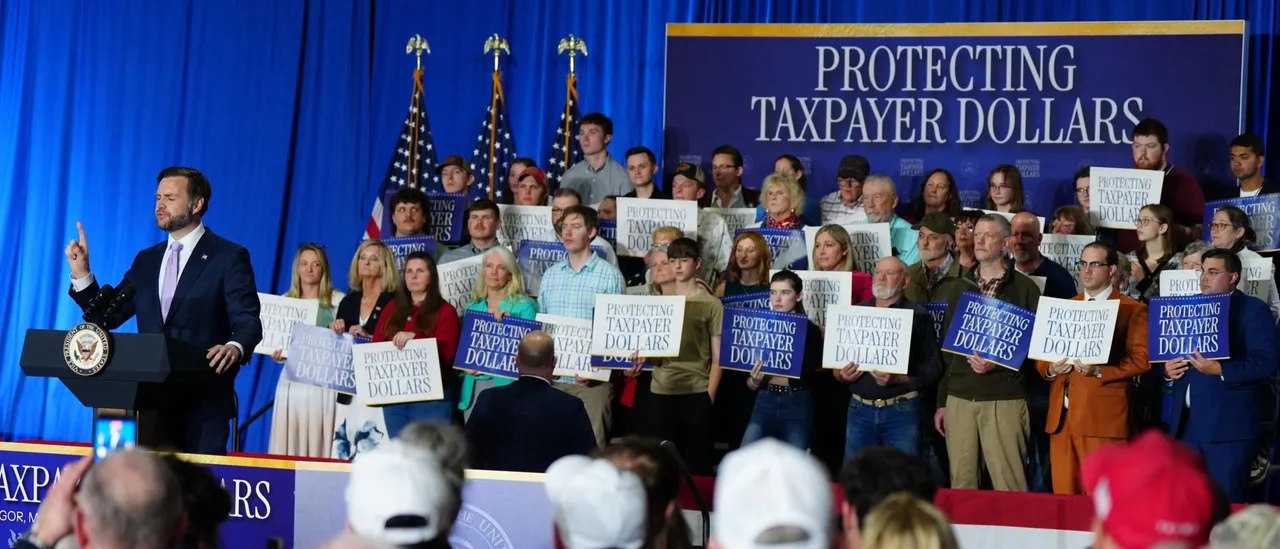
BANGOR, Maine — Vice President JD Vance spent Thursday in Maine leading an event for the White House Anti-Fraud Task Force, delivering remarks at Bangor International Airport just ahead of the state's primary elections for several high-profile races. Vance, whom President Trump tapped to chair the task force, framed the misuse of government social programs as far from a victimless crime. "You are the first victim of fraud," he told the crowd, speaking against a backdrop of signs reading "PROTECTING TAXPAYER DOLLARS" and "FIGHTING FRAUDSTERS." The visit came a day after the Centers for Medicare and Medicaid Services, working with the task force, announced a six-month moratorium on new hospices and home health agencies enrolling in Medicare, describing such agencies as a key source of fraudulent activity. The task force — which includes roughly half the Cabinet — has previously flagged nearly $6.3 billion in government contracts going to potentially fraudulent businesses and suspended dozens of providers in Los Angeles.
Vance used the event to tie the task force's work to local politics in Maine. He was greeted on the tarmac by former Republican Gov. Paul LePage and LePage's wife, Ann, and repeatedly praised the former governor, urging Maine voters to send him to Washington to help combat fraud. "[He's] a guy who came to work every single day, protecting your tax dollars, protecting your essential services, protecting our local law enforcement, making sure common sense — that the government actually works for the people who deserve and have the right to be in the United States to begin with," Vance said. He went further still, telling the crowd that "fraud has festered in Maine because this guy is no longer the governor of Maine." LePage, who governed from 2011 to 2019 and is now the sole Republican seeking the nomination in the Bangor-area 2nd Congressional District, addressed the crowd before Vance's arrival, casting the visit as "a warning shot to every fraudster, scam artist and corrupt bureaucrat." That seat opened up after Democratic Rep. Jared Golden declined to seek reelection, and Republicans see a strong pickup opportunity there.
The vice president also addressed intra-party dynamics in Maine, offering a careful characterization of U.S. Sen. Susan Collins, who did not attend the rally in order to keep her voting streak in Washington. Vance described Collins as "independent," arguing that her approach reflects Maine voters even as it has created friction with the administration on nominations and other matters. The exchange illustrated the White House's broader midterm calculus of maintaining party cohesion while courting local allies. Collins, the state's only Republican in Congress, is facing one of the most competitive Senate races in the country — a contest Democrats view as critical to retaking the chamber. The Democratic field shifted notably when outgoing Gov. Janet Mills, barred by term limits from a third term, dropped her Senate bid, effectively ceding the nomination to progressive activist and oyster farmer Graham Platner.
Vance linked the fraud narrative to broader criticisms of the Biden administration, blaming President Joe Biden for allowing large numbers of illegal migrants into the country and tying that claim to alleged fraud in federal programs: "This is why I blame Joe Biden, because you cannot talk about the fraud problem in the United States of America without acknowledging that Joe Biden's administration let in tens of millions of illegal aliens all over the United States of America, including the State of Maine," he told the crowd. He also took aim at outgoing Democratic Gov. Janet Mills during his remarks. Outside the venue, the appearance drew a counter-demonstration: the Bangor Police Department set up a designated zone across the street, where roughly three dozen protesters gathered for several hours. Maine Democrats, including gubernatorial candidates Shenna Bellows and Nirav Shah, used the occasion to argue that Vance was touting fraud investigations while the cost of necessities such as heating oil and gas was climbing for Maine families.
The visit comes as the Trump administration seeks a unifying message ahead of the midterms, a task complicated by international developments and domestic economic pressures. The administration's messaging has at times been challenged by geopolitical events, including the U.S.-Iran war and associated rises in gas prices. Earlier this year, President Trump made a domestic push with events in Las Vegas and Phoenix highlighting policies like "No Tax on Tips" and a "Build the Red Wall" appearance at a Turning Point USA event, but the White House has continued searching for a consistent rallying issue. The anti-fraud theme dovetails with broader affordability concerns voters have raised, and the administration has cast rooting out waste as both a fiscal and a moral imperative — task force vice chair and FTC Chair Andrew Ferguson has gone so far as to call the fraud problem "existential."
In Bangor, Vance leaned on his 2024 role as a top surrogate for Trump—at times conversational, at times combative—and appeared to test whether a concrete policy focus like fraud prevention can become a durable midterm theme. The trip also fit a wider pattern for Vance, who is viewed as a potential 2028 presidential contender and has been pairing task force promotion with campaigning for Republican candidates in recent months. He closed by promising to pursue fraudsters through prosecutions and contract reviews, tying task force activity to the campaign message that protecting taxpayer dollars will be central to the administration's pitch to voters in 2026.