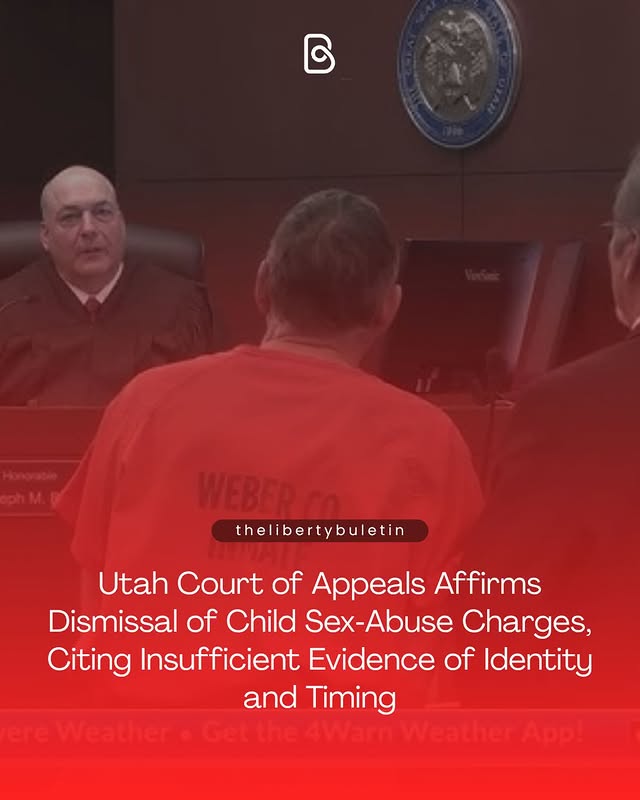
Utah Court of Appeals Affirms Dismissal of Child Sex‑Abuse Charges, Citing Insufficient Evidence of Identity and Timing
A Utah appellate panel has affirmed a magistrate’s decision not to bind over a man charged with aggravated sexual abuse and sodomy of a child, finding the state failed to produce probable cause that he committed the alleged offenses. The court pointed to mutually exclusive and inconsistent testimony about who the babysitter was, when the incidents occurred, and how long the child was in the babysitter’s care as reasons the evidence could not support a reasonable inference of guilt.
By Eugene Volokh
1,041 views
The Utah Court of Appeals on Thursday affirmed a magistrate’s decision declining to bind over a defendant known as Murphy on charges of aggravated sexual abuse and sodomy of a child, concluding that the State failed to produce probable cause that Murphy committed the alleged offenses. The three-judge panel—Judge David Mortensen, Judge Gregory Orme, and Judge Ryan Harris—issued the decision in State v. Murphy after reviewing evidence presented at a preliminary hearing in which the magistrate had determined there was insufficient evidence to justify trial.
The allegations in the case arose when Jonathan, the son of a former close friend of Murphy identified in court as Mother, was taken to an emergency room following a mental-health episode at age 15. During an interview at the Children’s Justice Center, Jonathan reported that he had been abused when younger while spending several hours at a babysitter’s house at night while Mother worked an evening shift. Based on these statements, the State charged Murphy with aggravated sexual abuse and sodomy on a child.
At the preliminary hearing, however, the magistrate found the evidence unable to establish probable cause that Murphy was the perpetrator. The magistrate concluded that the critical issue was identity and described the evidence as “so wholly inconsistent as to the when and the who as to render the testimony regarding identity just simply incredible and as wholly lacking and incapable of supporting a reasonable inference that the defendant is the person that [Jonathan] is talking about.” The Court of Appeals agreed that the magistrate acted within his limited discretion in reaching that determination.
The appellate opinion set out several specific reasons the State’s evidence fell short. First, Jonathan was unable to identify Murphy as the perpetrator in court despite only two possible candidates being present from whom to choose. The court said that this failure, coupled with the absence of other evidence placing Murphy as the babysitter when the abuse allegedly occurred, did not provide probable cause to conclude Murphy committed the crimes.
Second, the parties’ testimony sharply conflicted about Jonathan’s age at the time of the alleged abuse. Jonathan initially estimated he was seven or eight, but he later agreed he could not say whether he was four, five, six, seven, or eight. Mother testified Murphy babysat Jonathan when he was about three or four. The court observed that these discrepancies meant there was only a speculative basis, at best, to conclude Murphy was the babysitter during the period Jonathan described. Indeed, the court noted, if Jonathan’s original testimony that the abuse occurred when he was seven or eight were credited, Murphy would effectively be excluded.
Third, the reported time of day for the abuse was at odds with Mother’s account of when Murphy provided babysitting. Jonathan said the abuse occurred at night while Mother worked an evening shift; Mother testified that Murphy babysat in the mornings—riding with her to the TRAX station, leaving Jonathan in daycare afterward. That mismatch in timing, the court said, excluded Murphy as the abuser under Jonathan’s version of events.
Fourth, the length and circumstances of the babysitting differed widely between the two accounts. Jonathan described extended overnight babysitting—“maybe six or seven hours”—whereas Mother described much shorter periods, sometimes about an hour. The court agreed with the magistrate that the difference “between being babysat for maybe an hour and six or seven hours” is significant and made it impossible to reconcile Murphy with the babysitter Jonathan described.
The Court of Appeals emphasized the role of the bindover hearing and the limited showing the prosecution must make: “A defendant may be bound over for trial only if the prosecution produces evidence sufficient to demonstrate probable cause that the charged crimes were committed.” That standard exists “to ferret out groundless and improvident prosecutions,” the opinion noted. But it does not permit a magistrate to rely on unreasonable inferences or speculation to bind a defendant over for trial. Here, the court concluded, the State’s evidence was mutually exclusive and “not capable of supporting a reasonable belief” that Murphy was the person who abused Jonathan.
The appellate court therefore affirmed dismissal at the preliminary stage, concluding the State failed to produce “reasonably believable, non‐speculative evidence to support probable cause to believe that Murphy was the abuser.” Defense counsel in the case were Freyja Johnson and Hannah Leavitt‑Howell. The decision underscores the importance accorded by courts to the probable-cause inquiry at bindover hearings and illustrates how contradictory witness statements and lack of identifying evidence can prevent criminal charges from proceeding to trial.