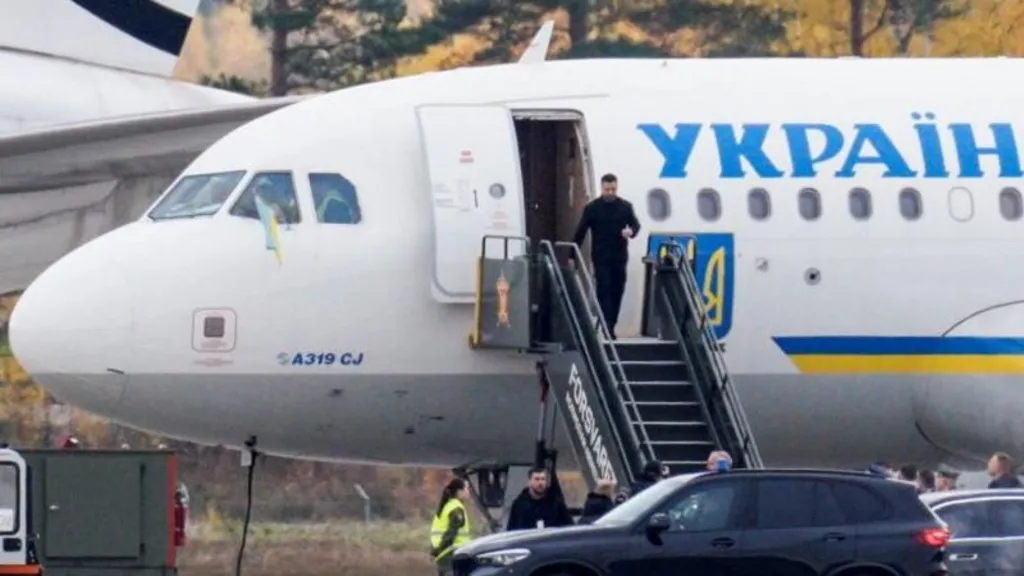
US Envoy Arrives in Norway for Talks as Tensions Grow Between Trump and Zelensky
US special envoy Steve Witkoff has arrived in Norway for discussions involving Ukrainian President Volodymyr Zelensky and Western allies, as disagreements between Kyiv and Washington deepen over military support and the future of the war with Russia.
By Christopher Manley
1,024 views
Norwegian Prime Minister Jonas Gahr Støre said Zelensky had asked Norway and neighbouring Finland to help organise the meeting at what he described as a critical moment for Ukraine. The talks are intended to improve strained relations and encourage a coordinated diplomatic approach to ending the conflict.
The meeting comes amid renewed debate over US intelligence-sharing with Ukraine. Secretary of State Marco Rubio strongly rejected allegations that Washington was withholding intelligence, describing the accusations as “scandalous” and “outrageous”.
His comments followed remarks by Ukrainian military technical adviser Serhii “Flash” Beskrestnov, who told the BBC that inconsistent access to US warnings had left Ukrainian forces without reliable information ahead of some attacks. He said the situation was difficult to understand, noting that warnings were sometimes received before an attack but not on other occasions.
Relations between Zelensky and US President Donald Trump have deteriorated in recent weeks. Trump has questioned Zelensky’s continued leadership and suggested that another representative should negotiate on Ukraine’s behalf.
Støre said the purpose of the Norway meeting was to move relations towards a more constructive direction. He stressed the importance of reaching a diplomatic settlement that would deliver a lasting and just peace.
Ukraine Seeks Greater Military and Technical Support
Zelensky said he had held a constructive conversation with Rubio about Ukraine’s need for advance warnings of incoming attacks, additional missile interceptors and continued access to SpaceX’s Starlink satellite communications network.
Concerns over Starlink disruptions have also drawn attention in Washington. Last week, a bipartisan group of US senators called for an urgent investigation into interruptions affecting the network in Ukraine.
Questions have additionally emerged over the delivery of further Patriot interceptor missiles. Rubio, who is visiting India, acknowledged that reports of outstanding deliveries could be accurate, while maintaining that the United States had not deliberately denied Ukraine assistance.
Witkoff is expected to be joined remotely by Jared Kushner, Trump’s son-in-law, alongside European representatives. Participants are expected to include Finnish President Alexander Stubb and officials from the United Kingdom, Poland, France and Germany, as well as representatives of the European Union and NATO.
It remains uncertain whether Witkoff will travel to Russia after the Norway discussions. Kremlin spokesman Dmitry Peskov said Moscow valued the mediation efforts of US negotiators and hoped a meeting with the American envoy could be arranged soon.
Russia Relations Add to Diplomatic Uncertainty
Earlier this month, Russian President Vladimir Putin discussed the war with Trump by telephone. Following the conversation, Trump announced an arrangement involving the supply of more than 300,000 tonnes of Russian diesel to the United States and other markets, alongside an end to US sanctions on Russian diesel exports, according to the original report.
The announcement came as Witkoff and Kushner were meeting Ukrainian officials in Miami. Zelensky criticised the development, describing it as a “happy birthday present” for Putin.
Energy prices have also become part of the political dispute in Washington. With US midterm elections approaching next month, Trump has blamed Ukrainian attacks on Russian oil refineries for contributing to higher fuel prices in the United States. The remarks come against the backdrop of the US-led war on Iran.
European governments have expressed concern about Washington’s recent signals regarding Russia and its approach to the conflict. German Chancellor Friedrich Merz said on Monday that messages coming from the United States had been mixed, adding that he was working to persuade Washington that the war needed to be addressed jointly.
Merz also highlighted the financial burden carried by European countries in supporting Ukraine. He said the United States had not been paying directly for Ukraine’s defence since the beginning of 2025, leaving European and other partners to shoulder much of the cost.
Speaking to Bloomberg TV, Merz described the assistance as a substantial commitment for European budgets and the European Union, adding that support would continue until the war ended.
US Vice-President JD Vance has also outlined differences between Washington and Kyiv. In a television interview, he described Ukraine as a partner in some areas while pointing to disagreements over certain military decisions, including Ukrainian strikes on Russian energy infrastructure.
Vance added that the United States did not have a formal alliance with Ukraine and reiterated that Kyiv was not a NATO member.
The discussions in Norway are expected to test whether Washington, Kyiv and their European partners can narrow their differences over intelligence cooperation, military assistance and the diplomatic path towards ending the war.