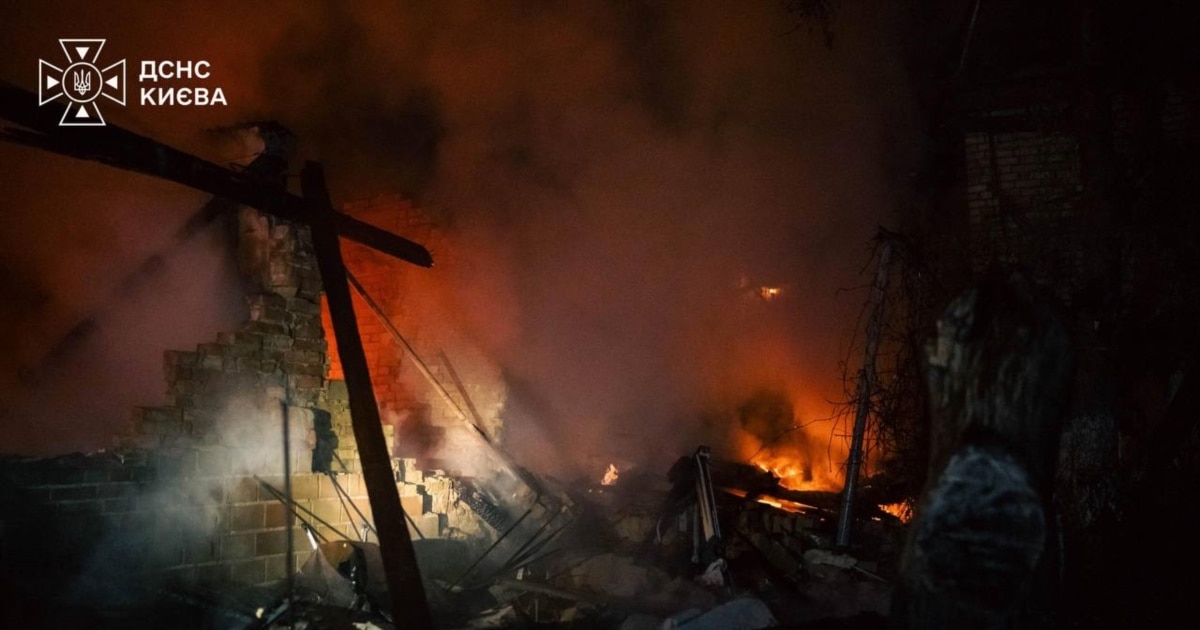
Ukraine says overnight Russian strike concentrated on Kyiv region; hits recorded at 18 sites, civilians killed
Ukraine's Air Forces said Russian forces launched a major attack overnight on 29–30 September using ballistic missiles and nearly 200 strike drones, with the main direction of the assault aimed at the Kyiv region. Air defenses intercepted most targets, but strikes were recorded at 18 locations, leaving several civilians dead or injured and causing damage to homes and infrastructure.
By Clémence Desjardins
945 views
Ukrainian military officials reported a large-scale Russian attack overnight on 29–30 September that concentrated its main strikes on the Kyiv region and struck multiple locations across the capital and surrounding districts.
According to a statement published on the Telegram channel of the Air Forces of the Ukrainian Armed Forces, the assault began from 18:00 on 29 September and included anti-ship missiles identified as “Tsirkon” and “Oniks,” ballistic missiles described as “Iskander-M” and S-400-launched projectiles, and a total of 188 strike unmanned aerial vehicles (UAVs) of various types — 86 of which the statement characterized as reactive. By 08:00 on 30 September, Ukraine’s air defenses had neutralized 160 targets, the military said.
The Air Forces reported that the intercepts included five ballistic missiles and 155 strike drones, naming models such as Shahed and Gerbera among those shot down. Despite the high interception numbers, Ukrainian forces recorded explosions and strike impacts at 18 separate locations; the attack was described as ongoing in early morning reports.
Local authorities in Kyiv said two civilians were killed and four others wounded as a result of the assault, with damage reported across four districts of the city. In the broader Kyiv region, officials said a child died when a private home was destroyed; rescuers pulled three people, including a child, from the rubble of damaged dwellings. According to the State Emergency Service, in Vyshhorod a private home was destroyed at the point of impact — rescuers found a child born in 2012 beneath the debris; attempts to save the child were unsuccessful.
Officials also reported strikes on infrastructure in multiple Kyiv-region districts, including Bucha, Vyshhorod and Obukhiv. Emergency services and local authorities continue to assess damage and conduct search-and-rescue operations where impacts were reported.
The Ukrainian military and independent analysts have emphasized that Russia in recent months has increasingly relied on so-called reactive or jet-propelled strike drones to attack Ukrainian cities and infrastructure. Those weapons, officials say, present particular challenges: the Air Forces estimate interception rates of conventional strike drones at about 90–95 percent, whereas reactive drones are intercepted at roughly 60 percent.
Anatoliy Khrapchynskyi, director of development at a defense enterprise and a reserve officer of the Air Forces, told Radio Donbas Realii that countering the more difficult reactive drones requires deploying expensive assets — including aviation, surface-to-air missile systems and man-portable air defense systems — making sustained defense both costly and logistically demanding. Kyrylo Budanov, head of the Office of the President of Ukraine, recently said that achieving mass interception of reactive “Shahed” drones would take months.
Ukrainian authorities and multiple international organizations have repeatedly classified Russian strikes on civilian areas and critical infrastructure as potential war crimes, arguing that attacks aimed at depriving the civilian population of electricity, heat, water, communications and medical services are deliberate and have particularly severe humanitarian consequences. Some statements have asserted that systematic attacks on life-support systems could amount to genocidal actions. The Russian government denies that its forces deliberately target civilian infrastructure, rejecting allegations that it is conducting targeted strikes on hospitals, schools, power and water facilities.
The outlet reporting these developments, Krym.Realii, also noted that Russia’s communications regulator Roskomnadzor has sought to block access to its site inside Russian-controlled territory. The publication provided an alternative mirror link and urged readers to follow its channels on Telegram, Instagram and Viber and to use VPN tools where the site is blocked.
The situation remained fluid in the hours after the overnight assault. Ukrainian authorities continued air-defense operations and emergency response activities, and investigations into the strikes and their impact on civilians and infrastructure were ongoing.