Ukraine Receives 252 Bodies in Repatriation, Identification Process Begins
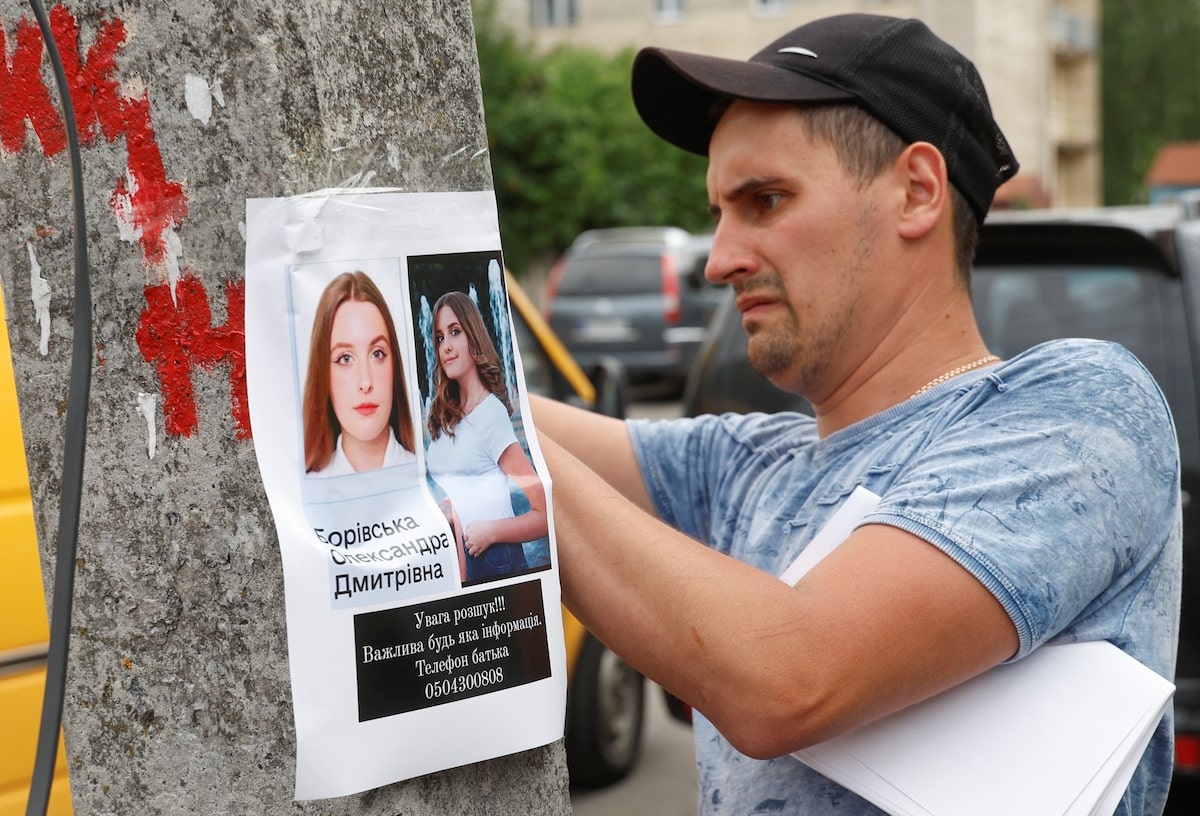
Ukraine has repatriated the remains of 252 people from Russia, but identifying the dead and returning them to their families can be a lengthy and painful process. More than 114,000 Ukrainians have been reported missing during the full-scale war, while families continue to face delays, bureaucratic obstacles and uncertainty over the fate of their loved ones.
By Albina Kastrati
1,197 views
Photo: REUTERS/Valentyn Ogirenko
Civilians, children, adults, and military personnel – more than 114,000 Ukrainians have been reported missing amid Russia's full-scale war, according to Norad, Norway's development agency, on 26 September 2026. The search for answers usually continues long after contact is lost, with uncertainty over the fate of their loved ones, whether they are alive, held captive or dead.
On 22 October, Ukraine received the bodies of 252 people repatriated from Russia, which said they were Ukrainian service members. Ukrainian investigators and forensic specialists must now establish their identities before the remains can be returned to families for burial, the Ukrainian Interior Ministry reported.
Identifying the dead can be a lengthy process. Families searching for missing relatives face several obstacles in establishing their fate, according to Nataliia Yesina, a lawyer and coordinator of the public reception office of the Ukrainian Helsinki Human Rights Union in Sumy. In a written statement for The Liberty Bulletin, she said that in occupied territories and active combat zones, investigators may be unable to access suspected places of death or burial, preventing the recovery and examination of remains. Even when bodies are returned, identification can be delayed by overloaded forensic institutions, damaged samples that require repeated DNA testing, and difficulties comparing genetic profiles when a missing person's parents or children are unavailable to provide samples.
The process is further complicated by bureaucratic delays and poor communication between the agencies involved in searches, including the National Police, Armed Forces and Security Service of Ukraine. Families may have to repeatedly contact investigators for updates, while missing medical, dental or other identifying records can make DNA analysis the only available means of identification.
“The things that most need to change are, above all, communication and speed…there is an enormous workload on laboratories and experts, and people need clear, accessible, human support," said Yesina for The Liberty Bulletin.
The challenges facing forensic identification are also reflected in a 2026 study published in the Egyptian Journal of Forensic Sciences. Researchers examined 305 repatriated military dead processed by the Ivano-Frankivsk Regional Forensic Bureau between August 2024 and February 2026. By the end of the study period, 94 cases, or 31 per cent, remained unidentified. DNA profiling identified 211 cases, while fingerprint and dental identification were limited by gaps in the systems used to compare remains with records collected before death. The findings relate to one regional bureau and should not be interpreted as a nationwide estimate.
However, the difficulties do not end with forensic examinations. For families of missing servicemen, finding out what happened in the first place can be a struggle in itself. Mykola Komarovskyi, a lawyer and researcher at the Kharkiv Human Rights Protection Group, said in a written statement for The Liberty Bulletin that families often receive only vague accounts from military units about the circumstances of a disappearance, with requests for further information sometimes going unanswered or receiving only formal replies.
For families, these failures are not simply administrative obstacles. They can mean years without knowing whether a missing relative is alive, where they are being held, or whether anyone is making efforts to establish their whereabouts. Kateryna Nazarii, 34, from Chernivtsi, has spent more than four years searching for her husband, Eduard, who went missing in June 2022 during the withdrawal of Ukrainian forces from Lysychansk.
Nazarii said she last spoke to her husband on the evening of 23 June 2022, when he told her he was going on a night operation and would be out of contact for several days. She later gathered testimonies from former prisoners who had seen him in Russian captivity. According to Nazarii, he was held at Sverdlovsk Correctional Colony No. 5 until 2025, when prisoners were transferred elsewhere. She has not been able to establish his whereabouts since.
She said Russian authorities have not officially recognised her husband as a prisoner of war, and she has received no letters from him.
“The hardest thing is not knowing. Fearing the worst and having no answer as to what tomorrow will bring. I’ve been told hundreds of times that I’m very strong, and yes, I’ve actually turned out to be much stronger than I thought, but the truth is, I never wanted to be strong.”, said Nazarii for TLB.
Nazarii said she has repeatedly tried to obtain information through official channels, former prisoners and organisations involved in tracing missing people, but has been unable to secure confirmation of her husband's current whereabouts.
The uncertainty surrounding missing people also extends to civilians taken from Russian-occupied Ukrainian territory. Unlike families searching for servicemen, relatives of abducted civilians may have no military records or established channels through which to trace their loved ones. Liudmyla Melnykova, 34, who now lives in Bansko, Bulgaria, said both her parents were taken from their home in occupied Melitopol in September 2023.
Melnykova said Russian security officers took her parents, Tetiana Plachkova, 50, and Oleh Plachkov, 53, from their home on 25 September 2023. According to her account, officers searched the property, seized documents and phones, and took her parents away.
She said her mother was held in detention and was taken to a hospital in Melitopol in a deep coma on 8 February 2024. Tetiana died on 23 May 2024. Melnykova alleges that her mother had been subjected to torture, starvation and inhumane detention conditions, and that she was denied timely medical care.
Her father remains missing. Melnykova said witnesses had indicated that he was initially held in Melitopol before being transferred elsewhere, but she has not received official confirmation of his whereabouts. She has also been unable to establish whether he is still alive.
“Perhaps the most terrifying thing about this story is the realisation that even when you know where your loved one is and realise that their life is in danger, you may still find yourself powerless.”
Melnykova said she had contacted Ukrainian authorities, international organisations and Russian institutions in an effort to locate her parents and obtain information about their treatment. She said many of these efforts resulted in no response or formal replies that did not resolve the questions surrounding her father's disappearance.
“We cannot check whether our loved ones are receiving medical care, whether they are being tortured, or even whether they are still alive.”, said Melnykova.
Families must also navigate several state institutions responsible for registering and searching for missing people, often submitting the same information to each. Komarovskyi said the overlapping responsibilities place an unnecessary burden on relatives already struggling with uncertainty.
These difficulties are reflected in a broader study by Ukraine’s Centre for Civil Liberties, which found that overlapping responsibilities between state institutions and parallel registries have made the search system confusing for families. The study recommends consolidating the process so relatives do not have to repeatedly submit the same information to different authorities.
“As a lawyer, I can say that this frankly feels like an insult to families: in effect, we change the addressee at the top of each application while the content stays exactly the same.”, said Mykola Komarovskyi for TLB.
The obstacles can also extend to the people legally recognised as relatives. Komarovskyi described representing a woman who wasn’t formally married to her partner who had gone missing.
“I represented a woman who had lived with a missing serviceman in an unregistered partnership, while his mother was unwilling to take any action. In such situations, the partner can neither receive benefits nor take steps herself or approach state authorities, because de jure she has no standing to do so. In such cases, she has to go to court to establish that they lived together as a family, which takes time and requires hiring a lawyer. Here, too, such women are not entitled to free legal aid, because until the court establishes the fact of cohabitation, they are not formally considered relatives of the missing person.”, added the lawyer.
But even when families have completed the required procedures, the search may offer no clear answer about what happened to their loved ones.
“The person cannot be presumed dead, as there is still a chance they are alive, and that hope makes it impossible to grieve. Yet there is no information confirming that they survived either. Families find this state of waiting extremely painful.”, said Komarovskyi.
Editor's note: The accounts of Kateryna Nazarii and Liudmyla Melnykova are based on written statements provided to The Liberty Bulletin and were added after the article's original publication. The circumstances of their relatives' disappearances, detention and treatment are presented as described by the respondents. The Liberty Bulletin has not independently verified all details of these individual cases. Allegations concerning the conduct of Russian authorities are attributed to the respondents.