U.S. War Secretary Says Iran Faces 'New Regime' After Operation Epic Fury as Ceasefire Holds Uneasily
Secretary of War Pete Hegseth declared Wednesday that Iran now operates under a “new regime” and a changed calculus for negotiating with the United States, remarks that followed President Donald Trump's two-week ceasefire announcement and his claim of a "very productive Regime Change." Hegseth reiterated U.S. demands that Iran possess no nuclear capability, outlined the administration’s options should Tehran refuse to comply, and described major leadership losses in Iran during Operation Epic Fury while Tehran has continued missile and drone strikes in the region.
By Harold Hutchison
905 views
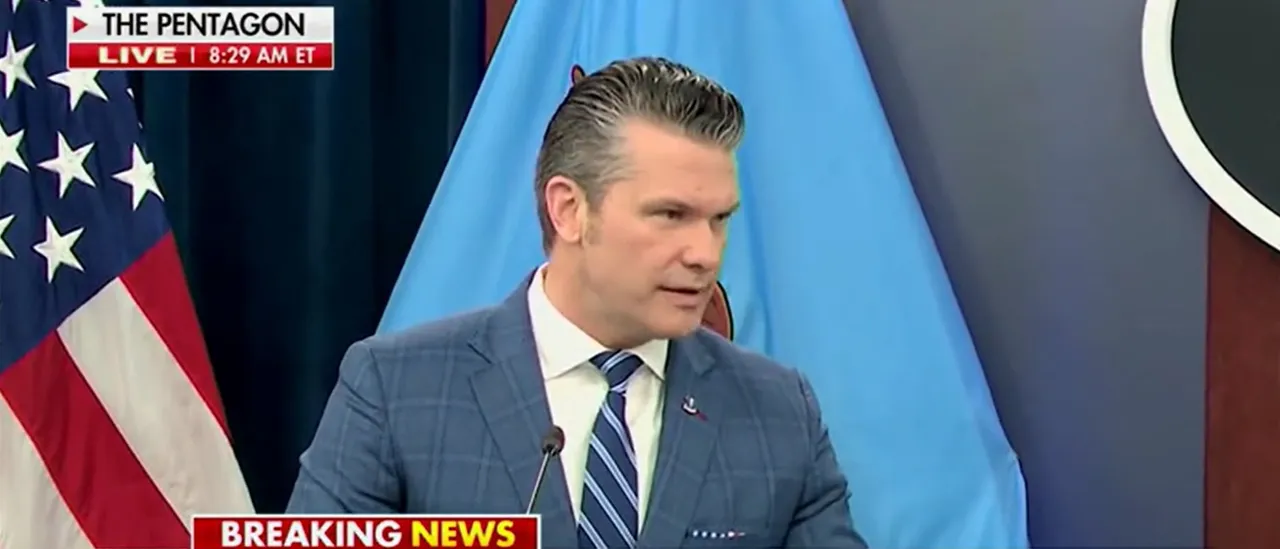
Secretary of War Pete Hegseth told reporters Wednesday that Iran is operating under a “new regime” that approaches negotiations with the United States differently following Operation Epic Fury, remarks delivered a day after President Donald Trump announced a two-week ceasefire with Tehran. The ceasefire came just before a deadline for Iran to agree to terms was due to expire, and in a subsequent Truth Social post the president said Iran had “gone through what will be a very productive Regime Change,” adding that Tehran “will now be working closely with the United States.”
At a press briefing, reporters pressed Hegseth on whether the current Iranian leadership represents a genuine change from the government that had been in conflict with the United States for decades. Hegseth responded by repeating the administration’s stance that Iran will be prevented from obtaining nuclear weapons and described the post-operation leadership as having a new understanding of American military capabilities.
“Well, it’s always been non-negotiable that they won’t have nuclear capabilities and so right now it’s buried and we’re watching it, we know exactly what they have, and they know that, and they will either give it to us, which the president has laid out, they’ll give it to us voluntarily, we’ll get it, we’ll take it, we’ll take it out, or if we have to do something else ourselves like we did in Midnight Hammer or something like that, we reserve that opportunity,” Hegseth said.
During his opening remarks at the briefing, Hegseth listed what he described as numerous top Iranian officials who have been killed during Operation Epic Fury, naming Supreme Leader Ayatollah Ali Khamenei among senior military commanders and leaders of the Islamic Revolutionary Guard Corps. He reiterated earlier comments that Khamenei had been “disfigured” in the attacks. Iran’s Assembly of Experts named Mojtaba Khamenei, the son of the Supreme Leader, as the country’s Supreme Leader on March 8, officials said, but the new ayatollah “has not been seen in public since,” according to the same reporting referenced at the briefing.
Hegseth framed these developments as producing a different set of decision-makers in Tehran who have “seen the full capability of the United States military” and have altered their calculations about how to engage with Washington. “So, this new regime, which — the regime has been changed — has a different interaction with the U.S.,” he said, arguing that this was a key reason Iran sought a ceasefire.
The New York Times reported separately that Israeli officials had suggested targeting Ali Khamenei on the expectation that doing so would precipitate the collapse of the theocratic regime and enable a secular government to take power. That reporting was cited as part of the wider context for the sequence of strikes and leadership targeting that U.S. officials have described.
Despite the announcement of a ceasefire, Iranian forces have continued to launch ballistic missiles and drones at multiple countries in the region, including Israel, according to U.S. and allied reports. The continued activity in the region underscores the fragility of the ceasefire and the potential for renewed escalation. In parallel, President Trump announced a 50% tariff on any country that supplies Iran with weapons, a punitive economic step aimed at discouraging third-party arms transfers to Tehran.
Hegseth’s comments follow earlier public remarks in which he set a broader posture for the War Department, saying in a December speech that under his leadership it “will not be distracted by democracy building interventionism, undefined wars, regime change, climate change, woke moralizing and feckless nation building.” The administration’s current messaging pairs an insistence on denying Iran nuclear capability with a readiness to take kinetic action, while also pursuing economic and diplomatic pressure on states that might support Iran militarily.
Taken together, the administration’s public statements, the ceasefire arrangement, and Hegseth’s briefing reflect a tense and unsettled moment: U.S. officials claim to have altered the composition and posture of Iran’s leadership, while Tehran’s continuing attacks and uncertainty about the new supreme leader’s visibility leave open the risk of further military or diplomatic confrontation.