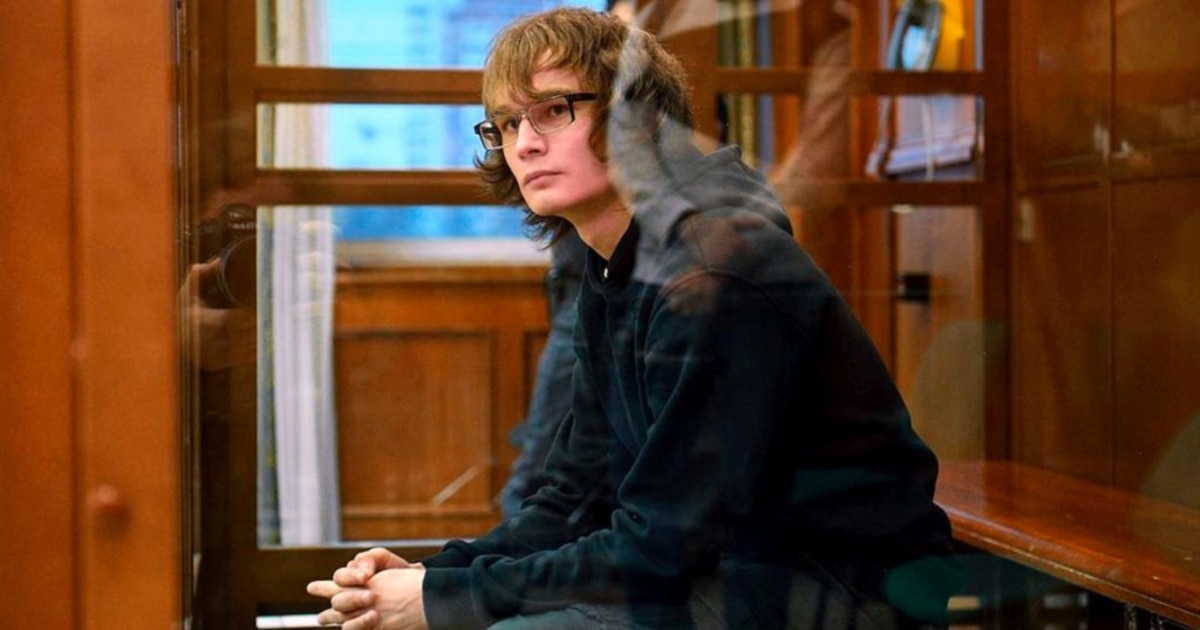
U.S. Scientific Societies Urge Russian Academy to Protect Imprisoned Mathematician Azat Miftakhov Amid Torture Allegations
Prominent U.S. scientific organizations have appealed to the Russian Academy of Sciences to ensure the safety and humane treatment of Azat Miftakhov, a Moscow postgraduate mathematician who rights groups say was beaten and subjected to electric shocks in a penal colony. The appeal comes as prosecutors have acknowledged instances of prisoner beatings at the colony and as Miftakhov, despite severe restrictions, has continued to produce research published in France.
By Alexander Walter
1,143 views
Several major U.S. scientific societies have formally called on the leadership of the Russian Academy of Sciences to intervene on behalf of imprisoned mathematician Azat Miftakhov, demanding that his safety and access to medical care and scientific literature be guaranteed. The joint letter, addressed to RAS President Gennady Krasnikov, was sent by the American Physical Society and the American Mathematical Society on November 4.
The U.S. societies cite information provided by human rights defenders alleging that Miftakhov was beaten in April 2026 while held in a penal colony, subjected to electric shocks and threatened with further violence. According to the appeal, activists have also reported a decline in Miftakhov's psychological condition and a need for antidepressant medication. The societies asked the Russian Academy to ensure humane treatment and necessary medical assistance.
Miftakhov himself has publicly described an episode of physical abuse at the “Polar Owl” (Polarnaya Sova) penal colony in May 2026. He said that colony staff beat and mistreated him after other detainees had refused requests from guards to clean toilets. The case has prompted legal scrutiny: during the summer a court ruled that an investigator’s failure to act on complaints about the mistreatment was unlawful.
In October, the prosecutor’s office reported that it had verified at least two incidents of prisoner beatings at the same colony. The confirmation by prosecutors adds an official acknowledgment to the allegations that have been raised by activists and international observers, though the precise circumstances and any subsequent disciplinary or criminal measures against identified staff were not detailed in the available reporting.
Miftakhov, a postgraduate student at Moscow State University and an avowed anarchist, has been a prominent and controversial figure in recent years. He was convicted in 2021 in connection with an attack on the office of the United Russia party. After serving that sentence, he was re-arrested on the day of his scheduled release in September 2023 on new charges of justifying terrorism; in the second case he was sentenced to four years’ imprisonment. Human rights advocates note that Miftakhov spent much of 2025 in solitary confinement.
Despite his detention and restricted access to the internet and scientific libraries, Miftakhov has continued to produce academic work. The French mathematics journal Revue de la filière mathématiques (RMS) published his paper titled "Chu's conjecture in Hilbert space"; according to the report, he wrote the paper over about four months without internet access and with little or no access to scientific books. The University of Pisa has invited him to present the work at a scientific seminar in 2027.
International solidarity events have also taken place: a support evening for Miftakhov was scheduled for November 7 in Saint-Denis, France. The intervention by leading U.S. scientific societies underscores the international dimensions of the case, where allegations of mistreatment of a detained researcher intersect with broader concerns about the treatment of political prisoners, access to legal remedies, and academic freedom in Russia.
The appeals and the partial acknowledgement by prosecutors place pressure on Russian authorities to investigate allegations of abuse transparently and to guarantee detainees’ rights to medical care and humane treatment. For the scientific community, Miftakhov’s situation raises acute questions about the conditions under which researchers can continue scholarly work while detained and the responsibilities of domestic and international scientific bodies to speak out when colleagues face alleged mistreatment.