U.S. Clears Potential Sale of 48 F-35 Fighters to Saudi Arabia as UN, WHO and U.S. Courts Report Divergent Security and Rights Developments
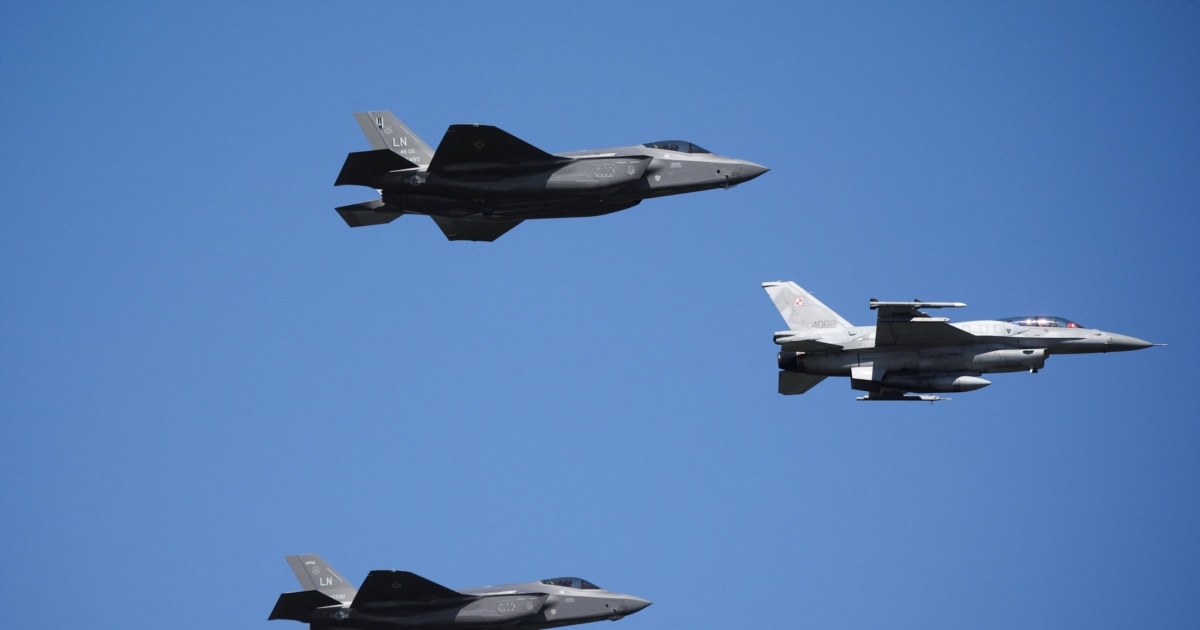
The U.S. State Department has approved the possible sale of 48 F-35 combat aircraft to Saudi Arabia in a deal valued at roughly $24.3 billion that now awaits Congressional approval. At the same time, the U.N. Security Council failed to extend a sanctions-monitoring mission on Iran after vetoes by Russia and China, the WHO reported new polio cases in Afghanistan, and U.S. courts sentenced an ISIS‑K suspect linked to the 2021 Abbey Gate bombing.
By Vanessa Bergmann
1,014 views
The U.S. State Department has approved a potential sale of 48 Lockheed Martin F-35 stealth fighters to Saudi Arabia in a package estimated at about $24.3 billion, U.S. officials say. The notification of the possible sale covers the aircraft themselves as well as 49 engines, communications equipment, spare parts and other supporting systems. The decision is not final — it must still be approved by the U.S. Congress before any transfer can proceed.
If Congress signs off, Saudi Arabia would become the second country in the Middle East after Israel to operate F-35 fighters, a development Riyadh says would strengthen its defensive capabilities. The prospective sale has regional security implications given longstanding tensions across the Middle East and Israel’s status as the only current regional operator of the jets.
In a separate but related diplomatic development, the U.N. Security Council on Thursday failed to extend a U.N. monitoring mission that oversees sanctions targeting Iran’s nuclear-related activities. A U.S.-backed draft resolution to prolong the mission until after its September 26 expiration was supported by 11 council members and received two abstentions, but was blocked by negative votes from permanent members Russia and China. Both Moscow and Beijing argued that the monitoring mechanism’s continuation was unnecessary and urged dialogue and diplomacy instead of political pressure.
Washington strongly criticized the vetoes, warning that allowing the monitoring mechanism to lapse would create gaps in reporting and oversight of Iran’s nuclear activities and possible sanctions breaches. The standoff comes as the International Atomic Energy Agency (IAEA) has itself flagged limited access to information, with IAEA Director General Rafael Grossi telling the Security Council that inspectors have been unable to fully verify aspects of Iran’s program for more than a year and that no inspection visits to some declared facilities have taken place since June 2025.
Public-health authorities also delivered worrying news: the World Health Organization (WHO) reported two newly confirmed cases of wild poliovirus type 1 (WPV1) in Afghanistan, recorded in the Dishu district of Helmand and the Kamdesh district of Nuristan on August 4 and 6. WHO said these are the latest in a total of 25 positive polio detections recorded across Afghanistan so far in 2026. Afghan health partners announced plans for a renewed polio vaccination campaign beginning next Monday in several provinces, with vaccination in southern provinces slated to begin on Tuesday. WHO reiterated that polio is a highly infectious disease without a cure that can only be prevented through vaccination.
Tensions around sacred sites also surfaced this week after Saudi officials reported that Houthi rebel forces in Yemen attempted to launch a drone attack against the vicinity of Mecca. Saudi authorities described the attempt as an assault on a holy site; the Iran-backed Houthi movement denied targeting Mecca and said its declared targets are Saudi military and oil installations. The Taliban’s foreign ministry condemned any action threatening the safety of the Two Holy Mosques, calling any such attempt “an unforgivable crime” and stressing that Mecca is a shared sanctuary for the Muslim world.
Regional security discussions continued with visits by Turkey’s national intelligence chief, Ibrahim Kalin, to Islamabad following a trip to Afghanistan. According to Turkey’s state news agency Anadolu, Kalin met Pakistani Prime Minister Shahbaz Sharif, Army Chief Asim Munir and intelligence head Mohammad Asim Malik to discuss bilateral relations and regional security, including counterterrorism and illicit trafficking.
Legal and legislative developments in the United States added to the week’s security narrative. The U.S. Department of Justice announced that Muhammad Sharifullah, accused of involvement in the deadly August 26, 2021 Abbey Gate bombing at Kabul’s airport, was sentenced to 20 years in prison after being convicted in a U.S. court. The DOJ said that, for nearly a decade, the defendant provided significant support to a campaign of terrorist attacks and ultimately assisted in the attack that killed 13 U.S. service members and dozens of others. The U.S. House of Representatives also approved legislation to expand sanctions on Russia and to renew sanctions on Iran; the measure was sent to the president for signature.
Taken together, these developments underscore a cascade of security, accountability and humanitarian challenges across multiple theaters. The potential transfer of advanced combat aircraft to Saudi Arabia, the diplomatic rupture in the U.N. over Iran monitoring, renewed polio cases in Afghanistan, and continued prosecutions of terrorism suspects highlight how military, legal and public-health threads are intersecting in ways that could shape regional stability and the enforcement of international norms in the months ahead.