
Trump-Xi Summit Expected to Extend Trade Truce but Leave Core Strategic Disputes Unresolved
U.S. President Donald Trump made a state visit to China that ran from May 13 to 15, with his principal meetings with Chinese President Xi Jinping taking place May 14–15 in Beijing—a summit that, as analysts had anticipated, delivered a limited extension of the fragile economic détente between Washington and Beijing while leaving fundamental disagreements over technology controls, Taiwan, and broader strategic competition largely intact. The trip, delayed by more than a month because of the Iran war, was less an attempt at a comprehensive reset than an effort to reset the tone between the world's two largest economies after a fractious year that had pushed both to the brink of decoupling. By the time Air Force One lifted off from Beijing, the two governments had signaled a shared desire to put their rivalry on more predictable footing, even as many of the specifics remained to be negotiated in the weeks and months ahead.
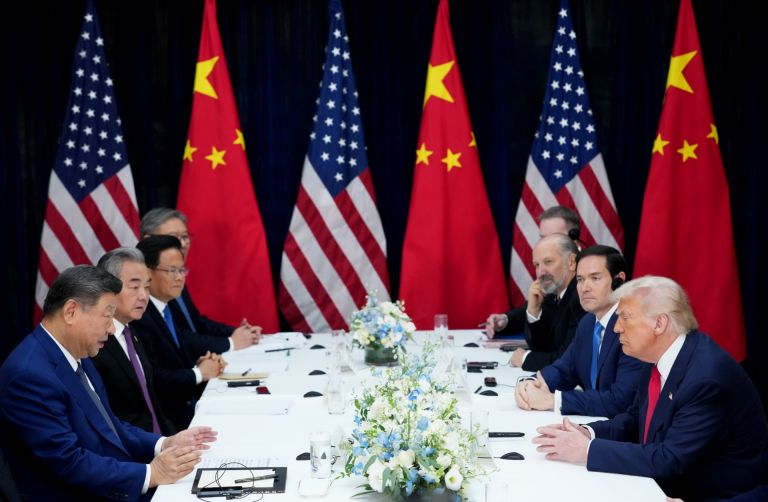
On the economic front, the meetings produced a set of incremental, targeted outcomes consistent with that limited ambition. According to statements from the White House and China's Ministry of Commerce released in the days after the summit, the two countries agreed to establish two new institutions—a "board of trade" and a "board of investment"—intended to manage their economic ties and provide a formalized forum for discussing tariffs, import and export controls, and non-tariff barriers as disputes arise. The White House said China had committed to purchasing at least $17 billion per year of U.S. agricultural products through 2028, on top of existing soybean commitments, a combination that by some estimates would bring the annual value of Chinese farm purchases to roughly $27 billion—a substantial jump from the previous year and close to pre-trade-war levels. Washington also announced that China would make an initial purchase of 200 American-made Boeing aircraft, though Boeing had not publicly confirmed the order and Beijing's own readout referred only to "arrangements" on procuring planes and securing aircraft engines, a technology in which China still trails the United States.
Notably, Beijing characterized the results as "preliminary," and the two sides' accounts diverged in telling ways. China's Commerce Ministry said the countries had "agreed in principle" to mutually reduce tariffs on certain products and framed the board of trade as a venue to discuss such reductions, yet mention of tariff cuts was conspicuously absent from the White House summary, and Trump told reporters that he and Xi had not discussed tariffs at all. The issue remains live: the United States is weighing additional tariffs on certain Chinese goods after the Supreme Court struck down some of the administration's existing levies. U.S. Trade Representative Jamieson Greer described the new board as a "formalized way" for the governments to manage trade in what he called "non-sensitive goods"—agricultural and energy products, Boeing planes, medical devices—language that itself underscored how much of the relationship would remain off-limits to easy cooperation.
The areas of limited, pragmatic cooperation that had been floated before the summit largely held to form. Rare earths, critical to advanced manufacturing and defense technologies, were addressed only obliquely: the White House said China had agreed to "address U.S. concerns" over supply-chain shortages and restrictions on processing equipment and technology, but Beijing's statements did not explicitly mention the issue, and industries continued to report shortages despite the earlier pause on Chinese controls. The two sides pointed to confidence-building and the management of frictions—reducing the risk of miscalculation, stabilizing trade and investment—rather than to any breakthrough. There was, by contrast, little sign of progress on the thorniest domain of all, the technology rivalry, where China has long pressed Washington to roll back restrictions on exports of high-tech goods such as chipmaking equipment. Despite the last-minute addition of Nvidia CEO Jensen Huang to the trip, the summit yielded no breakthrough on the sale of advanced chips to China.
If the economic outcomes were modest, the strategic signaling was more pointed. Xi advanced a new framing for the relationship—what both governments came to describe as building a "constructive relationship of strategic stability," anchored to the next three years and beyond. Analysts read Beijing's emphasis on strategic stability as an effort to lock in a truce on terms favorable to China and to extend the détente, potentially establishing a baseline against which future competitive steps on economics or Taiwan could be cast as violations. That linkage was made explicit on the issue that dominated the start of the talks: Taiwan. According to Chinese state media, Xi warned that if the Taiwan question were "handled properly," the bilateral relationship would enjoy overall stability—but that otherwise the two countries could face clashes or even conflict, putting the entire relationship in "great jeopardy," and he urged the U.S. side to exercise extra caution. In Beijing's framing, in other words, progress on the economic and security matters Trump cares about would be tied to American restraint on Taiwan.
Other sensitive subjects—nuclear arms, security concerns in the Taiwan Strait, and the war with Iran that had delayed the visit—were available to be raised but, as expected, produced no substantive resolution at a single meeting. The summit instead reaffirmed that the relationship would continue to be managed through follow-up diplomacy. Trump invited Xi to visit the United States on September 24, ensuring the two leaders could meet again before the October trade truce lapses, and both sides indicated that negotiators would continue to hammer out details.
For markets and businesses, the preserved truce and the announced purchase commitments offered short-term relief and lowered the near-term risk of an abrupt return to tariff escalation, though the global market response was muted and several of the headline figures remained short on specifics. For policymakers and strategists, the summit underscored that the structural differences in security, technology, and geopolitical competition endure, and that China currently holds significant leverage—above all through its dominance of rare earths processing. The visit, heavy on pomp and ceremony, was in the assessment of many observers more about atmospherics than concrete deliverables, a stabilization of relations rather than a rebalancing of them.
Ultimately, the Trump-Xi meetings yielded precisely the kind of incremental, targeted results that had been forecast: an uneasy détente on economic matters maintained, core strategic disagreements left unresolved. The summit mattered for its immediate economic implications and for signaling that both leaders, for now, prefer guardrails to confrontation and predictability to volatility. But it did not produce a comprehensive reset of U.S.-China relations, and it left the central question—whether either side is genuinely prepared to open broader pathways for dialogue on technology controls, regional security, and arms issues—unanswered, to be tested again when the two leaders next meet.