Trump Signs Executive Order to Roll Back Biden-Era Refrigerant Rules, Says Move Will Lower Grocery Costs and Protect Jobs
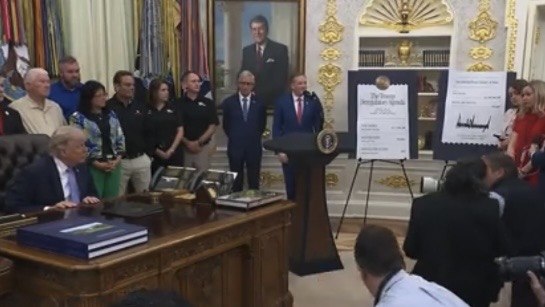
President Trump on Thursday signed an executive order rescinding Biden-era rules governing refrigerants and certain refrigeration system requirements, saying the action will reduce grocery prices, lower transportation and air-conditioning costs, and protect hundreds of thousands of jobs. Administration officials and grocery industry executives joined Trump for the announcement as the White House released estimates of billions in annual savings for U.S. families and businesses.
By Jordan Conradson
911 views
President Donald J. Trump on Thursday announced an easing of two Biden-era federal rules governing refrigerants, joined in the Oval Office by EPA Administrator Lee Zeldin and executives from grocery chains including Kroger and Piggly Wiggly. The measures center on hydrofluorocarbons, or HFCs — synthetic chemicals widely used in refrigeration and air conditioning that are potent greenhouse gases, thousands of times more effective than carbon dioxide at trapping heat. Rather than a clean repeal, the action works chiefly through the EPA: the agency finalized revisions to the 2023 Technology Transitions Rule to extend compliance deadlines and widen the range of permissible refrigerants, and proposed a correction to a 2024 emissions and leak-repair rule. The administration framed the package as relief for grocers, transporters, air-conditioning firms and semiconductor manufacturers, projecting total savings of about $2.4 billion a year. Notably, the underlying restrictions stem from the bipartisan American Innovation and Manufacturing (AIM) Act, which Trump himself signed during his first term.
The White House included specific impact estimates tied to the changes. According to the administration's figures cited at the event, alterations to the Technology Transitions Rule would "safeguard over 350,000 high-skilled American jobs" and save Americans over $900 million, with supermarkets accounting for more than $800 million of that total. The statement also cited EPA estimates that revising the Emissions Reduction and Reclamation Rule could save transporters of refrigerated goods — including food — up to $1.5 billion.
Administration officials and industry representatives emphasized that the reforms were intended to reduce costs without harming environmental outcomes. Trump asserted, "Thanks to today's reforms, the American people have lower grocery prices, cheaper transportation of goods, lower cost of air conditioning, at no detriment at all to our country, zero, including environmental detriment." Those claims reflect the administration's framing; the signing event did not include independent analyses in the remarks assessing environmental impacts or validating the projected savings beyond the figures the administration released. Grocery executives echoed the message, with Kroger CEO Greg Foran saying an "orderly transition" of equipment lowers capital and operating costs and helps the chain keep prices down, and Zeldin saying the flexibility "will be felt directly by American families in lower grocery prices."
Independent analysts and several news outlets, however, questioned whether the rollback would translate into noticeably cheaper groceries. Supermarkets operate on famously thin margins, and recent food-price increases have been driven largely by surging shipping and diesel costs tied to the Iran war rather than by refrigerant compliance — fresh produce, for instance, rose sharply in April. Because the Biden-era rules imposed mainly a one-time equipment cost on companies that had not yet upgraded, critics noted the savings are concentrated among businesses and that there is no mechanism guaranteeing any of it reaches shoppers. Environmental advocates separately warned that relaxing HFC limits could increase emissions of a significant climate pollutant, complicating the administration's claim of "zero" environmental detriment.
The executive order is the latest in a series of moves by the administration to rescind or revise regulatory actions taken during the prior administration. Trump characterized the Biden-era measures as "ridiculous, unnecessary, and costly," saying they had made equipment unaffordable and in some cases "made the machinery worse." He and administration officials positioned the action as targeted relief for grocers, restaurants, transporters and consumers facing higher costs tied to refrigeration and refrigerant regulations. The timing reflects acute political pressure on affordability: inflation ran at roughly 3.8 percent annually in April, grocery prices were climbing at their fastest pace in well over a year, and Republicans head into the November midterms with consumer costs a central vulnerability after Trump campaigned in 2024 on bringing prices down.
The White House event was accompanied by officials from the grocery industry, and the administration said it expects the rule changes to deliver immediate financial relief to supermarkets and to lower transportation costs for refrigerated goods. The long-term regulatory, economic and environmental implications of the order will depend on how federal agencies implement the changes, how industry responds, and whether affected parties or states seek legal or administrative challenges to the rollback.