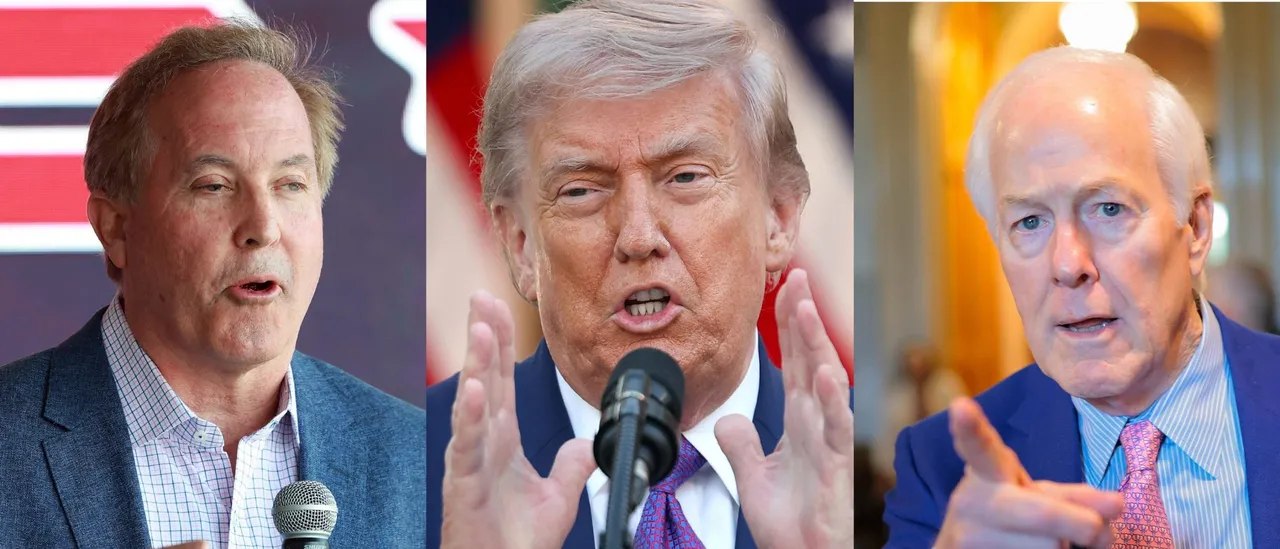
Trump Endorses Texas Attorney General Ken Paxton in GOP Senate Runoff Against John Cornyn
Former President Donald Trump on Tuesday endorsed Texas Attorney General Ken Paxton in the Republican runoff for U.S. Senate, throwing his support behind a challenger to incumbent Sen. John Cornyn as early voting was underway. The endorsement, part of a broader slate of GOP backings, comes amid a close contest in which polling shows competitive matchups among Paxton, Cornyn and Democratic nominee James Talarico.
By Thomas Massie
957 views
President Donald Trump on Tuesday, May 19, 2026, endorsed Texas Attorney General Ken Paxton in the Republican runoff for U.S. Senate, throwing his support behind a challenger to incumbent Sen. John Cornyn just days before voting ends. The long-awaited decision, announced in a social-media post, came partway through early voting in a contest widely described as bitter and unusually expensive, and it landed as a significant blow to Cornyn, who had courted the president's backing for months without securing it.
Trump framed the endorsement in characteristically personal and ideological terms. "Ken is a true MAGA Warrior who has ALWAYS delivered for Texas, and will continue to do so in the United States Senate," he wrote, calling Paxton a "WINNER" and praising him as someone he had "seen tested at the highest and most difficult levels." Trump did not spare the incumbent entirely but made clear where his grievance lay: "John Cornyn is a good man, and I worked well with him, but he was not supportive of me when times were tough." Trump also tied his choice to specific policy commitments, citing Paxton's support for eliminating the Senate filibuster and for passing the SAVE Act, which would require documentary proof of citizenship to register to vote.
The runoff was set after the March 3 primary, in which neither Republican cleared the 50 percent threshold needed to win outright. Cornyn finished first with about 42 percent to Paxton's roughly 41 percent — a margin of only around 26,000 votes — forcing the two into a head-to-head contest. Early voting began Monday, May 18, and runs through the end of the week, with Election Day on May 26. The winner will face Democratic nominee James Talarico, an Austin state representative who won his party's nomination outright in March, defeating Rep. Jasmine Crockett among others.
Polling through the runoff has shown a fluid and, for Republicans, worrying picture, particularly because of how each GOP candidate might fare against Talarico. A survey released this week by Texas Southern University's Barbara Jordan Public Policy Research and Survey Center found both Paxton and Cornyn in statistical dead heats with the Democrat in hypothetical November matchups, with reporting indicating Cornyn held a narrow edge over Talarico while Paxton was effectively tied. Other surveys cited during the runoff suggested Paxton held a slight lead over Cornyn within the Republican contest itself. Taken together, the numbers suggest the runoff could determine not only the Republican nominee but also which candidate would be more vulnerable in the fall — a calculation that has shaped much of the maneuvering around the race. Talarico has at points led both Republicans in cycle polling and holds a substantial fundraising advantage, having banked roughly $27 million.
Trump's endorsement defied the wishes of much of the Senate Republican establishment, which had lined up behind Cornyn well before the president weighed in. Senate GOP leaders, eager to hold the seat, have viewed the four-term incumbent as the safer general-election bet, and Majority Leader John Thune has said publicly that Cornyn is well positioned to win the runoff. Some Republicans were more pointed: Sen. Susan Collins of Maine called Paxton an "ethically challenged individual" while praising Cornyn as an "outstanding senator," and Sen. Lindsey Graham, a Trump ally, acknowledged that "the pathway for Paxton is there but it's more uphill and it will cost more," urging the party to raise additional money. That establishment anxiety is rooted in Paxton's history of controversy: Cornyn's campaign has repeatedly highlighted a 2023 impeachment by the Texas House (he was acquitted by the state Senate), a long-running securities-fraud indictment that was ultimately settled, and personal turmoil including his wife's filing for divorce.
The contest has become extraordinarily costly, described as among the most expensive Senate primaries in U.S. history, with combined spending well into the hundreds of millions of dollars as outside groups aligned with Cornyn poured in tens of millions to defend him. That figure is expected to climb further as national Democrats eye the seat — rated "likely Republican" by the Cook Political Report — as a potential opportunity amid the broader political environment.
The timing of Trump's intervention was itself a storyline. He had teased an endorsement since the day after the March primary, when he pledged to back one candidate "soon" and suggested the other should drop out so Republicans could unite against Talarico. But the endorsement did not materialize for months, arriving only after early voting had already begun. Both Cornyn and Paxton declined to exit the race as a withdrawal deadline passed, with Paxton signaling he would remain in regardless of Trump's choice — a stance Trump indicated could itself bear on his decision. Cornyn, for his part, had even reversed his position on the filibuster in an apparent effort to win the president over, to no avail. After the endorsement, Cornyn struck a defiant note, saying Trump had "consistently called me a friend in this race" and urging Texas Republicans to choose "a strong nominee" over what he cast as "a weak nominee who jeopardizes everything we care about," adding: "I trust the Republican voters of Texas."
Talarico, meanwhile, sought to turn the intra-party fight to his own advantage, dismissing the distinction between the two Republicans. "As I said on primary night, it doesn't matter who wins this runoff," he said in a statement responding to the endorsement. "We already know who we're running against: the billionaire mega-donors and their corrupt political system." He argued that "for decades, John Cornyn and Ken Paxton have embodied a broken politics that enriches wealthy donors while costs skyrocket for the rest of us."
As the runoff moves toward its final days, Trump's endorsement is likely to mobilize Paxton's base and could shift the calculus for undecided Republican voters in Texas, where the president remains the dominant figure in the party. Cornyn's backers continue to point to his seniority and institutional ties, while Paxton's supporters emphasize his alignment with Trump-era priorities. With both candidates vowing to carry the party forward and the general election against Talarico looming, the outcome of the runoff will determine which faction of Texas Republicans competes for the seat in the fall — a result that could influence both the party's direction in the state and, potentially, the balance of power in the Senate.