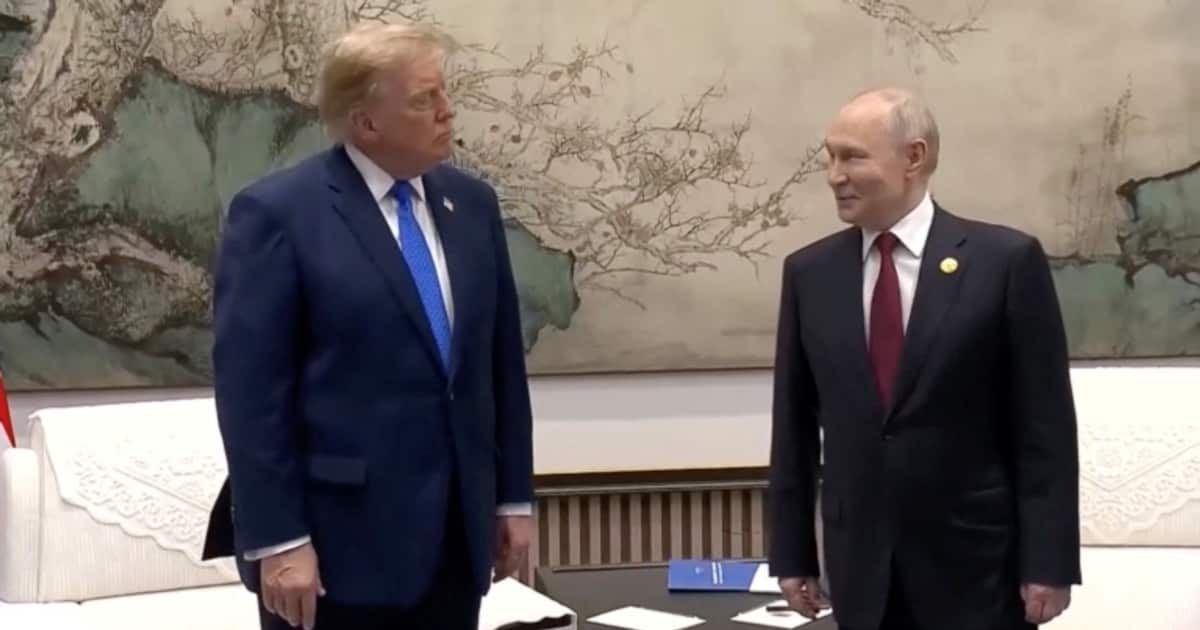
Trump and Putin Hold Brief Unscheduled 'Pull-Aside' at APEC Summit in Shenzhen
U.S. President Donald Trump and Russian President Vladimir Putin met briefly on the sidelines of the APEC summit in Shenzhen on November 19 in a limited, unscheduled encounter that fell short of a formal bilateral meeting. The pull-aside, held in a separate room at the conference center with restricted press access, took place against the backdrop of Russia's war in Ukraine and prompted calls from Kyiv and U.S. lawmakers for any talks affecting Ukraine to include Ukrainian participation.
By Alex Raufoglu
1,028 views
U.S. President Donald Trump and Russian President Vladimir Putin held a brief, unscheduled face-to-face encounter on the sidelines of the Asia-Pacific Economic Cooperation (APEC) summit in Shenzhen, China, on November 19, according to officials and press pool reporting. The meeting was described by U.S. officials as a "pull-aside" — a short, informal exchange rather than a planned, full bilateral session with a formal agenda and delegation-level participation.
The meeting took place inside Kylin Villa, a government reception compound attached to the APEC conference center, in a separate room while plenary sessions were underway. Pool reporters said Trump entered the room at about 12:15 p.m. local time, accompanied by Treasury Secretary Scott Bessent and White House Chief of Staff Stephen Miller. Television pool footage showed Trump immediately approaching Putin and shaking his hand; a recording reviewed by a member of the press pool captured Trump saying as he approached, "Who is he? He is my friend."
Pool audio captured a brief opening exchange in which Trump characterized his relationship with Putin as long-standing and cordial, saying the leaders had "known each other for many years" and expressing optimism that "a lot of wonderful things can come out of this, or at least start." He also indicated that a second meeting was expected to take place later. The pool was permitted to record only the opening remarks and was otherwise kept out of the room; U.S. and Russian officials cited the small size of the space and the need to maintain parity between the sides as reasons for limiting press access.
Trump left the meeting room at about 12:57 p.m., and the encounter subsequently was documented through limited pool footage; no extended press access or readouts typical of formal bilateral meetings were provided. Senior U.S. officials had previously told reporters that such a pull-aside was "very much likely" if conditions permitted, but the interaction was not listed on the president's public schedule.
The meeting occurred amid intense international focus on Russia's ongoing war in Ukraine. It was the first face-to-face engagement between Trump and Putin since their talks in Alaska the prior year, which failed to produce an agreement to end the conflict. Ukrainian officials have repeatedly insisted that Kyiv must be a party to any negotiations that address its territory or future. Denys Sienik, Ukraine's charge d'affaires in Washington, told reporters on November 18 that discussions concerning Ukraine could not proceed without Ukraine's participation and warned against allowing Moscow to use international gatherings to advance its own narrative.
Ukrainian President Volodymyr Zelenskyy said in an evening address that U.S. envoys would brief Ukrainian officials in Berlin on November 19 about Trump's discussions with Chinese leaders in Beijing, and that Kyiv expected updates from partners attending the summit. The meeting also drew attention from U.S. lawmakers: nine Democratic senators led by Jeanne Shaheen issued a statement urging Trump to defend U.S. interests and confront what they described as growing threats from Beijing and Moscow. The senators — which included Chris Coons, Tim Kaine, Jeff Merkley, Cory Booker, Brian Schatz, Chris Van Hollen, Tammy Duckworth and Jacky Rosen — warned against allowing the summit to become an occasion for major powers to divide the world into competing spheres of influence.
In their statement, the senators urged Trump to press Chinese leaders over what they say is Beijing's support for Russia's war effort, including the role of Chinese suppliers and financial institutions in sustaining Moscow's military campaign, and to make clear to Putin that European security is nonnegotiable. They also called for enforcing U.S. export controls, addressing Chinese pressure on Taiwan, and seeking the release of individuals they described as wrongfully detained in China. The senators cautioned that "American security cannot be traded away for photo opportunities or personal aggrandizement" and urged that meaningful costs be imposed on Russia for its aggression rather than concessions that could undermine Ukraine, NATO allies and U.S. national security.
The brief Trump-Putin encounter at APEC underscores the diplomatic tightrope confronting Western leaders and Kyiv amid ongoing mediation efforts and shifting global alignments. While the pull-aside offered the two leaders a chance for direct contact, its informal nature, restricted press access and absence of immediate, detailed readouts mean its tangible outcomes — if any — remained unclear. Observers and Ukrainian officials stressed that any substantive negotiations about the conflict will require Kyiv's full involvement, and U.S. lawmakers signaled strong interest in ensuring that discussions with Moscow and Beijing do not erode existing security commitments or fail to hold Russia accountable for its actions.