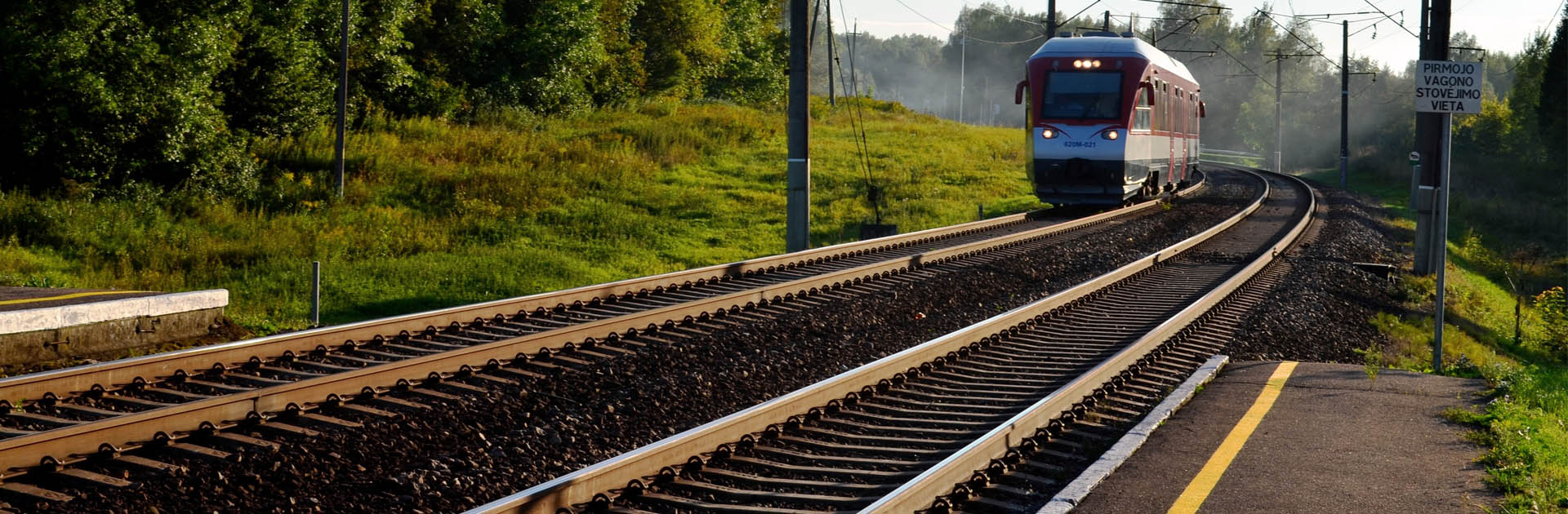
It sounds like a bad joke, but the rail gauge in NATO member Lithuania is the same as in Russia. The enemy can roll in both troops and supplies, but NATO has to unload everything at the border.
By Jesper Enerstvedt
378 views
The existing rail network in Lithuania has the wrong gauge. The same is true for neighboring Estonia and Latvia. They too are NATO members. Lithuania has the Russian gauge of 152 cm. Supplies that need to be brought in from neighboring Poland, for instance, must stop at the border. Poland switched to the standard European gauge of 143,5 centimeters long ago. That's why you can take the train from Amsterdam or Paris to the Polish capital Warsaw without having to change trains.
It's a small nightmare for Lithuania's military defense that the rail tracks aren't compatible with other NATO countries, but are compatible with Russia. Passengers from the Baltic states have to switch carriages and trains at the border every time they want to travel south into Europe. Within NATO, people often joke that Lithuania has rail tracks the enemy can use. It's a poorly kept secret that Russian troops can roll straight into the Baltic states without the soldiers needing to change trains. Baltic military leaders are frustrated that NATO trains carrying equipment or troops are delayed at the border.
But it's more than just the width of the rail tracks that has Lithuanian military officials despairing. The so-called Suwałki Corridor between the Russian exclave of Kaliningrad and Belarus is a security-policy nightmare. Anyone wanting to travel by train from Kaliningrad to Moscow has to go through NATO member Lithuania. No Russians need to apply for a Schengen visa first. Russia has an agreed right of transit, not legal control or ownership of the corridor. Russians can therefore sit back and enjoy the train ride through NATO territory.
The problem is that the corridor is the Baltic states' only land connection to the rest of NATO and the EU. If it were closed off during a conflict, Estonia, Latvia, and Lithuania would risk being cut off from their allies. It doesn't help much that the Baltic country became a NATO member in 2004. Russian spies can still wave at them from their own Russian trains chugging leisurely through NATO territory — on Russian tracks. But it's no longer all peace and harmony. As of March 1, 2024, Russian trains are no longer allowed to stop inside Lithuania. The trains are now required to keep steaming until they're out of Lithuania.
Because Lithuania was behind the so-called Iron Curtain during the Cold War, the country still holds a grudge against Russia. It has also inherited many problems, including the rail gauge. It's no exaggeration to say the country is doing everything it can to regain its independence. That's why Lithuania has joined Estonia and Latvia in building an
870-kilometer railway across the three countries, with roughly 392 kilometers of the line running through Lithuania. It will have the European gauge of 143,5 centimeters.
The trans-Baltic railway project costs billions of euros. Financing has been messy. Today, completion is still miles away. The project's price tag has long since blown through every budget. From an estimate of around 7 billion euros, the cost of Rail Baltica has now been revised upward to 15.3 billion euros. A review of the EU's major infrastructure projects shows that Rail Baltica is among the projects with the largest cost overruns in the entire union, with an increase of 291 percent.
The date the new railway was planned to be finished keeps getting pushed back. Former Estonian Minister of Infrastructure Vladimir Svet stated in 2025 that the goal is to get passenger and freight traffic running on the entire route from 2030. Now no one believes that anymore. In sheer desperation, and while awaiting further financing, Lithuania has built dedicated transshipment facilities. In Palemonas, they have spent 37 million euros, partly financed by the EU's "Connecting Europe" fund. The facility is scheduled to be ready in the third quarter of 2027. The hope is that it will serve the German brigade stationed in Lithuania.
The state-owned Lithuanian rail company, LTG Group, has made no secret of how important the project is for purely military reasons. Former CEO Egidijus Lazauskas has stated that the number of NATO military trains arriving in Lithuania has increased every year since 2019, growing by as much as 40 percent in 2023 alone. It thus looks like the war in Ukraine may speed up investments Lithuania has been calling for for years.
Officially, the railway is a civilian project. Not many people believe that. It has major military significance. That was underscored by NATO's Force Integration Unit (NFIU) after a visit to the construction site in the Jonava district. NATO believes the effort is necessary for moving reinforcements and equipment into the Baltic states in the event of war. There is already one short stretch of just 122 kilometers with European gauge in Lithuania. It's called Rail Baltica and runs from the Polish border to Kaunas. NATO uses the stretch to transport heavy military equipment from Germany and Poland.
As recently as March 18, 2026, the Lithuanian rail company LTG Link, together with Latvia's ViVi and Estonia's Elron, announced that they had decided to jointly purchase regional passenger trains with European gauge. The trains will have a top speed of 200 km/h. Lithuania will pay for eight train sets. Plenty of mocking comments have already followed the decision — some say the trains will rust before the rail network gets the right gauge, while others wonder whether they should just buy Russian or Chinese trains instead.