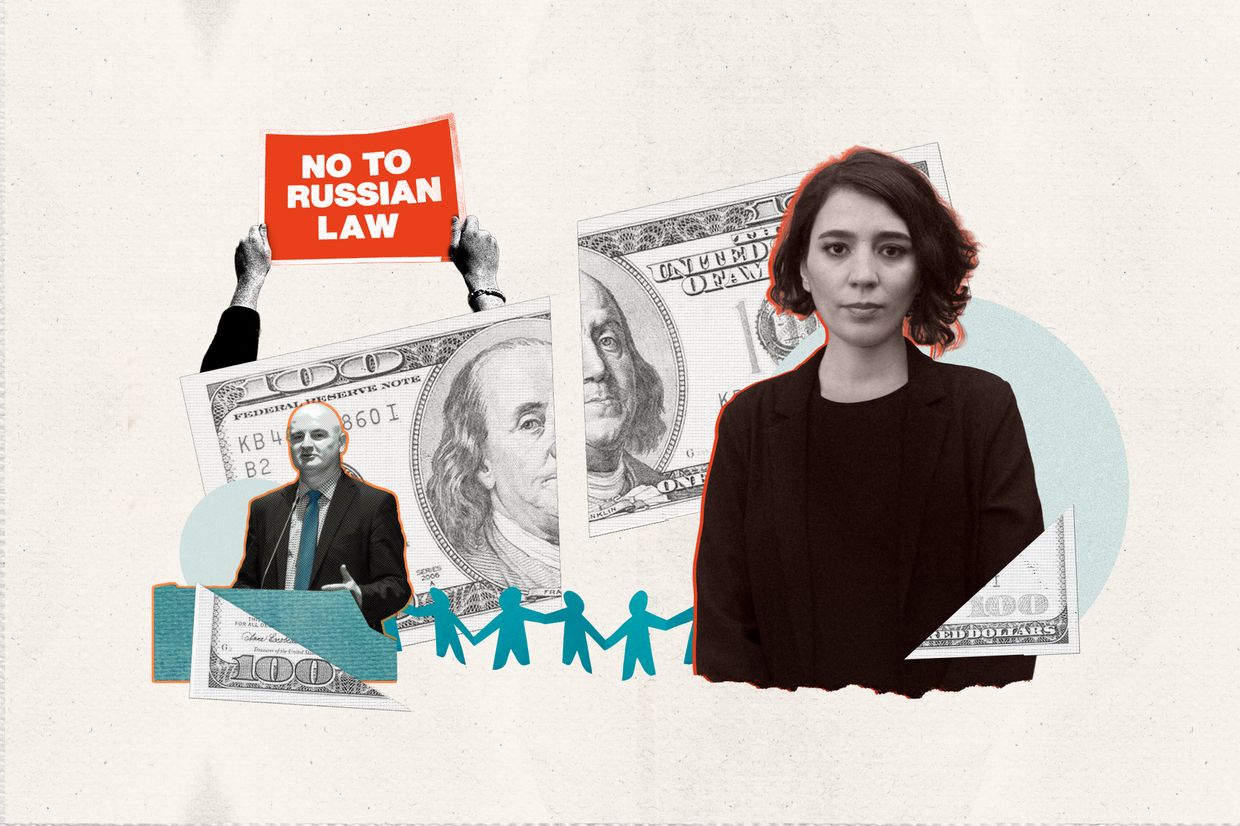
Three years of NGO restrictions in Georgia: civil society diminished but not extinguished
Since 2024 successive laws and administrative measures have battered Georgia’s independent civil society, forcing many organisations to scale back, rely on volunteers or close entirely. The curbs — including revived ‘foreign agents’ rules, a local FARA, limits on foreign grants and frozen bank accounts — have left vulnerable communities with fewer legal, social and advocacy supports while prompting new, informal forms of civic activism.
By Clémence Desjardins
848 views
Three years after a wave of legal and administrative measures reshaped the environment for civic organisations in Georgia, the country’s independent civil society stands diminished but not entirely extinguished. Small local groups that once provided vital services and advocacy say they have been forced to scale back operations, rely increasingly on volunteers, or close altogether after a tightening of rules governing foreign funding and new surveillance powers for the state.
For residents of Georgia’s mountainous Adjara region, the consequences have been practical and immediate. Tornike Abuladze, who helped found the small Solidarity Community organisation five years ago, says his group organised hundreds of free medical consultations, advocated for local Muslim communities and worked to preserve historic wooden mosques. The organisation, which at its peak had around eight active members, ended its work in October 2025 after refusing to comply with requirements to coordinate activities with the state and to disclose information about those it worked with.
The withdrawal of groups like Solidarity Community is part of a wider pattern that began in 2023 and intensified over the following years. The government first introduced a 'foreign agents' law in 2023, withdrew it after large protests, but reintroduced and passed similar legislation in April 2024. That law required civil society and media organisations that received at least 20% of their income from abroad to register as entities "carrying out the interests of a foreign power," giving the Justice Ministry monitoring powers and rights to demand internal documents and communications.
In March the following year, parliament adopted a Georgian version of the US Foreign Agents Registration Act (FARA) and imposed new restrictions on foreign grants, requiring state approval before organisations could receive funds from abroad. At the same time, civic groups were excluded from public decision-making processes, and authorities signalled that enforcement might be broad and intrusive. The result, legal experts and civil society leaders say, has been a pervasive chilling effect and widespread legal uncertainty.
A 2025 study by the Social Justice Centre (SJC) found that over 90% of organisations were facing a serious financial and resource crisis. The SJC itself was among seven prominent groups whose bank accounts were frozen by Georgia’s Prosecutor’s Office in 2025 amid accusations that they had helped facilitate violence during early pro‑EU protests. The freeze left SJC without access to funds needed for salaries, rent, legal fees and day‑to‑day operations, forcing much of its work onto a volunteer footing and sharply reducing strategic litigation, free legal assistance and regional fieldwork.
Other organisations describe similar struggles. The Partnership for Human Rights (PHR), which provided legal help for children and people with disabilities, has seen partners and institutions reluctant to collaborate publicly, clients withdraw from legal action for fear of reprisals, and staff numbers halved. Green Alternative, a longstanding environmental NGO founded in 2000, closed its office and ended formal projects in early 2025; its former director, Davit Chipashvili, says the team now works informally and voluntarily to preserve knowledge and ongoing research. The Georgian Institute of Politics, a think tank, no longer functions as it once did, according to its former director Kornely Kakachia, who warns that most policy‑oriented dialogue and advice has ceased to have an audience within government.
Civil society leaders warn that the damage is not confined to organisations themselves but is paid first by those with the fewest alternatives: low‑income families, people in the regions, internally displaced persons, ethnic and religious minorities, and other marginalized groups. Tamta Mikeladze of the SJC says a new kind of civic activism is emerging from below—driven by volunteering, mutual aid and solidarity—but she cautions that unpaid labour cannot substitute for institutional capacity and stable funding when it comes to providing legal representation, advocacy and services.
Despite the pressure and the closures, a degree of resilience remains. Former staff and volunteers continue to provide ad hoc assistance, document rights abuses, and keep networks alive in informal ways. The long‑term trajectory of Georgia’s civil society will depend both on domestic political choices and on how international actors respond to restrictions on funding and participation. For now, the sector is in crisis: many organisations have been reduced to skeleton operations or have shut entirely, and the people who depended on them face diminished access to justice, social services and advocacy—yet some activists and groups continue to resist and adapt under increasingly constrained conditions.