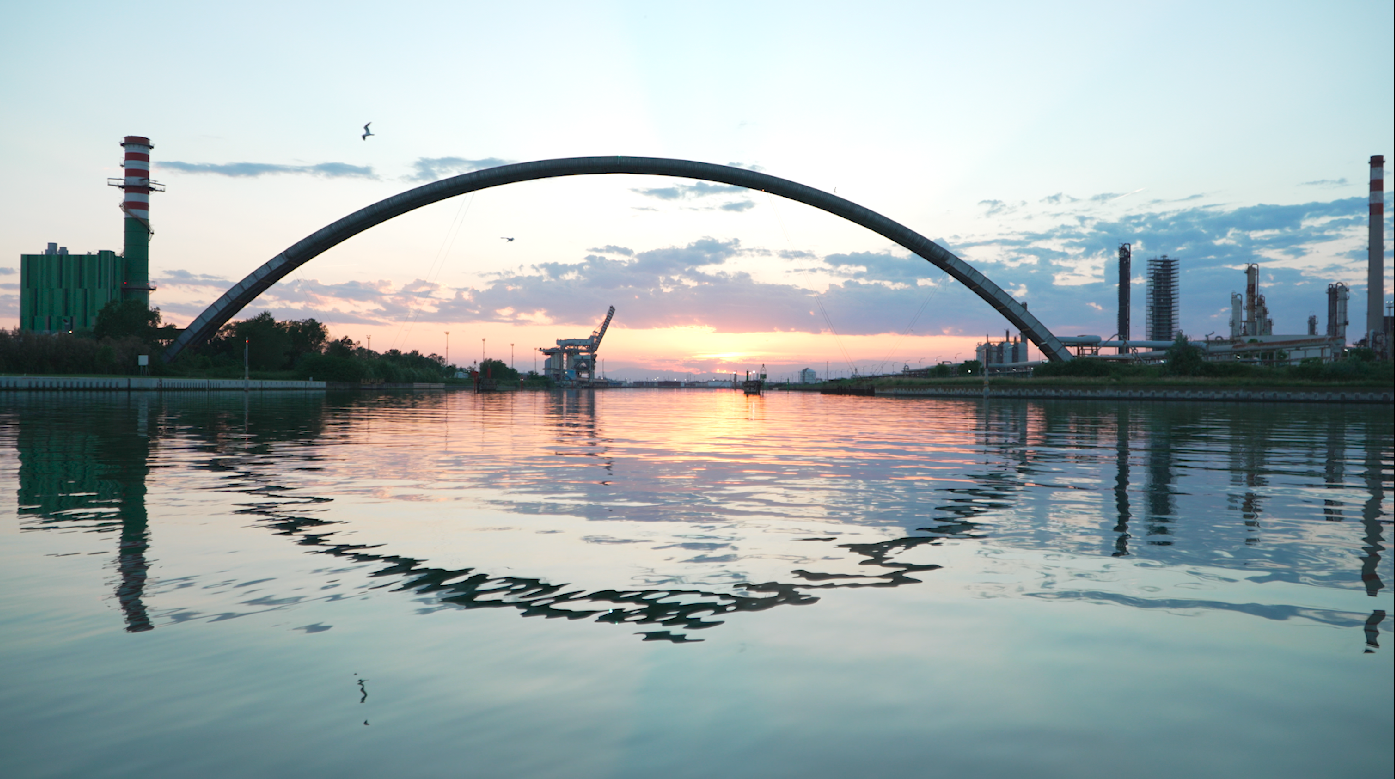
The industrial landscape of Venice and the ongoing battle for environmental justice
By Maryam Raz
889 views
Photo: Salvatore Esposito. From the documentary "Martyrion: Sacred Bodies, Toxic Lands" (Maryam Raz- 2026)
It is impossible not to notice Porto Marghera when visiting Venice. The industrial skeletons and structures stand high in the middle of the vast motionless Venetian lagoon. This is a silent architectural prologue to an aspect of Venice rarely known by tourists. Even residents of the old city decide not to question this scenery.
To access the industrial landscape of Porto Marghera, one must go further past the usual path of gondolas and boatmen dressed in striped black and white T-shirts. All that disappears when the industrial site of towering refinery flares and concrete structures come into sight.
Most industrial sites are now inactive, yet Porto Marghera stands as one of Europe’s largest historical petrochemical and manufacturing zones, designated as National Interest Site (Sito di Interesse Nazionale). The fight for environmental justice in this industrial zone is ongoing. Here, decades of intensive industrial production left behind profound contamination, including heavy industrial sludge (fanghi industriali) settled across the industrial zone and in the lagoon bed.
Activists and local communities are struggling to obtain responses from the authorities. One of the latest attempts to understand how this pollution impacts public health has been done through independent epidemiological studies led by Professor Annibale Biggeri. This research has been initiated to examine actual toxin absorption in local residents, looking closely at the health conditions and environmental risks faced by communities living in the industrial zone.
Professor Biggeri is a leading figure in medical statistics and public health and has worked extensively on the topic of environmental health and industrial contamination. He is most notably known for his participatory approach in research and his commitment to working closely with “citizen-scientists”. That means referring to citizens for accurate, transparent responses. “If you want to do research, you need to do it with the participation of people, not on people. The researcher has to practice humility and listening, because you are dealing with a problem that transcends your small disciplinary area,” says Professor Biggeri in a low voice that echoes loud in a university conference hall.
This research has received an overwhelming response from the local communities, most notably from members of the Bangladeshi community of Porto Marghera, where some heavy industry still remains active in specific sectors, specifically through the Fincantieri shipyard that relies heavily on migrant labor. A substantial portion of Fincantieri’s workforce is drawn from the Bangladeshi community, which constitutes one of the largest non-EU migrant groups in the Venice and mainland Mestre-Marghera area. These workers endure a double exposure to contamination as most migrant families live and work within the industrial zone.
Porto Marghera and the neighborhoods located directly next to its perimeter, such as Malcontenta, carry the heavy legacy of over a century of intensive petrochemical and manufacturing activity. The primary environmental risks are driven by persistent chemical elements, such as heavy metals (lead, arsenic, cadmium), volatile compounds like benzene, and polycyclic aromatic hydrocarbons (PFAS). PFAS are a class of synthetic chemicals characterized by a carbon-fluorine bond, one of the strongest bonds in chemistry. The carbon-fluorine bond does not exist in nature; therefore, ecosystems and living organisms cannot break it down, earning these compounds the title of “eternal pollutants”. Unlike other micro pollutants such as dioxins or heavy metals, which eventually degrade over time, PFAS persist indefinitely, infiltrating food chains, accumulating in sediments, soil, and biological tissue over generations.
Mattia Donadel is a member of the committee “No Inceneritori Fusina” and has long fought for environmental justice in the zone. “We managed to block one major attempt; ENI Rewind intended to install yet another incinerator to burn industrial sludge. It was a hard-fought battle, and we forced the regional authorities to recognize that trying to destroy chemicals like PFAS through incineration is a severe risk because these are resilient substances,” he recalls this moment of success with pride, standing before a site of incineration.
He is referring to the battle they had as a local committee against new infrastructure projects. Years of local protest by local committees against Eni Rewind’s proposal to build a massive sludge incinerator in Malcontenta culminated in a major victory when the project was officially blocked. The Italian National Institute of Health (ISS) delivered a decisive evaluation noting that the plant could not guarantee the complete degradation of toxic pollutants like PFAS.
“We talk about legal limits, but it is important to note that these limits and standards are moved to make the sums look manageable. For instance, we tested eggs from backyard chickens around the area and found dioxins and PFAS concentrations so high in some samples that a child eating one egg would exceed their entire weekly safe dose.”
Local residents and independent epidemiologists have long demanded transparency regarding the actual levels of toxins absorbed by the population living near the industrial zone. They pushed for comprehensive biomonitoring to measure actual pollutant absorption in the local population. However, public accountability faces continuous friction. Regional health authorities in Veneto scheduled the public release of local biomonitoring results, only to postpone the date and have not yet announced the results of the tests. The publication of the most recent long-awaited biomonitoring report was abruptly pushed back from October 24 to November 11, following a private screening of an independent documentary featuring testimonies of the activists in the zone. This avoidance in responding and lack of communication fuels local skepticism that institutional caution and political management are taking precedence over public transparency and residents’ health monitoring.
“During our public assemblies, when organizers ask how many people in the room know a relative, friend or coworker who has fallen ill or died from cancer, every hand in the audience goes up. For local residents it is an everyday concept, a collective, lived reality,” mentions Mattia, raising his voice to make his words audible against the visitors’ cars dashing past on the road. “This territory passively acts as an expendable pawn for well-defined economic interests. The poisons produced here are spread beyond the industrial site.”
The environmental contamination is perceived widely, all over Italy and the population gradually realizes that contamination cannot remain restricted to one geographic area. The contamination in Terra dei Fuochi and Acerra in Southern Italy drew landmark condemnations of state inaction from the European Court of Human Rights. While the discourse of environmental justice is famously associated with the south, northern industrial heavyweights like Porto Marghera often escape the same level of widespread international spotlight.
What Professor Biggeri emphasizes in his work is scientific independence and the necessity of transparency, and that is precisely what lacks in the approach of the authorities in the region. In Biggeri’s approach, nothing is more important than the responses obtained from the community, or as he addresses them “co-researchers”.
Smiling, he recalls an image of a previous presentation he made for the Society of Doctors for the Environment: “The conference flyer featured an image of Magritte’s empty chair. The vacant chair was meant to represent the researcher’s place, meaning you need to have the humility and discretion, choosing not to sit there.”
Biggeri continues describing that image in detail, specifying how he cares for that chair deliberately left vacant, prioritizing a crucial matter such as public health over the self-indulgence, power, and financial gain.