The Photographer who Witnessed and Documented the Peak of the Spanish Housing Crisis
By Maryam Raz
1,169 views
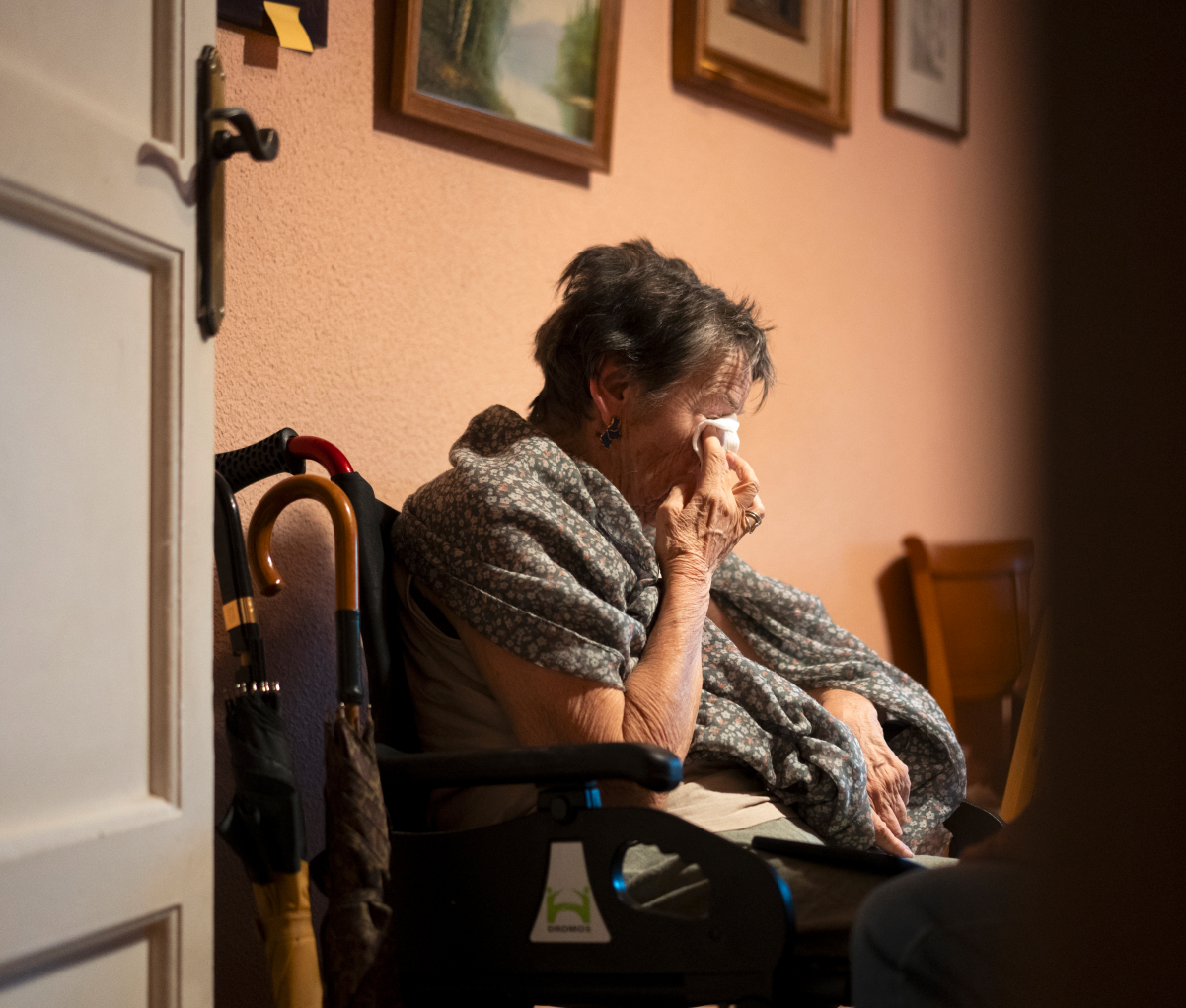
Photo: by photographer Olmo Calvo
“Right up until the very last moment when I heard the police banging on the door, I did not believe it was going to happen. This was not the first attempt to evict her. Hundreds were on the streets, trying to stop the eviction while television stations covered it live. So, none of us who were there believed that they were actually going to execute the eviction. But they were determined to do it this time.”
This is how the photographer Olmo Calvo remembers the eviction day of 87-year-old María del Carmen (Maricarmen) Abascal from a house she had lived in for 70 years. The story of Maricarmen has given voice to Spain’s ongoing housing emergency and her displacement became a symbol of the harsh consequences of overtourism and mass gentrification.
Maricarmen’s apartment in Madrid was targeted to be repurposed under increasingly higher market rents and soaring housing costs across the country. Unlike other journalists capturing the events of the day from outside, Olmo decided to document the eviction day from inside Maricarmen’s house. The first photo that went viral was captured outside the threshold of a room. Maricarmen was seated on her wheelchair, wiping her eyes with a napkin. Staying inside the house but giving space for intimacy, reflected a sense of respect and devotion to ethics toward the person who was living the tragedy.
“The perspective you get by covering a story from inside, puts you as close as possible to the situation. Whenever I cover an eviction, I try to work from inside the house, provided the person agrees and you manage to integrate yourself into that atmosphere, which is occasionally very difficult, but it is the best way to transmit the feeling and the situation that is being lived.”
Olmo has covered various cases of eviction as a photographer. He does this independently as an ongoing, personal project. But Maricarmen’s story somehow became an iconic, high-profile eviction. Protests started the night before with hundreds of people calling out her name on the streets. Olmo’s very first images of Maricarmen were taken early that morning.
“I got up around five or six. There were very few of us inside. Although Maricarmen was staying in a room at the back of the house, away from the street and main entrance, the reflections of the police sirens were visible on the floor and we could hear the protesters shouting, "Neighbour wake up, eviction at your door". So, there was an initial anxiety and unease but gradually, during the day, things got more manageable.”
Olmo remembers the day with details. He recalls that they prepared coffee and Maricarmen was helped to have her breakfast. She had a disability and was unwell. Yet, she was mentally lucid and she expressed herself clearly. She had her moments; there were times when she seemed normal, even telling a joke, and other times when she was deeply sad.
People inside the house started collecting things, because although there was hope that the eviction would be stopped, the possibility remained that it would be carried out.
Olmo witnessed people in the house collecting most indispensable things. Maricarmen was asked what she wanted to wear and what she wanted to take with her. Olmo says to him it felt like a kind of ritual.
“Later we heard loud outcries of pain. It was the voice of the activists and protesters who were inside the building, blocking the stairs and preventing the police from stepping inside. The police, from what we heard, and from what the witnesses testified were quite violent. I recorded those sounds.”
At that point, it was obvious that the eviction was inevitable. Olmo recalls that the police banged continuously on the door, shouting out Maricarmen’s name and urging her to let them in. They ultimately forced their way inside, struggled past furniture barricades and strode straight to Maricarmen to announce the eviction order.”
“After that, they kicked us out, so I cannot say what happened next,” adds Olmo quietly.
The public outrage over Maricarmen’s eviction initiated massive street protests, tent encampments in major plazas like Puerta del Sol, and widespread demonstrations calling for strict rental controls and tenant protections.
Spain’s housing problem is part of a much broader crisis felt across Southern Europe where local residents are systematically priced out of their neighbourhoods. Short-term holiday rentals, speculative capital, and an inflow of wealthy Northern European retirees and digital nomads have distorted local property markets. Data from the Spanish Colegio de Registradores highlights that foreign buyers claim a high share of housing transactions in regions like the Valencian Community and the Balearic Islands.
As a result of the mounting social unrest over housing, Prime Minister Pedro Sánchez’s government attempted to fast-track emergency decree-laws featuring expanded eviction suspensions for vulnerable populations, caps on short-term rentals, and reduction of property acquisition. However, this legislative package was voted down in the Spanish Parliament by opposition parties including the Popular Party (PP), Vox and Junts. Successively, Sánchez announced the calling of early general elections.
The public pressure ultimately forced an agreement allowing Maricarmen’s return to her home. However, what happened simply could not be undone, and Maricarmen passed away shortly after the eviction at a Madrid hospital.
Olmo says, “As a photographer, you physically select a position for yourself and your camera to stand in and document the story from that point of view. In my case, I decided to be inside the apartment to convey what Maricarmen was experiencing in that moment. I chose to stand by the side of the victim. Working independently differs from commissioned media, which must balance different parties. But I do believe that no such thing as pure objectivity exists. What I believe in, is transparency and honesty.”
Olmo met Maricarmen only on the very day of eviction, permitted by the Tenants' Union to document the story from inside the apartment. Not knowing her for long, his take on her character was inseparable from the image of her home.
“It could have been the house of anyone that age in Madrid; old walls, antique furniture. You could see that she had lived there throughout 70 years. Photos were hanging in every corner. Some of the photos were marked with yellow post-it notes. When I asked the reason for that, they told me those were the ones she wanted to take with her when evicted.”
Olmo returned to the house, the day Maricarmen died. He recalls a ceremony at the building’s entrance and a demonstration that went from the Puerta del Sol to the Congress of Deputies. He mentions that he approached the main door where people were placing candles in Maricarmen’s memory. As the door was left open, he walked inside and climbed the stairs to Maricarmen’s apartment. The only thing to see was a closed door with a goodbye note on it and an old worn-out sofa, previously used to prevent the door being forced open, now left in the vacant stairway.