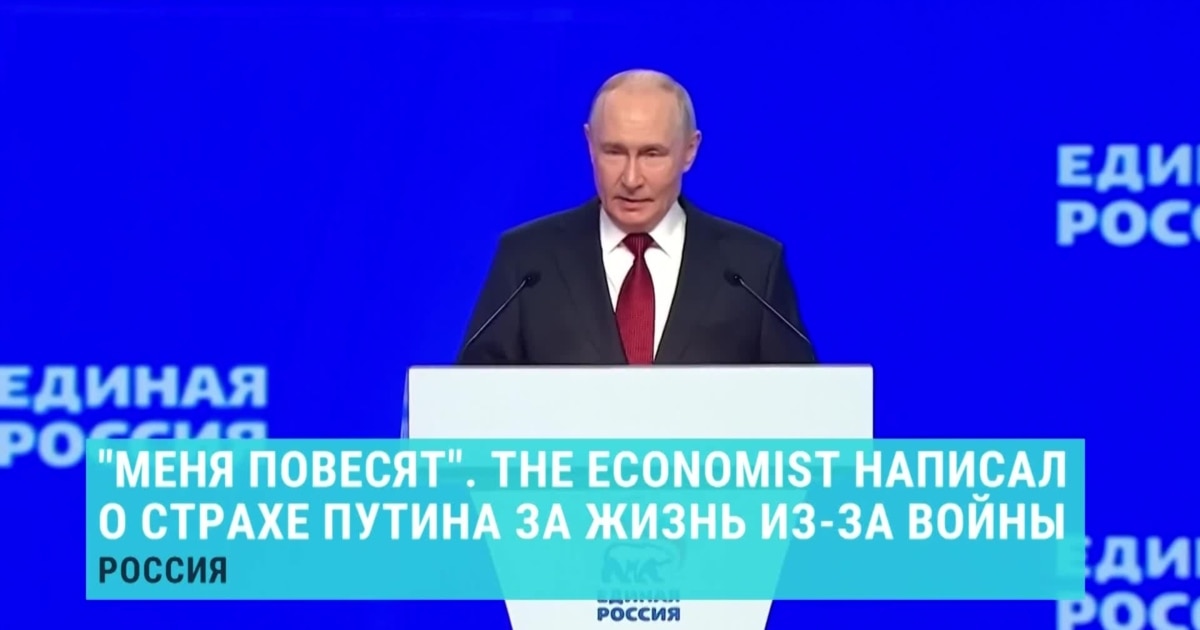
The Economist reports Putin told aides "Они меня повесят" — paper says he fears showing weakness and is unsure how to end the war
The Economist, cited by Настоящее Время (Current Time), reports that President Vladimir Putin told members of his inner circle "Они меня повесят" and that the publication characterizes the Kremlin’s approach as driven by a "преступная логика его режима: он отличается высокой терпимостью к насилию, но не прощает неудач". The article argues that Putin’s fear of appearing weak, and his belief that he would be personally endangered if he fails, complicate prospects for ending the war and shape the regime’s tolerance for violence and punishment of perceived failure.
By Clémence Desjardins
971 views
A recent piece in The Economist, highlighted by Настоящее Время (Current Time), reports that Russian President Vladimir Putin told members of his inner circle "Они меня повесят" — an admission the outlet says reflects a deep personal fear of retribution should he fail. The publication frames this confession as one element of what it describes as the Kremlin’s "преступная логика его режима: он отличается высокой терпимостью к насилию, но не прощает неудач".
According to The Economist’s reporting as relayed by Current Time, the remark underscores a dilemma at the heart of Russian decision-making: the leadership’s appetite for violence combined with a low tolerance for failure. That combination, the article suggests, helps explain why concessions or visible signs of weakness may be politically and personally unpalatable for the president and his closest advisers.
The Economist’s characterization—phrased in Russian in the quote—portrays a regime that institutionalizes harsh measures while simultaneously imposing severe consequences on those deemed to have failed. The piece links such dynamics to the conduct of the war and to domestic political control, arguing that the leadership’s calculation is not only strategic but also driven by fears for personal survival.
The central claim—that Putin is uncertain how to bring the war to an end but fears the consequences of appearing weak—carries implications for the trajectory of the conflict and for internal governance. If the head of state believes his personal safety depends on victory, The Economist suggests, compromises that would be framed as defeat become less likely, and the pressure on military and political elites to achieve results may intensify.
Beyond battlefield calculations, the report raises concerns about accountability and the treatment of perceived failure within an authoritarian system. The cited phrase about the regime’s criminal logic points to a governance model that tolerates or employs violence but exacts harsh punishment on those who do not deliver. Such dynamics can produce cycles of repression, scapegoating and purges that affect both military personnel and civilians accused of disloyalty or incompetence.
The publication of these claims invites broader questions about the intersection of personal vulnerability at the top of power structures and the human-rights consequences for populations caught in protracted conflict. Observers of authoritarian governance note that when leaders conflate political survival with military success, the cost in human suffering and restrictions on civic freedoms often rises, as options for diplomatic resolution narrow and the space for dissent shrinks.
Current Time’s summary of The Economist’s article does not provide further detail on circumstances in which the quoted remarks were made or on reactions from Russian officials. Nevertheless, the reporting contributes to an ongoing public record—through international media—of how personal fears and regime incentives can shape state behavior. For advocates and monitors of human rights and accountability, the piece reinforces the importance of documenting decision-making processes at the highest levels and of pressing for mechanisms that reduce impunity and protect civilians and political opponents.
As with any reporting that hinges on accounts from close sources, the claims should be understood as attributed reporting. The Economist’s framing—reproduced by Current Time—nonetheless highlights key themes relevant to human rights and democratic freedoms under threat: the personalization of risk at the top of power, a tolerance for violence coupled with punitive responses to failure, and the potential for those dynamics to prolong conflict and suppress alternatives to force.