Thailand cleans up its own corruption, Punishes foreigners
Thousands of foreigners who have invested in holiday homes in Thailand now risk losing everything they own because of a thoroughly corrupt system. Most of those affected bought their houses through established law and accounting firms.
By Jesper Enerstvedt
1,178 views
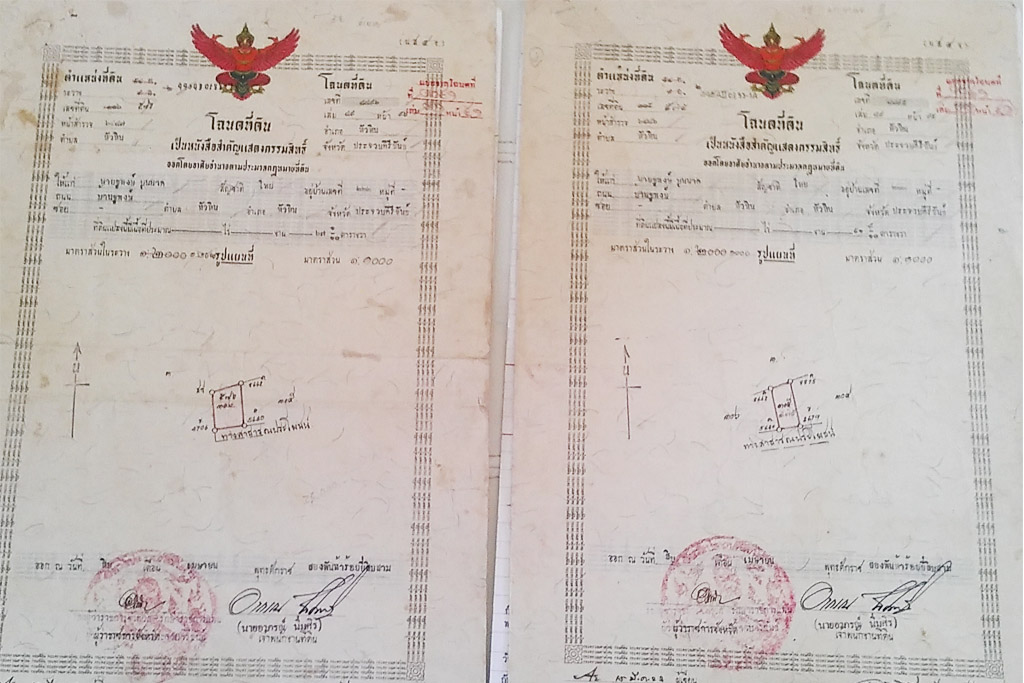
Photo: Saffron Prescott The image shows two original land deeds from the Thai Land Office. Foreigners in possession of such deeds through a limited company are now living dangerously.
Special police units (CIB), together with the Department of Business Development (DBD) and the land authorities (the Land Department), have begun cracking down on the system of minority shareholders in Thailand. As a result, retirees who have saved money and worked hard all their lives now risk losing everything.
In recent months, convoys of police cars have driven into residential areas where retirees from all over the world live. Many Germans, Russians, Britons, Ukrainians, Scandinavians and EU citizens live in these areas. Now they are all in the same boat. For people who have obeyed the law all their lives and never had any contact with the police, it must be frightening to have police officers at the door in a foreign country. The police are now carrying out continuous operations in all the well-known holiday towns in Thailand. Whether you live on Koh Samui, in Chiang Mai, Hua Hin, Phuket or Pattaya, you risk having the police at your door.
The cause is a well-established and corrupt system for selling houses and property to foreigners. The system has tailor-made illegal ownership structures, but to those who buy, smiling lawyers and accountants have said that this is how it has always been done in Thailand. That's just how it is. But now the politicians have decided to interpret the old law literally. It could affect tens of thousands of foreigners.
Thailand has a law that prohibits foreigners from owning land in their own name.
Most direct foreign ownership therefore takes place in freehold apartments, or so-called condominiums, where foreigners can lawfully own up to 49% of the total floor area. For detached houses and villas, foreigners often rent on 30-year long-term leases, giving them a kind of sense of ownership. Those who own in this way are not affected by what is now happening.
The police operations are aimed exclusively at foreigners who own houses through a Thai limited company in which the Thai holds 51 percent of the shares, but without voting rights. Only the foreigner holds the voting rights. In reality, the foreigner then owns both house and land. The foreigner is a "minority shareholder," yet is the one who holds 100 percent of the power. It is this system that the authorities are now cracking down on hard.
Even though the Thai business law, the "Foreign Business Act," and the property law, the "Land Code," say that foreigners cannot own land, they have done so anyway. Foreigners have been able to do this because an established corrupt system has encouraged them to. Both lawyers and accounting firms in the tourist towns have sold "package solutions" with ready-selected straw men in the form of poor Thai citizens who have been majority shareholders without voting rights. From 1 January 2026, the DBD requires documentation of the source of funds for all new companies. From 1 April 2026, this also applies to amendments to existing companies.
Everyone has been aware that using Thai straw men to circumvent the prohibition is in fact a criminal offence. Even so, the system has worked smoothly for more than fifty years. That the authorities are now cracking down on the system is a shock to local business and even to the local police. Most of those who work at the accounting firms that have offered package solutions have become friends with the foreigners they assist, and they may well have police officers in their own families. When local police have to assist tax authorities and special police from Bangkok, awkward situations often arise.
The investigators are forcing the accounting firms to hand over information about the Thai straw men. When the authorities question the straw men, it quickly emerges that they are poor people who barely know what a share is at all. They are often afraid of the police and readily admit that they have never put any money into the company. The truth comes out quickly. They were simply paid a small sum to sign. When this is proven and exposed, the company is declared an unlawful circumvention of the law and is forcibly dissolved. The land purchase is declared invalid. Both the accounting firm and the foreigner risk fines and prison sentences. Land Code § 111 provides for up to two years' imprisonment and a fine of 20 000 baht. Foreign Business Act § 36 provides for up to three years and a fine of 100,000–1,000,000 baht when a company has been used.
The overview of who owns apartments or condominiums is fairly clear. There is a national statistic from REIC (the Real Estate Information Center), which is the research unit of the state-owned Government Housing Bank. It is based on transfers registered with the land authorities (the Land Department). According to REIC, foreigners accounted for 11.7 percent of all condo transfers in Thailand in the first half of 2026 by number of units, and 21.7 percent by value. Chinese are the largest group, both by number and by value.
Russia has seen enormous growth around holiday islands such as Phuket and in regions such as Chonburi. Russians own many of the detached villas. Nationally, the latest figures show that Russians bought 13 percent and Chinese about 28 percent in the first half of 2026. But Russians owned about 40 percent of the foreign-owned apartments in Phuket in 2022. Now the figure is higher, perhaps as much as 44 percent. Taiwan and the US each account for about 3–5 percent of the market. The United Kingdom, France and Germany together account for around 10–15 percent of the total foreign market, often linked to retirees. According to REIC, 6,533 condo units were transferred to foreigners in Thailand in the first half of 2026. Chinese remain the largest group, with 1,813 units. Russia is now number two in terms of value, and the value of Russian transfers rose by 76 percent, especially in Phuket and Chonburi.
What will happen in the time ahead is hard to predict. If fear spreads and everyone terminates their companies and sells their houses, it will undoubtedly lead to a price decline, because supply will, for a period, exceed demand.