
Texas Student Alleges Conservative Club Faced Censorship as Muslim Groups Distributed Religious Materials at High School
A 16-year-old student at Wylie East High School in Wylie, Texas, a suburb northeast of Dallas, has publicly accused school administrators of systematic bias against his conservative student organization, alleging that officials delayed approvals, removed posters, and scrutinized his group's activities while permitting Muslim student groups to distribute religious materials and host events with little apparent resistance. Marco Hunter-Lopez, who founded and leads the school's Republican Student Club, says he has documented more than 55 instances of what he describes as unequal treatment, censorship, and harassment dating back to August 2024. His claims, first amplified in a viral video and then in an account published by Gateway Pundit, have since traveled well beyond Wylie, drawing in conservative commentators, members of Congress, and the school district itself, which has forcefully disputed the central charge.
The flashpoint was an incident in February 2026, when representatives of an outside organization called Why Islam—invited by the campus Muslim Student Association—set up a table during lunch in connection with World Hijab Day. Hunter-Lopez recorded his encounter with the booth and posted it online, claiming the group was distributing hijabs to female students "throughout the high school," along with copies of the Quran and pamphlets that, he said, advocated for Sharia law. He further alleged broader disparities: that the district offers halal meal options and a dedicated prayer room for Islamic observances, that a Quran is available in at least one middle school library while no Bible is offered, and that the school principal had personally worn a hijab and promoted the World Hijab Day event on social media in consecutive years. Conservative and Christian student groups, he argued, had never received comparable accommodations.
The published Gateway Pundit account, written by Jim Hoft, leaned heavily on Hunter-Lopez's own documentation and on supportive reactions from the political right, including a social media post by Andrew Kolvet that described the student's claims as "BREAKING" and said the school had been "EXPOSED." Independent reporting by local and national outlets, however, has since filled in significant context that the original account did not, including a detailed response from Wylie Independent School District and a narrower picture of what actually occurred at the February booth.
The district has acknowledged that the February incident violated its policies, characterizing it as a "procedural breakdown" rather than a deliberate endorsement of any faith. Officials said the Why Islam representatives—four women, by the district's account—had not received the required approval to distribute materials or interact with students outside the sponsoring club. Reviewing security footage, the district said fewer than 50 students visited the table over the lunch period; most appeared to take a piece of candy, roughly four received henna designs, and about a dozen tried on a scarf or hijab. A staff member was placed on leave pending review, and the district said it was adding new visitor-screening safeguards, expanding staff training, and reviewing procedures districtwide. In written responses, Wylie ISD stated that its approval and distribution rules "apply equally to all outside groups and student organizations, regardless of religion or viewpoint," and that other student clubs routinely host outside speakers under the same guidelines. "This situation is not about religion, politics, ideology, or any personal belief system," the district said. "It is about a procedural breakdown," adding that it "firmly rejects any suggestion that this was part of a coordinated effort to promote a religious or political agenda."
As Hunter-Lopez's broader allegations gained national attention, the district pushed back more directly on the claim of viewpoint discrimination. In a statement to Fox News Digital, a Wylie ISD spokesperson said the district "does not endorse or promote any religion" and is "legally required to remain neutral regarding religion while respecting the constitutional rights of all students." The spokesperson specifically disputed one of the student's signature claims, stating that the district "does not operate 'Islamic prayer rooms' or provide preferential treatment to one religious group over another," while noting that reasonable accommodations for students' religious practices may be made when appropriate under the law. Many of the student's specific allegations—the library claims, the characterization of the principal's conduct, and the tally of more than 55 incidents—rest chiefly on his own documentation and have not been independently corroborated in the available reporting.
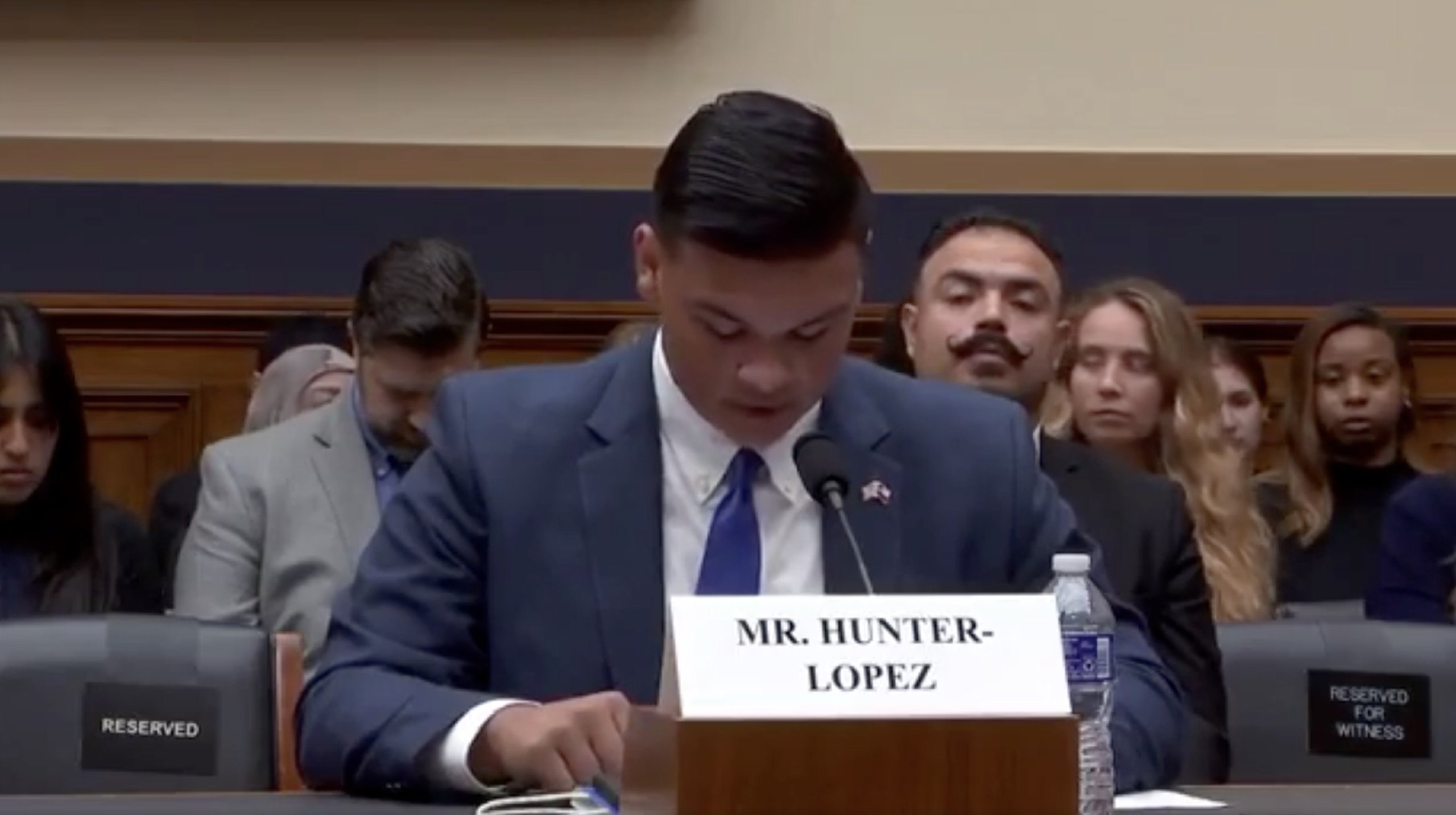
The controversy did not stay local. On May 13, Hunter-Lopez testified before the House Judiciary Subcommittee on the Constitution and Limited Government, telling lawmakers that "if Sharia can be introduced this easily in a small suburban town of Wylie, it can happen anywhere," and that his Republican club had faced hostile scrutiny since its founding. He also said that after his February video went viral, he received death threats, including messages saying people would be waiting at his home to shoot him and others urging him to kill himself. His appearance, which included a televised exchange with Representative Jamie Raskin of Maryland, drew praise from Republican figures including Representative Chip Roy, who tied the episode to claims of growing Islamic influence in Texas. Wylie ISD called the remarks of one congressman, Keith Self, "disappointing," and said he had never contacted district leadership or campus administration before raising the matter publicly.
The episode has also prompted a counter-mobilization on the ground. Conservative radio host Chris Krok announced plans to hand out Bibles outside Wylie East High School in response to the February Quran distribution, framing it as an assertion of equal access. Representatives of the Council on American-Islamic Relations, meanwhile, argued that the backlash reflected a broader climate of suspicion toward Muslims, with one CAIR official suggesting the outreach had been easy to misinterpret amid fears that "Muslims are trying to take over." District leaders, for their part, urged parents and students to bring concerns directly to administrators rather than relying on social media accounts of events.
At its core, the dispute raises questions about how public schools accommodate religious expression and whether administrators apply their rules consistently across student organizations with differing viewpoints. Federal law permits student-initiated religious clubs to meet on public-school campuses during non-instructional time, provided schools remain neutral and apply policies uniformly; schools may not promote religion or allow outside organizations to interact with students without authorization. Wylie ISD maintains that its policies meet that standard and were enforced—if imperfectly in February—without regard to faith or ideology. Hunter-Lopez maintains the opposite, contending that the pattern he has documented amounts to selective enforcement. Independently verifying the competing accounts would require records the district has not publicly released, including its log of club approvals, event permissions, and the rationale for the specific administrative actions the student describes. For now, the most consequential facts in dispute remain the student's allegations on one side and the district's categorical denials on the other, with the February booth—an unapproved visit the district concedes should not have happened—the one element on which both sides largely agree.