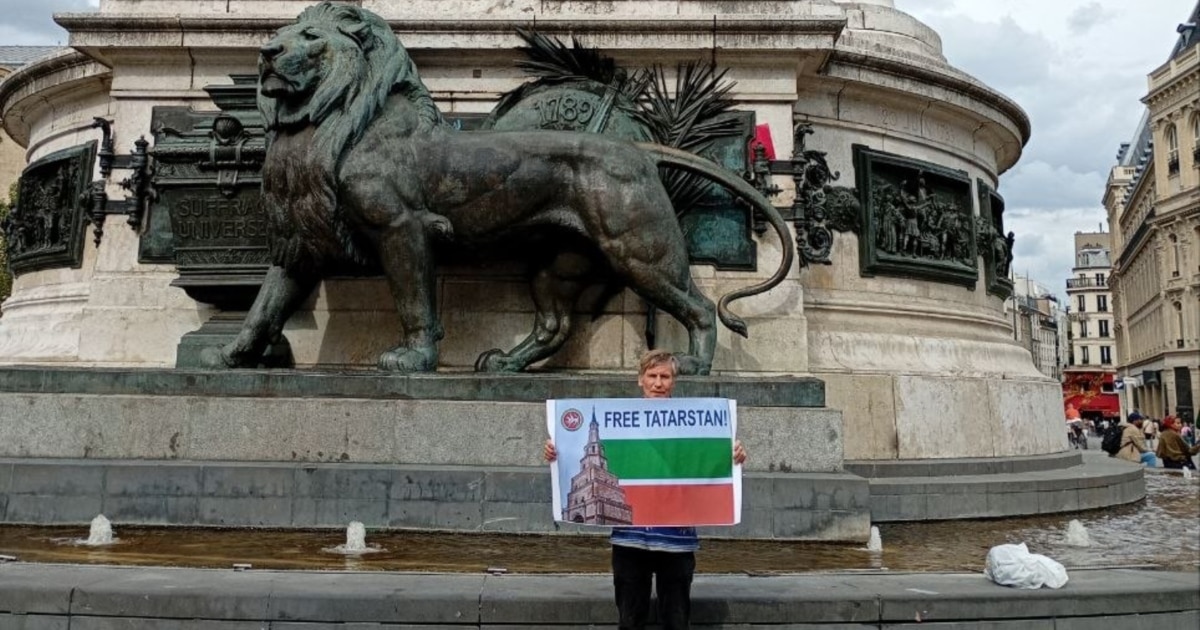
Tatar Public Center Leader Holds Paris Picket on Anniversary of Tatarstan Sovereignty Declaration, Accuses Former Leaders of Betrayal
Farit Zakiev, head of the Tatar Public Center, staged a picket at Place de la République in Paris to mark the 30 August anniversary of the Declaration on State Sovereignty of Tatarstan. Zakiev used the demonstration to accuse former regional authorities of enriching themselves while Tatars were left without statehood and to denounce what he called Tatarstan’s current role as a colony funding Moscow and sending men to the war in Ukraine.
By Christopher Manley
1,049 views
Farit Zakiev, chairman of the Tatar Public Center (Татар иҗтимагый үзәге, TIÜ), held a public picket at Place de la République in Paris on the anniversary of the adoption of the Declaration on State Sovereignty of Tatarstan, 30 August. The small demonstration was dedicated to remembering the 1990 events that led to the declaration and to voicing current grievances against Tatarstan’s political leadership, as reported by Azatlyk.
Speaking at the picket, Zakiev framed the anniversary as a moment of both celebration and reflection. "Бүген бөек бәйрәм. 36 ел элек татар халкы бәйсез дәүләт төзү юлына басты. Бу авыр юлда зур җиңүләр дә, артка чигенүләр дә булды," he said, invoking the movement that pushed for recognition of Tatarstan’s sovereignty three decades and more ago. Zakiev emphasised the historical importance of the campaign for self-determination and the role of grassroots activism in bringing the issue to public attention.
In his remarks Zakiev levelled sharp criticism at the region’s post-Soviet leadership, singling out former Tatarstan president Mintimer Shaimiev. He accused Shaimiev and his family of personal enrichment during his time in power and said that ordinary Tatars had been left without meaningful statehood. "Шәймиев һәм малайлары миллиардер булдылар, ә татар халкы дәүләтсез калды," Zakiev said, asserting that the former president and his close associates became wealthy while the Tatar people lost their sovereign institutions.
Zakiev went further to characterise contemporary Tatarstan as subordinate to central Russian power. He said the region was acting as a source of funding for Moscow and as a pool of manpower for the war in Ukraine. "Бүгенге көндә Татарстан Украинага каршы җинаятьчел сугыш өчен Мәскәүгә акча җибәрүче һәм татар ир-егетләрен корбан итүче колония. Бу хурлыклы хәл озакка сузылмас," he declared, framing Moscow’s actions in Ukraine as criminal and describing the sending of funds and men from Tatarstan as a form of colonial subjugation.
Beyond contemporary politics, Zakiev used the picket to recall key moments from 1990 that he said precipitated the declaration of sovereignty. He noted a hunger strike announced on 2 August 1990 in Chally (Naberezhnye Chelny) by Zinnur Ahliullin, whom he described as one of the leaders of the Tatar national movement demanding union-republic status for Tatarstan. "Бу ачлык игълан итү милли хәрәкәт ялкынын кабызган очкын булды," Zakiev said, crediting that action with igniting wider mobilisation.
According to Zakiev’s account, thousands of Tatars protested across cities such as Chally, Nizhnekamsk and Almetyevsk before converging on Kazan. He said that on 30 August demonstrators from those cities were joined by thousands in Kazan and that the Tatar Public Center under Marat Mulekov had led people into central squares. Zakiev asserted that more than ten thousand people gathered at Freedom Square (Ирек мәйданы) in front of the Supreme Council (Югары шура) and that the Declaration on the State Sovereignty of Tatarstan was adopted by the will of the people and their representatives.
He also listed activists and deputies who participated in the adoption process, naming figures such as Фәүзия Бәйрәмова (Fäuzia Bayramova), Фәндәс Сафиуллин (Fändas Safiullin), Рәиф Галиев (Raif Galiev), Марат Мөлеков (Marat Mulekov), Җәмил Сафиуллин (Jamil Safiullin), Азат Зыятдинов (Azat Ziyatdinov), Дамир Сираҗиев (Damir Sirajiev), Мөдәррис Шәйхиев (Mudarris Shaykhiev) and Рәшит Вәгыйзов (Rashit Wagizov) among those he credited with the declaration’s passage.
The Paris picket highlights continuing activism among members of the Tatar diaspora and points to unresolved political grievances over regional governance, historical memory and the distribution of power and wealth in Tatarstan. Zakiev’s comments accusing local elites of enrichment and decrying the region’s role in the war against Ukraine tie local nationalist claims to broader debates about federal control and human costs of the conflict. The report was published by Azatlyk, whose website is noted as blocked in Russia, a fact flagged at the end of the original item.
The demonstration in Paris was symbolic and relatively small in scale, but it underscores how anniversaries of late-Soviet-era declarations of sovereignty remain touchstones for Tatar political activists at home and in the diaspora. Zakiev’s charges against former and current authorities, and his appeal to historical episodes of mobilisation, illustrate how the legacy of 1990 continues to inform contemporary demands for autonomy, accountability and protection of cultural and political rights for Tatars.