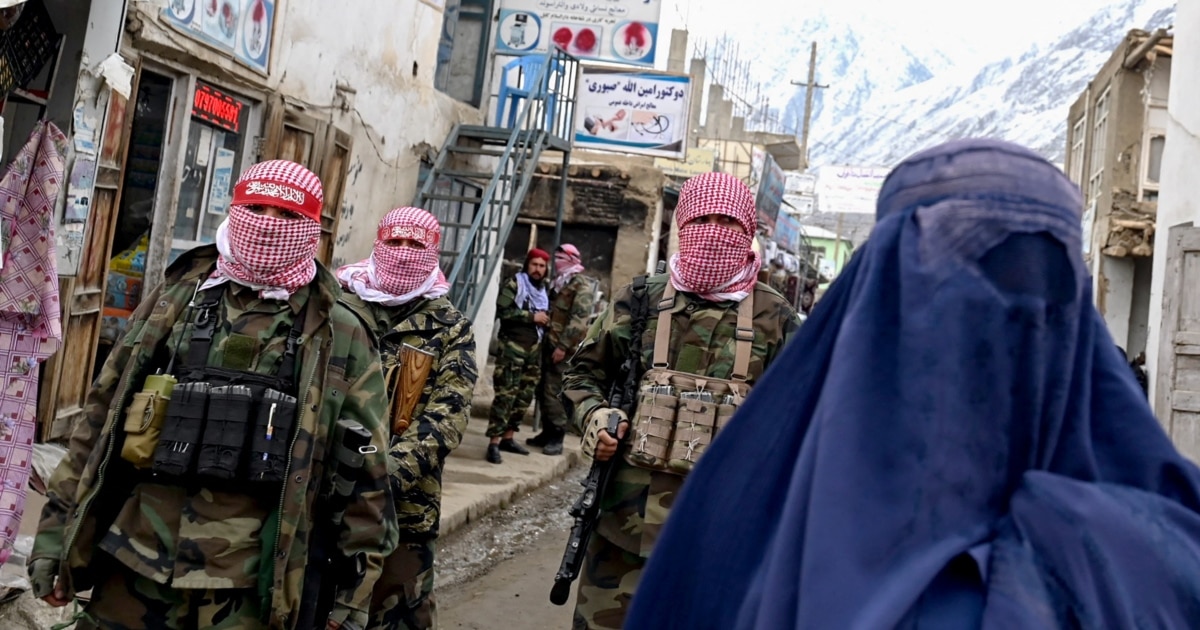
Taliban Morality Police Detain and Beat Women in Herat After New 'Proper Hijab' Directive
The Taliban in Herat has escalated enforcement of a June directive requiring a 'proper hijab,' detaining and publicly beating women accused of noncompliance and prompting rare street protests that security forces violently dispersed. The United Nations reported at least 30 arrests in the first week after the order, while demonstrators on June 9 suffered at least two deaths and more than 20 wounded.
By Farangis Najibullah
1,160 views
Women in Herat, Afghanistan’s third-largest city, have faced an intensifying campaign of coercion and violence after the Taliban issued a directive in early June demanding women appear in public with what the group calls a "proper hijab." According to local accounts gathered by RFE/RL’s Radio Azadi, members of the Taliban’s morality police have arrested women in the streets, publicly beaten some alleged offenders and stepped up inspections at markets, entrances to public buildings, and other public spaces.
The directive reportedly bars women from appearing in public without full coverage of their faces and bodies and specifically warns against showing the face or wearing makeup. "Women in Herat were already wearing the hijab," a woman in the city told Radio Azadi on condition of anonymity for fear of retribution. "But now the Taliban demands that women wear a facemask, too, and cover their faces." The United Nations reported that at least 30 women were arrested in Herat in the first week after the directive took effect.
On June 9, the new restrictions sparked rare street protests in Herat that were met with force. The UN said the demonstration was violently dispersed by Taliban forces; at least two people were killed and more than 20 were wounded. Those figures underscore the lethal risks residents now face for public acts of dissent or for defying dress rules enforced by the de facto authorities.
Women and witnesses described a climate of fear in Herat. "Even those who are properly covered are sometimes stopped and questioned," one resident told Radio Azadi. Another said that Taliban clerics have been deployed to local mosques to amplify the new requirements and that one internal order stated: "One order said female officers have been deployed to detain those who disobey. And it warned that if family members or others try to intervene, they will be arrested too." Observers say the group has followed through on these threats, detaining relatives who attempt to push back when arrests occur.
Several incidents recounted by eyewitnesses highlight the severity of the crackdown. In the Jadae Abresham area of the city, morality police detained a woman on the street, and when relatives intervened they were detained as well, an eyewitness told Radio Azadi. In Khwaja Kalla, officers reportedly attempted to detain two young women despite their wearing hijabs. "When one of the women argued, officers struck her on the head with the butt of a rifle, causing bleeding. She was taken to a nearby hospital, but the morality police followed her inside and ordered doctors not to treat her," an eyewitness said. "The officers then took her away while she was still bleeding."
Herat, a city of roughly 1 million people near Afghanistan’s border with Iran, has grown noticeably quieter as many women choose to stay home rather than risk confrontations with security forces. "These are incredibly hard days for the women and girls in Herat," another woman in the city told Radio Azadi. "The city has fallen silent. Young women are too afraid to leave their homes."
The enforcement push in Herat follows broader policies the Taliban have pursued since returning to power in 2021. In 2024 the group enacted a morality law requiring women to fully cover their faces and bodies in public. Implementation of these measures has been uneven across Afghanistan, often depending on local commanders and officials. Prior to the Taliban’s return, many Afghan women—particularly in urban areas—wore looser headscarves that covered hair but not the face; burqas and niqabs, which cover the face more fully, have been less common and are viewed by many Afghan women as alien to their cultural norms.
Human-rights advocates say the intensified policing of women’s dress and the use of violence and arbitrary detention represent part of a wider pattern of erasing women from public life in Afghanistan, curtailing their rights to movement, work and education. The actions in Herat are likely to further isolate women in the city and to deepen the already stark restrictions on female participation in Afghan society. International bodies and rights groups have documented similar episodes elsewhere in the country, and the United Nations’ casualty and arrest figures from Herat signal urgent concern about the human cost of enforcing the Taliban’s strict interpretation of personal status and public morality.
The reporting for this article draws on accounts collected by RFE/RL’s Radio Azadi and reporting by Farangis Najibullah and Firuza Azizi.