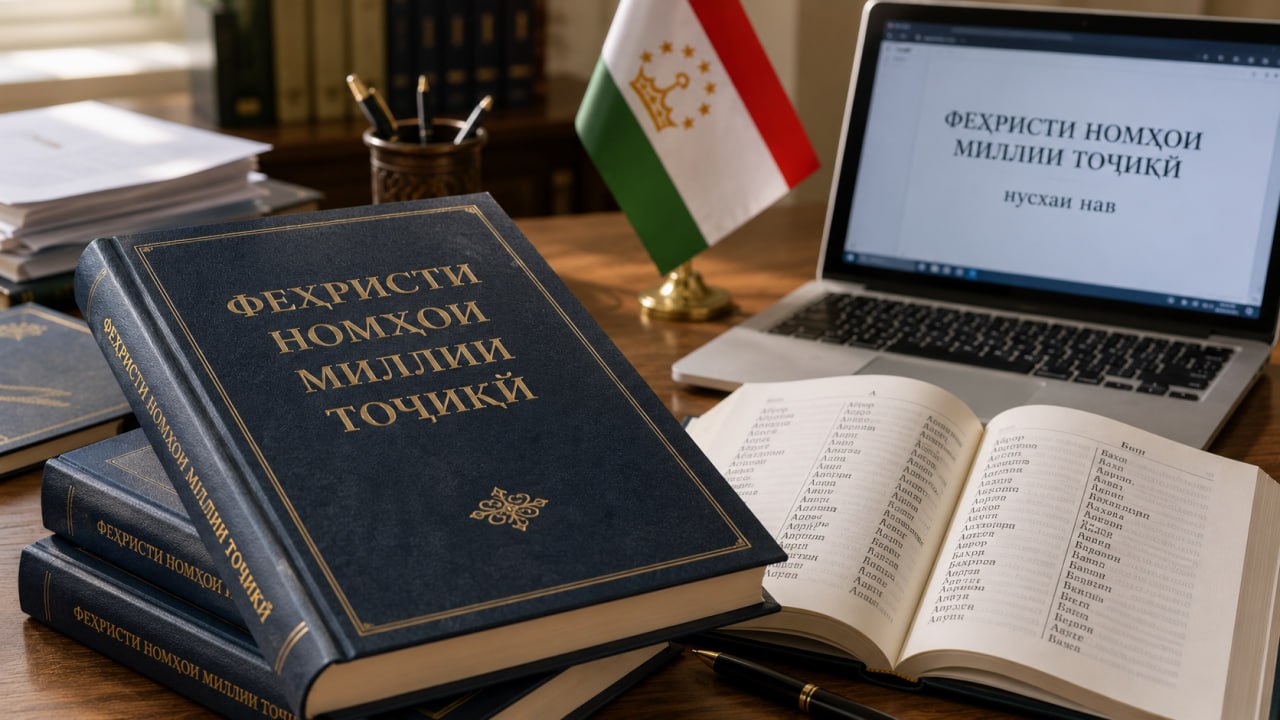
Tajikistan enacts revised national name list, removes nearly 1,700 entries and adds 965
Tajikistan has enacted an updated official List of National Tajik Names that removes 1,745 names and adds 965 more, bringing the approved roster to 3,461 entries. The Committee on Language and Terminology says the list, approved by a government decree on February 26, 2026, will be used for newborn registrations and aims to ensure names have roots in Tajik culture and language.
By Mehrofarin Najibi
1,023 views
Tajik authorities have approved a revised official List of National Tajik Names that will determine which personal names may be registered for newborns across the country. The Committee on Language and Terminology said the new edition, formally approved by a government decree on February 26, 2026, has already entered into force and is being used by civil registry offices.
Dilovar Karimov, chief specialist of the committee’s Department of Naming and Terminology Regulation, told Asia-Plus that the update followed a review of the 2023 edition. The previous list contained 4,056 names; 1,745 entries were removed during the review, leaving 2,311. An additional 965 names were then added from the publication Dictionary of Beautiful Aryan Names, producing a final approved list of 3,461 names.
Under Tajik law, parents are required to choose names for their children from the official list. If a desired name is not included, parents must demonstrate that the name is not alien to Tajik culture before it can be approved. The committee noted that these restrictions do not apply to representatives of other nationalities or to foreign citizens whose children are born in Tajikistan.
Karimov said names were excluded for several reasons, including a lack of historical roots and an insufficient connection to Tajik culture. He also noted that current legislation bars the use of names derived from objects or household items. Some names were removed following public appeals or because they were judged inconsistent with accepted linguistic norms.
Several specific examples were cited by the committee. Female forms of traditionally male names, including Amira and Aliya (the female forms of Amir and Ali), were not included in the approved list. The widely used name Jasmine was excluded in favor of its Tajik equivalents, Yosuman and Yosamin. At the same time, the committee said all newly added names are of Tajik origin and carry positive meanings.
New additions listed by the committee include Anush (“eternal” or “immortal”), Argavon (the name of a flowering tree), Armin (“calming” or “uplifting”), Arnavoz (“good name”), Bahornoz (“slender and beautiful”), Behvash (“wonderful” or “beautiful”), Behdiz, Behina (“the best”), and traditional names such as Vis, Gavharon, Geti, Gulbakhsh, Gulbom, Gulbu, and Guldukht. Karimov said the new edition of the book has been sent for publication, though a release date has not been announced. An electronic version of the updated list has already been distributed to relevant government agencies, including offices under the Ministry of Justice.
The government first introduced restrictions on naming practices through amendments to the Law on State Registration of Civil Status Acts in 2016. That legislation prohibits names that are considered foreign to Tajik culture and bans the use of honorific titles and prefixes in names and surnames, including Mullo, Tura, Khoja, Amir, Sheikh, Sufi, and Khalifa. The law also bars naming children after birds, objects, or tools, citing examples such as Sang (“stone”), Tabar (“axe”), Tesha (“pickaxe”), Maina (“myna bird”), and Zogh (“crow”).
With the decree in effect, civil registry offices are now registering names according to the updated list. The change reinforces state control over personal naming conventions in Tajikistan and will directly affect which given names parents can register for their children unless they successfully argue that an excluded name is not foreign to Tajik cultural and linguistic traditions.