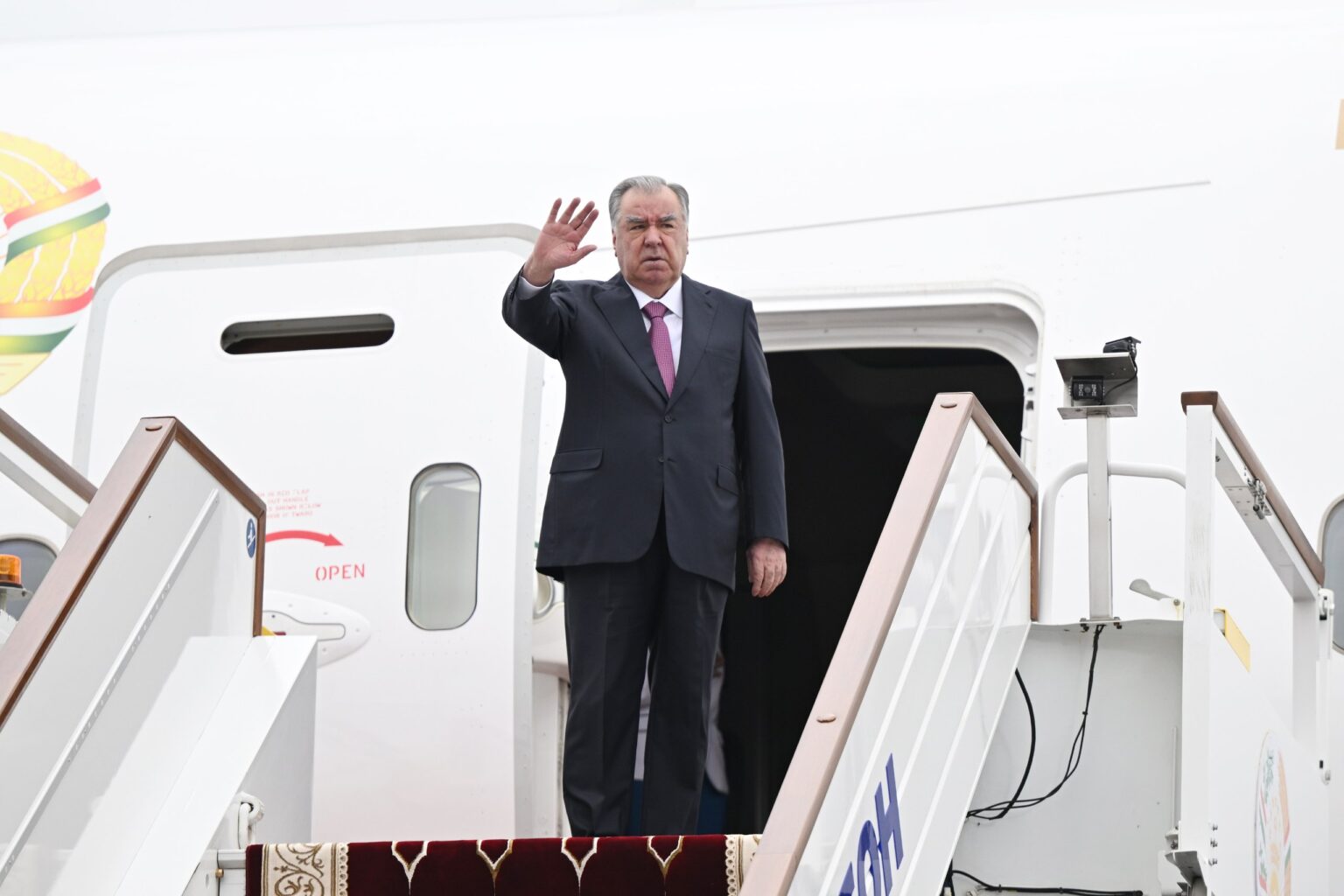
Tajik President Emomali Rahmon Travels to Moscow for CSTO Summit as Alliance Moves to Reinforce Tajik-Afghan Border
Tajik President Emomali Rahmon flew to Moscow on November 10 to attend a CSTO summit chaired by Russian President Vladimir Putin, where leaders will discuss measures to strengthen collective security and military cooperation. Central to the agenda is a multi-stage programme to equip Tajikistan’s border with Afghanistan, with the CSTO planning arms and equipment deliveries from member states before the end of 2026.
By Clémence Desjardins
1,041 views
Tajik President Emomali Rahmon departed Dushanbe on November 10 bound for Moscow to take part in a Collective Security Treaty Organization (CSTO) leaders’ summit scheduled for November 11, which will be chaired by Russian President Vladimir Putin. The Tajik president was seen off at Dushanbe International Airport by the heads of both chambers of parliament and other senior officials. His delegation includes Tajikistan’s foreign and defence ministers, the secretary of the Security Council, the presidential aide for foreign affairs and other senior officials.
Kremlin briefings ahead of the meeting said member-state leaders will focus on bolstering regional security, deepening military cooperation and measures to strengthen the alliance’s collective defence mechanisms. Several multilateral documents are expected to be adopted at the summit, including a final declaration and a CSTO Anti-Terrorism Strategy through 2030, the latter developed at Russia’s initiative.
A principal item on the agenda is the CSTO’s programme to strengthen Tajikistan’s border with Afghanistan. CSTO Secretary General Imangali Tasmagambetov announced on October 21 that the programme’s first phase has been completed, and that Tajikistan has identified suppliers and agreed on equipment quantities. The alliance plans to begin deliveries of military equipment and weapons before the end of 2026, with initial consignments expected from Russia, Belarus, Kazakhstan and Kyrgyzstan. The CSTO has not disclosed the precise types of weapons, volumes or costs.
The multi-stage programme runs through 2029. According to CSTO outlines, the second phase covering 2026–2027 will concentrate on equipping the most vulnerable segments of the Tajik-Afghan frontier, and the final phase from 2027–2029 will expand coverage to the entire border. CSTO officials have emphasised publicly that the initiative is not aimed at Afghanistan or its population, framing it instead as an effort to secure member-state borders against cross-border threats.
The planned deliveries and the broader security push come amid heightened concerns in Dushanbe over instability spilling over from Afghanistan and the prospect of cross-border militant activity. For Tajikistan, which shares a long and rugged frontier with Afghanistan, the CSTO assistance represents a significant augmentation of its defensive posture and a concrete example of alliance cooperation.
The summit also takes place against the backdrop of growing strains within the CSTO, most visibly in relations between Russia and Armenia. Armenia suspended active participation in CSTO activities in February 2024 while remaining a formal member, accusing the alliance of failing to provide adequate support during its conflict with Azerbaijan. Kremlin spokesman Dmitry Peskov acknowledged recently that Armenia was effectively not participating in CSTO activities and suggested Yerevan’s future role would depend on further talks. Armenian Prime Minister Nikol Pashinyan on November 5 said his country’s interest in the CSTO had “run its course.”
Those tensions have reopened questions about the CSTO’s cohesion and its ability to act collectively in crises. Established in 1992, the Russia-led CSTO includes Tajikistan, Russia, Belarus, Kazakhstan and Kyrgyzstan; Uzbekistan and Georgia are among former Soviet republics that withdrew. The alliance’s stated mission is to coordinate defence and security policies, respond to regional threats, and provide collective assistance to members facing external aggression. With concrete arms deliveries planned and a formal anti-terror strategy set for approval, the Moscow summit will test both the CSTO’s operational capacity and its political unity at a time of shifting regional security dynamics.