Tajik Authorities Intensify Controls on Hijabs and Beards in Campaign to Enforce 'National Culture'
Tajikistan has stepped up efforts to regulate citizens' clothing and appearance, targeting Islamic head scarves and men's facial hair as part of state campaigns to promote a prescribed 'national culture.' Residents and rights monitors say the measures have included fines, detentions, forced shavings, and routine monitoring by officials, raising concerns about restrictions on religious freedom and personal expression.
By Farangis Najibullah
1,071 views
Tajik authorities have increasingly moved to regulate clothing and appearance they consider incompatible with a narrowly defined national identity, a campaign that has affected women who wear head scarves and men with beards. Individuals interviewed by Radio Free Europe/Radio Liberty describe a mix of administrative penalties, detention, public shaming and ongoing surveillance intended to discourage dress associated with Islamic practice.
One such person, a 38-year-old market trader from Bokhtar identified only as Khushnud for security reasons, says he must send a weekly selfie to local police showing that he has shaved his beard. Khushnud said the requirement followed a three-day detention in which officers accused him of violating public order and fined him 180 somoni (about $18). "They ordered me to send them a picture every week showing that I have shaved my beard," he told RFE/RL. RFE/RL requested comment from police authorities about his case but received no response.
The tighter controls come after Dushanbe in 2024 amended the law on "traditions and celebrations" to ban "clothing alien to Tajik culture," a phrase widely understood to encompass Islamic attire such as the hijab. Restrictions had already been in place at schools, universities and government offices; the new law formalized and broadened the scope of official efforts to discourage clothing deemed foreign or nonconforming to state-promoted norms.
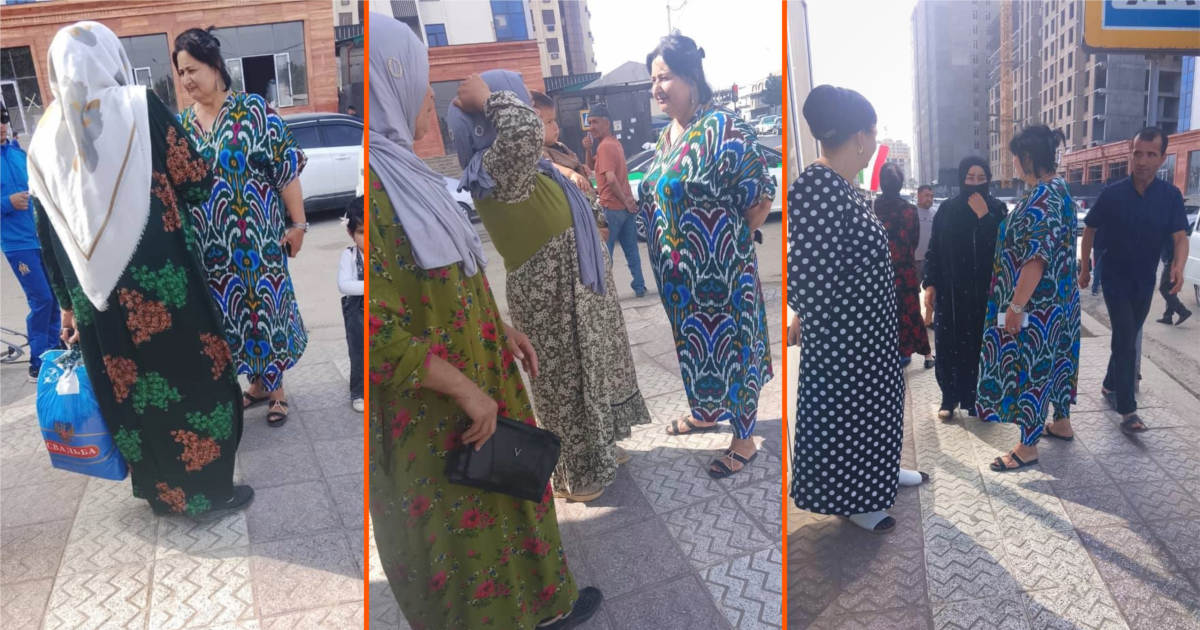
Women interviewed for this report described changes in their everyday behavior. Mohira, 35, from Khatlon Province, said a clinic worker once stopped her at the door and told her to adjust her head scarf "so that my jaw and neck were visible." She now opts for bright, patterned scarves rather than plain white or black, which she said are perceived as more religiously conservative or as resembling dress in other Muslim countries. "I still wear my head scarf, but I choose bright colors, floral patterns, or scarves with sequins," she said, adding that she picks clothing carefully when visiting government offices, medical facilities or her children's school.
Local government bodies have publicly promoted campaigns to encourage so-called traditional dress. In May, the Women's Affairs Committee in the Rudaki district posted photos from a campaign titled Village-By-Village showing officials talking to women wearing head scarves and long, loose clothes. The post was deleted after drawing criticism and an outcry on social media. Observers and international monitors have interpreted such initiatives as part of broader pressure to conform to state-sanctioned norms of appearance.
International rights monitors have raised alarms about the broader implications of these policies. A May report by the U.S. Commission on International Religious Freedom (USCIRF) said the Tajik government has continued efforts to "control all aspects of Tajik religious life," citing restrictions on religious associations, clothing, education and public worship. The commission said authorities were enforcing the 2024 ban through campaigns discouraging clothing deemed "foreign to national culture," and that officials had visited schools in February to discuss what they described as the "imitation of foreign culture."
While there is no explicit law banning beards, men have reported being stopped by police, forcibly shaved, and released without formal charges. Two men told RFE/RL that officers shaved off their facial hair before letting them go; in other instances officials applied administrative penalties such as fines or invoked vague offenses like disturbing public order or smoking in prohibited areas. Amin, 37 and also from Khatlon, said police "shaved [his beard] dry" and issued a verbal warning in front of his 6-year-old son. "I'm not even religious. I grew a bushy beard after I started losing my hair," he said.
Additional reporting indicated that officials in some districts systematically document citizens' appearance. A passport office official in Khatlon, speaking on condition of anonymity, told RFE/RL that applicants with beards are routinely told to shave before receiving documents and that cases are recorded and reported to higher authorities. The official said the information is included in monthly reports tracking men's facial hair and women's religious clothing.
The Tajik government frames these measures as efforts to preserve national traditions and prevent extremism, and officials have repeatedly denied that they are restricting citizens' religious freedoms. Nonetheless, rights groups and observers say the cumulative effect is to curtail personal expression and to place religious practice under close administrative control. For many Tajiks, the changes have prompted greater caution in public life, including how they dress for routine interactions with state institutions.
RFE/RL's Tajik Service, which has reported extensively on the issue and on the government's broader policies toward religious practice, continues to document individual cases and official campaigns that critics say amount to systematic interference in private and religious life. The measures raise questions about proportionality and the balance between state efforts to promote cultural identity and individuals' internationally recognized rights to freedom of religion and expression.