Systematic persecution of CSO activists; attacks on freedom of expression and assembly continue
Systematic persecution of CSO activists; attacks on freedom of expression and assembly continue
By IPHR
19,459 views
This report covers developments on freedoms of expression, association and peaceful assembly in Kazakhstan from January to March 2020, and was prepared for the CIVICUS Monitor by the International Partnership for Human Rights (IPHR) and Kazakhstan International Bureau of Human Rights and Rule of Law (KIBHR) based on KIBHR’s monitoring of the situation in the country.
The first three months of 2020 saw ongoing and systematic persecution of civil society activists, journalists, bloggers and other citizens exercising their right to freely express themselves. The situation is currently deteriorating, particularly in connection with the state of emergency, which was declared in the country on 16th March 2020 due to the coronavirus (COVID-19) pandemic. Citizens who spoke up about the status of the pandemic in Kazakhstan and the authorities’ handling of it have on numerous occasions been criminally prosecuted. Political activists associated with two unregistered political parties – the new Democratic Party founded by Zhanbolat Mamay and the new movement “Street Party” - have faced persecution, administrative prosecution and significant harassment, both from the authorities and from unidentified persons. Their constituent party congress scheduled to take place in Almaty on 22nd February 2020 was also prevented from taking place by the authorities and unidentified non-state actors.
According to monitoring by human rights group Kaharman in February 2020 there were 625 cases of persecution of civil society activists in Kazakhstan. Of these, 71 activists were arrested on administrative charges and ten activists were fined for exercising their right to freely assemble, associate and express themselves.
From January to March 2020, Kazakhstan was confronted by several crises and tragic events, which had a direct impact on fundamental freedoms in the country. In February 2020, violent ethnic clashes occurred south of Almaty, leaving 11 dead and causing thousands to flee their homes. In late February 2020, well-known civil society activist Dulat Agadil died while in police detention, sparking outrage in the activist community and resulting in a series of peaceful protests across the country. However, following the introduction of the state of emergency the country has been locked down, with extreme limitations on freedom of movement.
In another concerning development, the lower house of Kazakhstan’s Parliament approved a new controversial draft law on assemblies in mid-March 2020, despite drawing criticism from human rights groups and the international community.
These major developments of concern are described in more detail below, followed by an update on freedom of expression, peaceful assembly and association during the period covered.
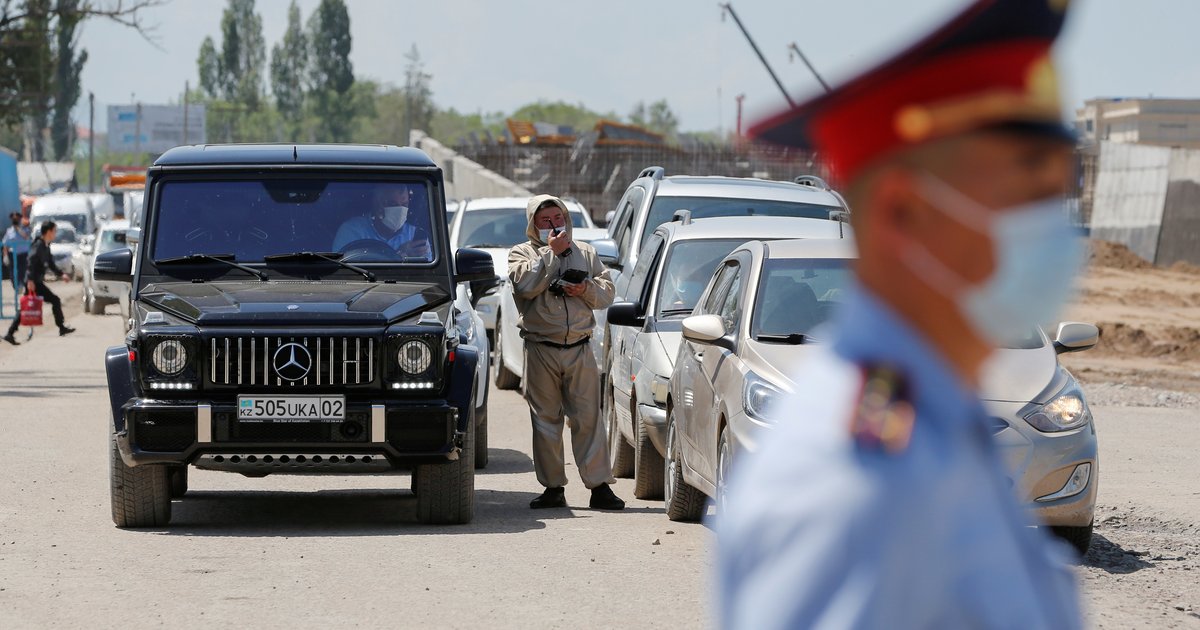
On 16th March 2020, Kazakhstan declared a state of emergency until 1st May 2020 in response to the coronavirus pandemic. During the state of emergency, the movement and activities of citizens, organisations and businesses have been restricted. Most cities, including Almaty and Nur-Sultan, have been sealed off in quarantine, with entry and exit prohibited. Movement within cities has also been severely restricted. All protest actions and demonstrations have been banned. Bloggers and journalists who have reported on the situation concerning the pandemic have faced serious consequences. These cases are discussed in detail below.
A new draft law on holding peaceful assemblies has been a cause for concern, despite public assurances from the authorities, including President Kassym-Zhomart Tokayev, that the law will improve the regulation of peaceful assemblies. However, KIBHR’s analysis of the draft law shows that it merely makes cosmetic changes and that some of its provisions will result in more serious restrictions than before. Minister of Information and Social Development Dauren Abayev presented the draft law to the public on 12th March 2020. On 26th March 2020, the Mazhilis (the lower house of the bicameral parliament) approved the draft law and on 30th April 2020 it was approved by the upper house (the Senate). The law now awaits approval from the president. Director of KIBHR, Yevgeniy Zhovtis, left the draft law Working Group on 1st April 2020. On 22nd April 2020, 24 members of the Civic Solidarity Platform, including KIBHR, the Norwegian Helsinki Committee and IPHR published an open letter to President Kassym-Zhomart Tokayev, expressing concern that the draft law is not compliant with international human rights standards because it:
Introduces unjustified restrictions on the timing and place of assemblies;
Retains the requirement for people to obtain government approval prior to conducting peaceful meetings, marches and demonstrations;
Provides for extensive requirements for submitting notification and permit applications;
Allows for assemblies (except single pickets) to be held only in certain locations designated by the local authorities;
Stipulates that only Kazakhstani citizens will be permitted to organise and participate in assemblies;
Provides for an extensive list of reasons why the local authorities can reject applications to hold public assemblies;
Increases liability for the organisers and participants in public assemblies; and
Prohibits spontaneous assemblies.
Signatories to the letter urged the Kazakhstani authorities to take into account recommendations from relevant international bodies such as the Organisation for Security and Co-operation in Europe (OSCE) and Office for Democratic Institutions and Human Rights (ODIHR) Panel of Experts on Freedom of Assembly and Association or the Office of the High Commissioner of Human Rights, and to not rush it through approvals during the coronavirus pandemic.
On 7th-8th February 2020, in the Kordai border region located south-west of Almaty, a violent ethnic conflict erupted between groups of ethnic Kazakhs and Dungans, mainly targeting Dungans living in the villages of Masanchi, Aukatty, Sortobe and Bulan Batyr. Around 50,000 to 60,000 Dungans live in this district. Eleven people were killed, of whom nine were Dungans and two were Kazakhs. Two hundred people were injured, and more than 30 houses were set on fire. According to KIBHR monitoring, between 4,000 and 10,000 Dungans fled over the border to neighbouring Kyrgyzstan. Reports indicated that the burned houses and businesses belonged to Dungans, whereas some burned cars belonged to the alleged perpetrators, often ethnic Kazakhs, who had arrived from the regions of Zhambyl and Almaty. The Kazakhstan-Kyrgyzstan border became overcrowded with Dungan refugees and several border crossing points were temporarily closed following the incident. Following the tragic events, an inter-departmental group was created by the Kazakhstani authorities to investigate the incident. The group was led by the office of the Prosecutor General, which launched investigations in over 120 criminal cases, including the 11 killings. Initially, three Dungans were arrested, accused by investigators of “provoking a pogrom”. However, on 27th March 2020, Prosecutor General Yerlik Kenenbayev announced that an additional 25 alleged perpetrators had been detained, of whom seven were former prisoners. The investigation is ongoing at the time of writing. There is widespread disbelief in the human rights community and among journalists about the official explanation of the incident and the legal aftermath for the alleged perpetrators.
Civil society activist Dulat Agadil from the Akmola region was detained on 24th February 2020 after he had earlier attended a peaceful protest in Nur-Sultan. On 25th February 2020 police issued a statement stating that Agadil had died in detention. Social media videos showed that the night before his death Agadil was forcibly taken from his home by an unidentified man in civilian clothing.
Agadil was taken into custody because of an alleged violation of the terms of his house arrest. He had been placed under house arrest on charges of contempt of court, which were under investigation. According to the police, 43-year-old Agadil died of acute heart failure, although he was not known to have had any health problems. The police also stated that Agadil had been mildly to moderately intoxicated upon arrival at the detention centre, that he became ill during the night and vomited several times. Agadil continued to be sick in the early hours of the next morning but no medical assistance was given to him until an ambulance was called at around 7:30 am. The ambulance took almost half an hour to arrive and Agadil was pronounced dead at around 8:20 am. On 28th February 2020, the Deputy Prosecutor of Nur-Sultan, Eldos Kilymzhanov claimed that the lesions on Agadil’s body were indicative of a natural death and were marks that would appear after cardiac arrest.
Agadil’s death sparked outrage among journalists, activists and members of civil society. There was widespread mistrust of the official claim that his death was caused by ill health and intoxication. Some people reported that injuries and wounds were visible on a video showing Agadil’s body in the morgue, indicating that he could have been beaten before death. Prior to his death, Agadil had participated in numerous peaceful protests, among others, in support of mothers with many children and political prisoners. He was also connected to the new Street Party and was a known critic of the regime. The protests spurred by Agadil’s death in custody are described in detail in the section on Peaceful Assembly below.
Several activists and groups were subject to pressure, court-imposed obstacles and threats during the reporting period. Many of the cases affected unregistered organisations, parties and movements.
The Almaty-based eco-activist Saltanat Tashimova stated that during the night of 2nd to 3rd January 2020 unknown attackers threw stones at the windows of her apartment, smashing three of them. On the evening of 6th January 2020 someone threw a Molotov cocktail at her kitchen window. Fortunately, her apartment did not catch fire. Tashimova says that she fears for her life. She filed a complaint with Bostandyk police department in Almaty. Tashimova is active in the Kok-Zhailau movement which aims to protect a wildlife site in the mountains near Almaty from real estate construction.
In a case previously covered on the Monitor, the Uralsk-based election observation organisation Movement for Independent Observers has repeatedly been denied registration. On 14th January 2020, the Supreme Court rejected the movement’s appeal against the repeated refusals of the Ministry of Justice to register the organisation.
On 17th February 2020, two uniformed police officers accompanied by unidentified civilians carried out a search on the office of the unregistered foundation “Nagyz Atajurt”. They photographed the whole office but did not ask any questions and filled out a form. One of the police officers stated that it was not a search but rather a “check” as the police had received a statement complaining that “illegal gatherings” were being held inside the office. The foundation is a spin-off of the Atajurt Foundation, whose leader Serikzhan Bilash faced a fine and ban from leading public associations last year and for incitement to national discord, as mentioned in a previous Monitor update. After Bilash left the organisation, his supporters created the new unregistered “Nagyz Atajurt”, as his associates had lost control of the original organisation after it was legally registered. “Nagyz Atajurt” works to raise awareness and support for the ethnic Kazakhs who have disappeared in the Chinese Xinjiang internment camps. Almost two weeks after the office search, on 4th March 2020, Serikzhan Bilash announced that the unregistered foundation “Nagyz Atajurt” had dissolved itself. It appeared that this was as a result of pressure.
As reported previously by the Monitor, the group behind the new and unregistered party “The Democratic Party of Kazakhstan” has faced problems when holding meetings across the country. The group announced that several of their members had faced police pressure ahead of the planned constituent party congress in Almaty on 22nd February 2020.
In Zhanaozen, five political activists from the Democratic Party were taken in for questioning on 12th March 2020 at the Mangystau Regional office of the Committee for National Security (KNB). They were informed that criminal proceedings against them were under way for violating Article 174 of the Criminal Code – incitement to social discord. The five activists had earlier recorded a video demanding the release of an imprisoned associate. The video is now being examined by the authorities.
One member, Abzal Dostiyarov, stated that on 15th January 2020 the police had come to his house when he was not at home and questioned his family members about his activities in the party.
Political activist Maksat Aisautov was sentenced to five days’ administrative imprisonment in Uralsk on 17th February 2020. He was imprisoned for not complying with a court decision, where in 2018 he had failed to pay two court-ordered fines of around 30,000 KZT (63 EUR or 69 USD). Aisautov was detained by law enforcement as he was leaving Uralsk for the party congress in Almaty scheduled to take place on 22nd February 2020. His supporters believed that the imprisonment was an attempt to prevent him from participating in the party congress.
On 17th February 2020, police also detained party delegates in Atyrau. The Administrative Court sentenced Kasym Kozhantaev to five days of administrative imprisonment for not abiding by a court decision on the repayment of a loan. However, Kozhantaev maintains that he does not have any outstanding loans, casting doubt on the nature of the charges. Political activists Talgat Ayan and Daria Ulzhagalieva were also detained by police and interrogated for several hours, which led to them missing their train to the congress in Almaty. Activist Altyngul Ishimova was also summoned by police for interrogation. Ishimova managed to catch the train but was removed from it by police.
On 17th February 2020 in Zhanaozen, political activist Muratbai Zhumagaliev’s car was set on fire by unknown persons. Zhumagaliev, who found a set of gloves and matches near the car, filed a police complaint. He is a supporter of the new Democratic Party and was supposed to take a train to Almaty to attend the party congress but missed the train due to the arson incident.