Surge in Autism Diagnoses Across Europe Raises Questions Over Healthcare Systems’ Capacity to Provide Support
As autism diagnoses surge across Europe, health systems have grown far better at identifying autistic people than at supporting them, leaving families facing long waits for therapy, housing and employment help.
By Klaudjo Jonuzaj
948 views
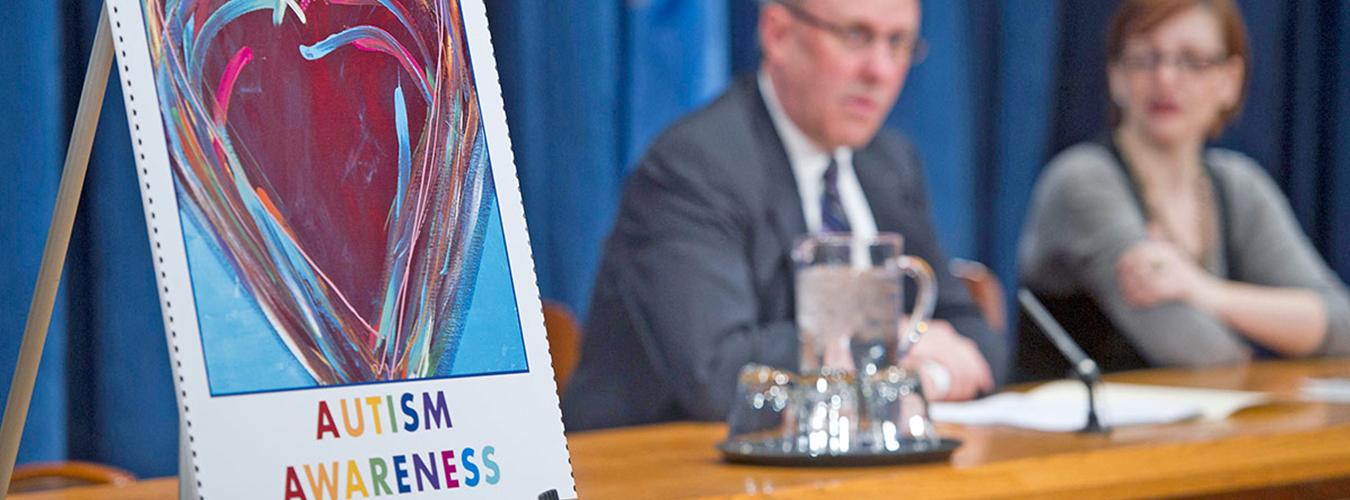
Photo: Press conference in 2012 on UN stamps issued to commemorate World Autism Day. UN Photo/Mark Garten
A sharp rise in autism diagnoses across Europe, from Ireland to Sweden and Wales, has exposed a widening gap between identifying autistic people and providing the services they need, with long waiting lists and limited access to therapy, housing and employment support.
In Ireland, about one in 20 schoolchildren is now reported to have an autism diagnosis, according to figures from the country’s Department of Education. Swedish registry data show a roughly 800% increase in registered autism prevalence between 2001 and 2020. In Wales, the number of new diagnoses increased by more than 150% between 2008 and 2016, according to data from a Cardiff University study published in the journal “Autism”.
The figures show that health systems are becoming better at identifying people who may previously have gone undiagnosed, while often remaining unable to provide adequate support once a diagnosis is made.
A 2025 ACCESS-EU survey of 2,322 formally diagnosed autistic people and family carers across the European Union and the United Kingdom found major gaps in access to services. Reported successful access ranged from 34.3% for medical services and 33.4% for therapy to just 6.8% for housing, 7.5% for employment and 4% for legal services.
According to the survey, when access failed, respondents most often cited services being unavailable, being deemed ineligible, services being unsuitable, waiting lists being too long or services being unaffordable. Almost 10% said they had been rejected because of their autism diagnosis.
The survey has limitations. It relied on self-reported experiences and was conducted during the COVID-19 pandemic. Still, its central finding points to a problem that goes beyond the numbers: a diagnosis does not guarantee access to support.
A separate study by the European Brain Council, published in “European Psychiatry”, reached a similar conclusion after examining autism care pathways in Italy, Spain and the United Kingdom. Researchers found substantial differences in how families moved from screening and diagnosis to intervention, with long waits and fragmented systems recurring across the countries studied.
Ireland offers one of the clearest current examples. Applications for statutory Assessments of Need rose from roughly 4,700 in 2020 to 10,690 in 2024, according to figures supplied to the Irish parliament, more than doubling in four years.
The pressure continued into 2025. Bernard Gloster, chief executive of the Health Service Executive (HSE), said demand was challenging and that the service was seeking additional providers to increase assessment capacity. The HSE later announced a panel arrangement with private providers to conduct autism diagnostic assessments.
During a May 2025 debate in the Dáil, the lower house of the Irish parliament, one parent said her son had waited five years for an Assessment of Need and had missed early intervention as a result. Another said her son had waited two years for therapy without receiving it. These are individual testimonies, not population-level evidence, but they illustrate what prolonged waiting times can mean for families.
In late May 2026, the HSE and three government ministers announced a new tiered autism assessment and intervention protocol aimed at standardising assessments and creating a more specialised pathway. It is not expected to take effect until mid-2027. The reform reflects a shift in the debate, from whether people are being identified to what happens after diagnosis.
The gap is also visible among adults. A 2026 population-based study of the United Kingdom and Sweden found that adult autism diagnoses have changed substantially since 2010, with sharper increases among younger adults and women. The researchers also found a decline in the proportion of newly diagnosed adults with previous diagnoses of intellectual disability and some other conditions, alongside increases in recorded ADHD, anxiety and depression.
The study is currently available as a medRxiv preprint and has not been peer-reviewed, but its findings provide another indication of how the profile of people receiving autism diagnoses is changing.
Taken together, the evidence points to healthcare systems in transition. More people are being identified, including adults who spent decades without an explanation for their difficulties, but the infrastructure that follows diagnosis has not expanded at the same pace.
The trend leaves Europe with a measurement problem. A rising diagnosis rate shows that more people are being identified, but it cannot show how many receive meaningful support afterwards. As waits for that support stretch from months to years, the number that matters most may no longer be the number of diagnoses, but the number of people still waiting.