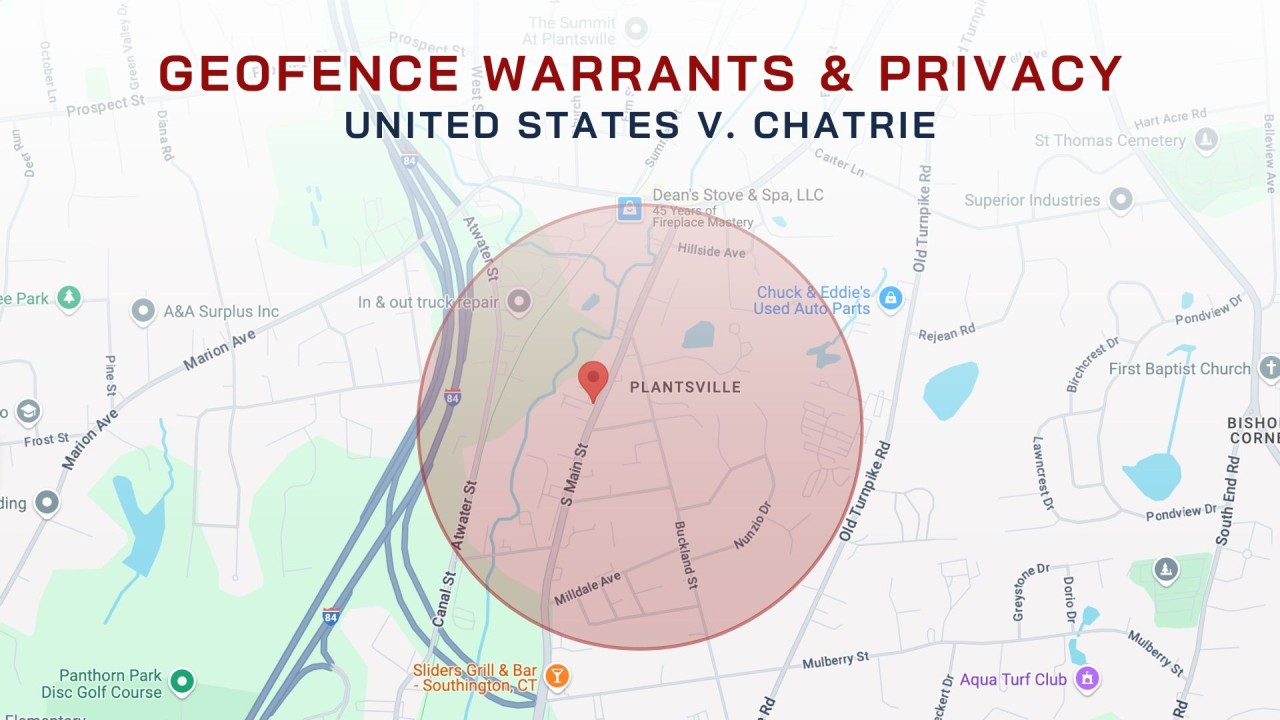
Supreme Court to Hear Chatrie on Geofence Warrants; Narrow Ruling on Warrant Validity Seen as Likely
The Supreme Court will hear argument in Chatrie v. United States on April 27, a case that raises foundational Fourth Amendment issues about law enforcement access to location data through so-called geofence warrants. Legal observers who filed briefs in the case say the Court may opt for a narrowly tailored decision addressing the constitutionality of the warrant itself rather than resolving the broader question of whether obtaining location records from providers like Google constitutes a Fourth Amendment search.
By Orin S. Kerr
871 views
The Supreme Court is scheduled to hear oral argument on April 27 in Chatrie v. United States, a case that poses significant Fourth Amendment questions about geofence warrants and the retrieval of location data from private companies. The case has drawn attention because it implicates not only the mechanics of geofence warrants but also larger doctrinal questions about when the government’s acquisition of third-party data constitutes a “search” under the Constitution. The author of the source commentary, who filed an amicus brief in the matter, argues the Court may resolve the case on narrow grounds focused on the warrant’s validity.
Chatrie involves two principal lines of inquiry. First, courts must consider whether obtaining records from a business such as Google—specifically Location History or similar datasets—amounts to a Fourth Amendment “search” of a person’s “persons, houses, papers, [or] effects,” a threshold that would ordinarily trigger a warrant requirement. Second, assuming that the acquisition of records is a search, the Court must determine whether the warrant used in this case complied with Fourth Amendment requirements. Each of these questions contains multiple doctrinal sub-issues, and together they open the case to potentially far-reaching legal analysis.
The commentary suggests the Court may avoid deciding the broader search question and instead issue a narrower ruling about the warrant itself. Several practical considerations support that possibility. The case comes late in the Court’s Term—oral argument falls in the final week of argument—which compresses the timeline for drafting and circulating opinions. With only roughly two months until the customary end of the Term, the Justices and the justice assigned to write the opinion may face pressure to identify a majority position quickly. A narrower warrant-focused ruling could be faster to produce and easier to coalesce around than a broader, more doctrinal opinion on what constitutes a search.
The author argues that the warrant question is also, in some respects, more tractable. Precedent addressing the constitutionality of warrants and the required particularity and scope in digital contexts is relatively limited and concentrated, and it is not an area where the Justices historically have longstanding, entrenched positions. By contrast, the definition of a Fourth Amendment “search” has generated extensive caselaw, multiple separate opinions, and what appears to be ideological division among the Justices—differences that could make it harder to secure five votes for a comprehensive ruling.
A narrow resolution would not be merely procedural; it also could have significant practical consequences. The commentary highlights that Google responded to earlier proceedings in the case by phasing out its practice of storing Location History records after a Fourth Circuit panel hearing. That change in provider behavior alters the landscape of what kinds of data are available to law enforcement and what the Court’s ruling would affect in practice. More broadly, a decision focused on warrant doctrine could have ripple effects across many forms of digital surveillance beyond geofence warrants, because trial courts in other circuits have sometimes read wide rulings narrowly with difficulty—most notably, the Fifth Circuit’s decision that called geofence warrants into question and sparked related rulings about other types of location and communications data.
The author cautions that even if the Court opts for a narrow holding, the implications will remain consequential for law enforcement and national security surveillance practices that rely on digital warrants. The piece emphasizes that while a definitive ruling on the search question would be important for constitutional doctrine, a decision on the warrant question could have more immediate and broad-reaching effects on how courts and law enforcement approach digital evidence. Finally, the author previews further commentary to come, noting plans to discuss potential remedies and to consider why the Supreme Court has not addressed a major Fourth Amendment-and-technology case in eight years, topics the author views as related to the Court’s approach in Chatrie.