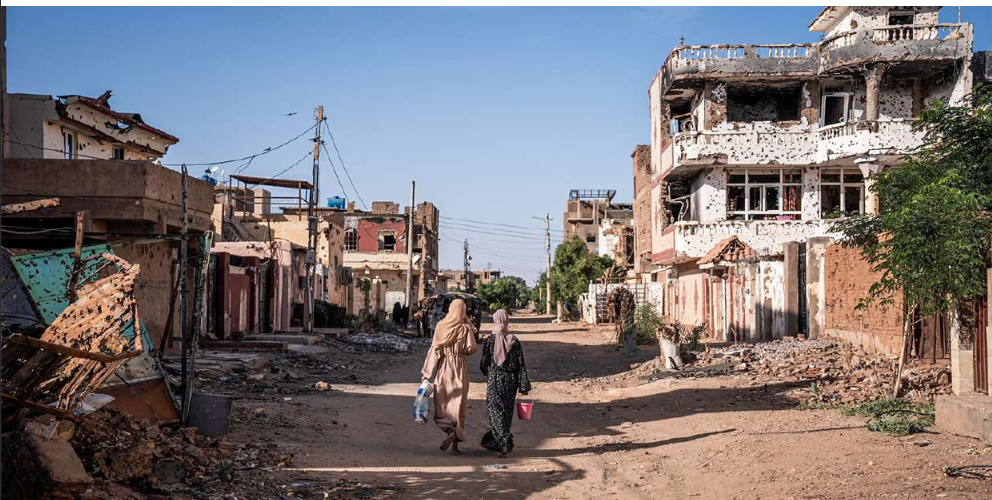
SUDAN: Who Is Funding the War as Civilians Pay the Price?
As Sudan's war passes 150,000 reported dead and nearly 9 million displaced, this piece asks who is funding the fighting, weighing evidence researchers say ties the UAE to the RSF, which it denies, against a civilian toll driven by drone warfare and sexual violence used as a weapon.
By Albina Kastrati
805 views
Photo: Amaury Falt-Brown/AFP via Getty Images
More than 150,000 people have reportedly been killed in Sudan since the civil war erupted between the Sudanese Armed Forces (SAF) and the Rapid Support Forces (RSF) in April 2023, according to the UN’s report, with nearly 9 million displaced, according to UNHCR, and 33.7 million in need of humanitarian assistance, according to OCHA.
In just the first 14 months of the war, more than 61,000 people died in Khartoum State alone, states a 2024 study by researchers at the London School of Hygiene & Tropical Medicine, including more than 26,000 from violence.
Neither the Sudanese Armed Forces (SAF) nor the Rapid Support Forces (RSF) are the democratically elected leaders of Sudan. The SAF is the country’s national armed forces, while the RSF is a paramilitary force.
While humanitarian organisations struggle to finance and deliver assistance, the conflict itself continues to receive external military support.
Both sides have received support from foreign actors, with countries including Egypt, Iran, Turkey and Saudi Arabia supporting the SAF, while the RSF has received alleged support from the UAE and other networks.
Nathaniel Raymond, executive director of the Humanitarian Research Lab at Yale School of Public Health, has been closely monitoring Sudan’s conflict since 2023. In an interview with The Liberty Bulletin, he said “the biggest thing people need to understand about the human cost right now is in 2026, the overall majority of civilian casualties are coming from drone warfare,” adding that earlier in the year, “both sides were hitting civilians with drones, more so RSF than SAF.”
Raymond said the lab has “three large categories of evidence that directly link” the UAE to the RSF. He cited phone data showing RSF-controlled headquarters locations moving through Ethiopia to Abu Dhabi, satellite imagery showing weapons he said were unique to the UAE arsenal in RSF hands, and monitoring of supply routes that he said were consistent with UAE shipments.
“We had phone data from headquarters locations controlled by the RSF moving through Ethiopia to Abu Dhabi in a period of time in which they could not get there on a commercial plane, and so there was no air traffic control data showing flights during that time, which suggests they flew in a four-hour period from Addis Ababa after exiting Darfur to Abu Dhabi on a plane with its transponder off, likely a military plane,” Raymond said.
The UN Independent International Fact-Finding Mission for Sudan said transnational entities operating across several countries recruited, trained and deployed foreign personnel to support the paramilitary Rapid Support Forces (RSF). The report also said there were “reasonable grounds to believe” that the Sudanese Armed Forces (SAF) used foreign-supplied drones in operations that harmed civilians and civilian infrastructure.
The Liberty Bulletin contacted the UAE Ministry of Foreign Affairs for comment, and UAE official said the country “is not a party to this conflict and is not in any way involved in the hostilities,” adding that the UAE “has not provided and is not providing military or financial support to any warring party in Sudan.
Beyond the humanitarian crisis, sexual violence has emerged as another devastating feature of Sudan’s war, with women and girls disproportionately affected. Reports have documented rape, gang rape, sexual slavery and other forms of sexual violence, with the UN describing its use as a weapon of war. Between April 2023 and mid-April 2026, OHCHR documented 546 incidents of conflict-related sexual violence affecting at least 838 victims (539 women, 284 girls, eight men and seven boys) across 16 of Sudan’s 18 states, while warning that the figures represent only a fraction of the true scale.
Meanwhile, Amnesty International, based on 247 interviews, including 39 children, documented RSF crimes including rape, sexual slavery, other sexual violence and enslavement around El Fasher.
Nathaniel Raymond said the situation in Sudan goes far beyond human trafficking, pointing to the use of sexual slavery and mass rape in Darfur.
“Last year we had a significant incident that I was directly involved in of women and girls being taken from the Zamzam IDP camp by Rapid Support Forces for sexual slavery and enforced marriage, and the Zamzam incident was beyond human trafficking. It was sexual slavery and large-scale mass rape. Women and girls were raped, and in some cases, raped and killed in front of their male relatives, and then their male relatives were then executed after they watched their loved ones be raped and murdered, and so we're far beyond human trafficking, in terms of what has happened, particularly in Darfur,” Raymond said.