SOUTH KOREA: Vietnamese Workers’ Abuse Case Brings Attention to Overlooked Migrant Workers’ Rights
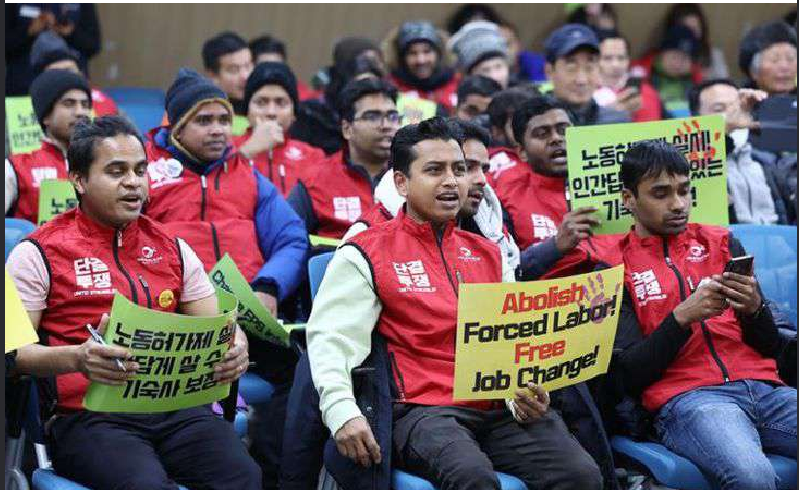
The alleged abuse of two Vietnamese fishing-boat workers has spotlighted how South Korea's Employment Permit System binds migrant workers to one employer, leaving them exposed to mistreatment and afraid to speak up as harassment reports rise.
By Albina Kastrati
923 views
Photo: Yonhap News Agency
On September 19, two Vietnamese workers employed on a fishing boat in Goheung, South Jeolla Province, were confronted by their employer while resting at their accommodation. Video released by the Gwangju-Jeonnam Migrant Workers’ Human Rights Network appears to show the employer shouting at the workers and spraying them with a powder fire extinguisher. It has been alleged that the workers also experienced assault, unpaid wages and extensive labour hours.
The case quickly drew intervention from The Ministry of Justice, which sent an Immigration Human Rights Investigation Team to interview the workers and inspect their working and living conditions, employment relationship and immigration status. It said that if human-rights violations were confirmed and the workers needed greater stability in their immigration status, it would actively support procedures to change their workplace. The Ministry of Employment and Labor also launched an inspection, while police investigated the alleged assault.
The two workers entered South Korea through the Employment Permit System on E-9 visas. Under the system, foreign workers are assigned to specific workplaces and cannot freely move between industries. The Ministry of Employment and Labor says E-9 workers can normally change workplaces up to three times during their initial three-year period and twice during the additional one year and 10 months, subject to legally recognised circumstances.
The Liberty Bulletin contacted the Ministry of Employment and Labor in South Korea for comment on the difficulties migrant workers face when reporting workplace abuse and seeking to change employers. No response had been received by the time of publication.
Under these circumstances and system, it leaves the immigrant workers in a very vulnerable situation.
The practical difficulty of changing employers has been a longstanding issue. A 2019 OECD review found that E-9 workers faced particularly strict employment restrictions and identified job mobility as a major concern among foreign workers. The report also discussed the tension between restrictions on worker mobility and migrant workers’ bargaining power.
South Korean law also provides a route for workers to change workplaces in cases involving employer violations. Under Article 25 of the Act on the Employment of Foreign Workers, workplace changes can be permitted in circumstances including violations of working conditions or unfair treatment that make it difficult for a worker to continue employment.
More than 1.1 million foreign residents were employed in South Korea as of May 2025, including about 321,000 workers on E-9 non-professional employment visas, according to data reported by Migrant Times from the Korea Employment Information Service.
The broader problem of workplace harassment also appeared in recent labour data, data which submitted by South Korea’s Ministry of Employment and Labor to the National Assembly, reports of workplace harassment by migrant workers rose from 95 in 2021 to 366 in 2025. A further 238 reports were filed in the first half of 2026, already exceeding the 225 recorded in all of 2024. Of 17 workplace-harassment cases that resulted in judicial action following labour-authority oversight since 2021, five involved migrant workers as victims.
Although these figures refer more to reports rather than confirmed cases of harassment, they still show a substantial increase in complaints involving migrant workers.
Cases documented by journalists and filmmakers have also captured migrant workers describing fear and difficulties in speaking up about abuse.
Senglab, a Cambodian migrant worker featured by Al Jazeera’s 101 East in a 2025 documentary about migrant workers in South Korea, described feeling that she had no right to speak after alleging abuse and excessive working hours at a poultry farm.
“As labourers, we are treated like slaves,” Senglab said in the documentary.
Beyond the alleged assault itself, The Goheung case raises concerns how effectively they can use the protections available to leave that workplace and remain legally employed in South Korea, without being intimidated by their employers.