Shortage of Shelters in Kyiv Deepens Civilian Hardship as Russian Attacks Intensify
Residents of Kyiv are increasingly left exposed to missile and air strikes because the city’s shelter capacity falls far short of need. Local mothers and district officials describe overflowing basements, metro platforms turned into sleeping areas, and a political standoff over who is responsible for building more safe spaces.
By Vanessa Bergmann
1,026 views
As Russian forces have intensified air and missile strikes on Ukrainian cities, Kyiv residents report a growing crisis: there are not enough shelters to protect the civilian population when alarms sound. Families who fled fighting elsewhere in the country say the level of danger that drove them to the capital is now matched by an absence of safe refuge in the city itself, forcing some to sleep in metro stations or crowd into a limited number of functional shelters.
One woman, identified only as Ana, said she fled Kharkiv with her nine-year-old son Miša to escape bombardment near the front line. She told Current Time that recent attacks on Kyiv have been comparable to those she fled and that basements — the traditional places for civilians to seek cover — are usually already full. "Podrumi su obično prepuni. Nije samo stvar u tome da nema gdje da se legne. Nema čak ni gdje da se sjedne ili stoji," she said, describing how people arrive to find there is no space for them anywhere in the neighborhood.
Ana lives in the Desnjanski district, a sprawling area of Soviet-era apartment blocks in the city’s northeast, which local officials and residents say is particularly short on shelters. Many residential buildings in the district lack basements at all, increasing pressure on a limited number of shelters located beneath hospitals, schools and kindergartens — facilities that together can accommodate less than half of the local population.
Another mother, Marina, said she typically hides in her apartment building’s hallway with her eighteen-month-old child during attacks. She told Current Time that while there is a shelter at a nearby school, it takes eight minutes to reach on foot. "Postoji sklonište u koje smo mogli da odemo, na primjer, u školi. Ali treba osam minuta da se do njega stigne pješke," she said, adding that walking there at night under fire with a small child is a daunting prospect.
The human cost of the strikes has been rising. Ukrainian authorities reported that 17 people were killed in a single night of attacks on the Kyiv region this week, and the United Nations has recorded 1,396 civilian deaths in the first six months of this year — a 37 percent increase over the same period last year. Officials also blamed failures in air-defense systems after Ukrainian defenses were unable to shoot down any of a number of ballistic missiles used in a recent attack on the region.
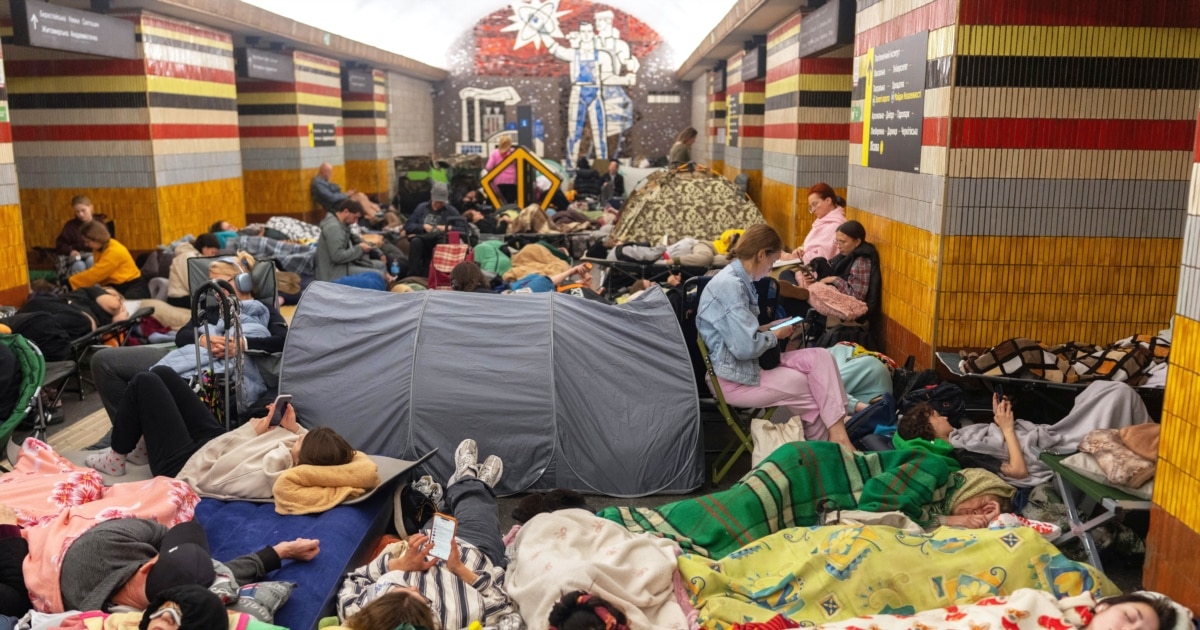
City data indicate that Kyiv, with a population now exceeding three million people, has only about 4,000 shelters, many of which are inaccessible or in poor condition. As a result, thousands of people are again spending nights in the capital’s metro stations, where crowded platforms and stairways recall the earliest weeks of the 2022 invasion. On one recent night, about 56,000 people arrived at metro stations with tents, mats and sleeping bags — a number that represents less than two percent of the city’s population.
Faced with the immediate need for more protective spaces, the head of the Desnjanski district administration, Maksim Bahmatov, said the fastest practical solution is modular above-ground shelters made from reinforced concrete. He described those units as easy to assemble from prefabricated sections — "Dolazi kao Lego komplet, u odvojenim dijelovima. Sklope ga, pričvrste vijcima. Gotovo je za 2-3 dana" — and said the district installed its first one in Kyiv in December with funding from local companies.
But responsibility for the shortage has become a point of contention between local and city authorities. Kyiv Mayor Vitalij Kličko has blamed district administrations for failing to provide adequate shelters, saying that more than $11 million was allocated for shelter construction for 2025 but much of the money has not been spent. "Ako okružne administracije ne ispunjavaju svoje obaveze, potrebno je pronaći [druge] ljude koji će ispuniti te obaveze. Nažalost, imamo administrativnu strukturu gdje [kijevski] gradonačelnik ne može čak ni da izda opomenu načelniku okruga," he said.
Bahmatov rejected those criticisms, arguing that the city administration already has the authority and budgetary resources needed and that the issue is not merely one of funds. "Nije stvar samo u raspodeli novca, već u tome da postoji plan, strategija," he said, adding that there is currently no clear determination of how many shelters are needed.
The lack of adequate protective infrastructure has immediate and tragic consequences. Ukrainian President Volodimir Zelenski reported that Russian strikes on the Kyiv region on August 8 killed three members of one family in Puhovka — a grandfather, a grandmother and their three-year-old grandson — and wounded four others who were hospitalized. "Dječak je imao samo tri godine. Još četvoro je hospitalizovano: roditelji djeteta i njegov petnaestogodišnji brat i komšija koji je došao da pomogne porodici i povređen je tokom drugog napada," he wrote on social media, adding that Russia had fired six ballistic missiles at civilian infrastructure in Kyiv. The city’s military administration also reported one death in the capital itself in attacks that same night.
With the frontlines largely static and Moscow increasingly relying on strikes against urban infrastructure, the shelter shortfall in Kyiv has emerged as a major protection gap. Residents and local officials warn that unless a coordinated plan — combining immediate measures like modular shelters with long-term investments in accessible, maintained shelters — is implemented rapidly, civilians will remain at heightened risk whenever alarms sound.