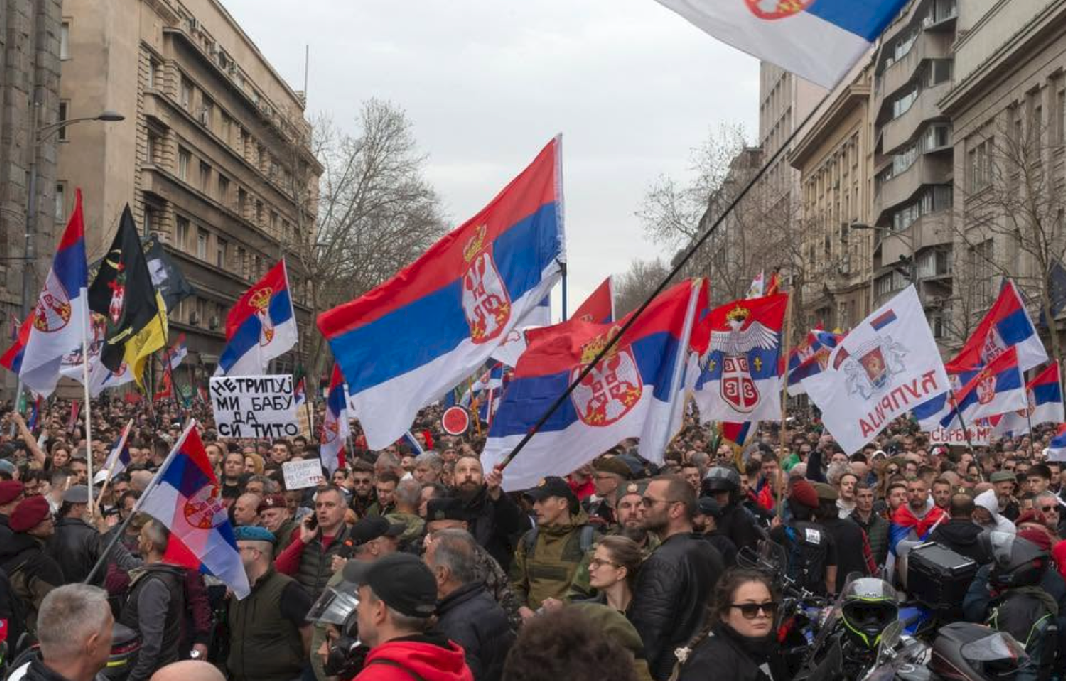
Serbian student campaign bids to overthrow ‘corrupt’ ruling party in election
Serbia faces a pivotal snap parliamentary election on 26 October 2026, with the student-led Student List – Students Win coalition challenging the ruling Serbian Progressive Party (SNS) after years of anti-corruption protests sparked by the Novi Sad railway station disaster. With polling showing a close contest, the election could test Aleksandar Vučić’s 14-year dominance and the political influence of a student movement demanding government accountability and institutional reform.
By Fiona Keating
1,116 views
Serbians are preparing for one of the biggest political shakeups in recent history, as the country gears up for a snap parliament election on 26 October 2026.
At a mass rally in Belgrade’s Slavija Square, Dr Ilija Srdanović, a cardiologist and academic gave a rousing speech. “We are witnesses to new pages of history textbooks being written. They are being written by students and the student movement, as a reaction to an alienated and corrupt government, an estranged one that has stolen our Republic.”
The Novi Sad University professor is the candidate for the Student List – Students Win coalition party, and he has no prior career in politics. In Serbia, this is a badge of honour. The United Nations Office on Drugs and Crime (UNODC) found that more than half of the population believed corrupt practices occur "often or very often", with political parties viewed with the most suspicion.
The Student List – Students Win movement is the main challenger to the ruling SNS (Serbian Progressive Party) and is changing the way politics is conducted in Serbia. What makes the organisation unusual is that despite being organised by university students, there are no students on the actual ballot. Instead, student bodies vet professional academics and public figures, who they perceive as incorrupt. This is a new model for Serbia, of who chooses politicians. The youth act as arbiters, rather than seeking office themselves.
Huzaifa Munawar, admin of the Students in Serbia Facebook group sees the student movement as an important development. “What makes it particularly interesting is that it developed outside the traditional political party structure and now has moved into the electoral process. I think it has become a significant political force, especially because of the scale and duration of the student mobilisation.
“Their biggest significance, in my view, is that students have demonstrated that they can mobilise people beyond universities and influence the wider political conversation.”
Vuk Vuksanovic, lecturer in Foreign Policy & Grand Strategy at King’s College London, believes that “for the first time since being in power, the SNP cannot be sure of the outcome of the elections. For the first time in 14 years, they have a competitor over whom they must be concerned about,” he told Liberty Bulletin.
Dr Srdanović was chosen out of a list of 250 candidates to lead the Student List. He stands on a ticket of anti-corruption, government accountability, and reform of the public health sector.
The university professor was born in Novi Sad, the city where the railway station canopy collapse happened, giving him a measure of kudos and an emotional anchor for his election campaign.
On 1 November, a concrete canopy suddenly crashed, killing 16 people, the youngest a six-year-old child, the oldest, 77. University students organised mass demonstrations which transformed into a national anti-corruption movement. As Vuksanovic puts it, “this was essentially an avalanche which has been piling up for a very long time.”
It served as a flashpoint for perceived government corruption. Many Serbs believed the Novi Sad railway disaster was the result of bad construction work during renovation and negligence. Demonstrators called for the criminal prosecution of the public officials, contractors, and those responsible for the building's safety oversight.
Student-led protests, centring around the University of Belgrade and the University of Novi Sad, organised traffic blockades, student lockouts of education institutions, and targeted demonstrations outside RTS, the state broadcaster.
Demonstrations have continued over the last two years, some of the largest ever seen in the country. The largest was a rally held at Slavija Square in Belgrade on 15 March 2025, attended by an estimated 275,000 people according to independent monitors.
No one has been convicted for the Novi Sad canopy collapse, as charges have been dropped and reinstated, preliminary hearings for the trial are currently frozen. The lack of progress has intensified public frustration which has led to the emergence of an opposition which is closing in on the ruling SNS party.
The ruling government’s response was strong, with reports of police brutality. The Balkan Investigative Reporting Network (BIRN) obtained testimonies from people at the protests. Stevan Zdravkovic stated that police “forced us to sit with our backs against the wall, then sprayed pepper spray in our faces. None of us were able to physically resist. The unit’s commander approached each one of us, kicking us in the stomach, stamping us in the head, and then spitting in our faces.”
In a bid to hold on to power, veteran political leader Aleksandar Vučić of the SNS Party, resigned from his post as president on 27 September. Having reached his two-term limit as president, he resigned to run for prime minister.
In his place, close ally Ana Brnabić took office as the acting President of Serbia on September 28, making her the first openly LGBT person to serve as head of state in Serbia and the wider Balkan region.
Ana Brnabić went into the history books in 2017 as Serbia's first female and first openly gay Prime Minister. Her appointment was at first seen as an indicator of progressiveness in Serbia. She has attended Belgrade’s annual Pride marches with her partner, Milica Đurđić.
And yet, her relationship with the LGBT+ community in Serbia is deeply divided. Nik Jovčić-Sas, producer of the Queer Balkan Atlas, says that LGBT rights have frozen in Serbia. “There is a spike in violent crimes. My friends in Belgrade are terrified. The police do not persecute homophobic attacks.
“She is no friend to the queer community in Serbia, and many people would say that she's used her position of privilege in the country to afford herself a life that ordinary queer people in Serbia could never live,” he told Liberty Bulletin.
“I think the vast majority of the queer community supports the student movement, I think because we see that this corrupt government is not going to bring any positive reform for the queer community.”
Ruling party fighting to maintain dominance
Serbian politics is at a turning point, with the SNS party fighting hard to maintain its 14-year hold on power.
Aleksandar Vučić is the dominant political figure in modern Serbia, hoping to return as Prime Minister. “He is no doubt a highly intelligent political operator,” says Vuksanovic, author of Serbia’s Balancing Act. “He has introduced a system where he pulls all the strings, and is also a successful foreign policy operator, playing multiple parties at the same time, whether it is the Europeans, the Americans, Russians, and the Chinese, doing political deals and attracting capital from all of these power centres.
“At the same time, he has created a system where there is a total cult of personality, in which he completely dominates the media and public landscape, where public morality is completely eroded, and where there is an atmosphere and culture of intolerance towards those people who are not on his side of the political aisle.”
Vuksanovic sees the SNS party’s electoral campaign as lacking in enthusiasm, with reliance on bringing in party loyalists to attend rallies. “He's faced with a serious problem. The student movement can really put a dent in him. I cannot say that visually the campaign of his political party has been as impressive as the student movement. It appears very artificial.”
Many political analysts believed that Vučić wouldn’t dare show his face in Novi Sad, scene of the railway canopy tragedy which sparked years of unrest. But in a show of strength, Vucic did indeed appear in the city at a pre-election rally on 16 October.
Serbia's Interior Ministry estimated that 110,000 people attended the meeting, but those numbers are disputed by the Public Assemblies Archive an independent organisation monitoring public gatherings, who put the figure at 16,500.
The latest polls show that the SNS party are on 44.3% of the vote, with the Student List close behind on 41.7%, according to PolitPro Election Trend for Serbia. Polls have been known to be incorrect, and many believe the result is too close to call.
“It remains an open question whether the students will be able to translate overall sympathy towards their protests into an election victory for the Student List,” said Professor Eric Gordy from the UCL School of Slavonic and East European Studies.
“Vučić’s party will make extensive use of its main advantages, including its informal network of support and broad control of the media and electoral process. And the students will make use of their advantages, which include wide public sympathy and disgust with the Vučić government.”