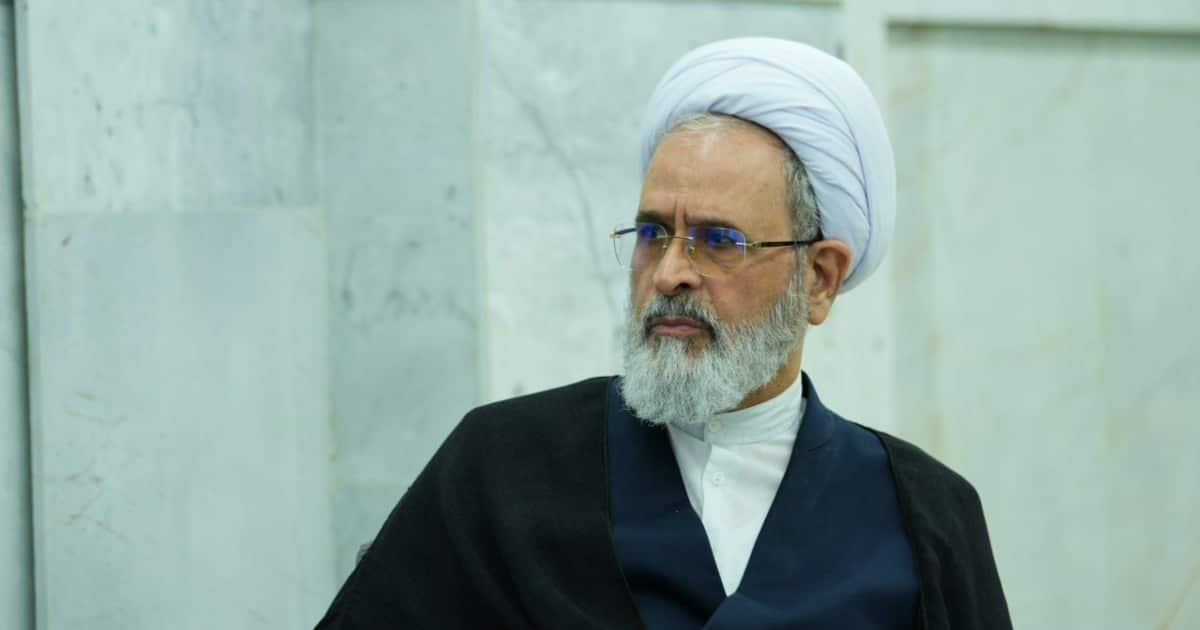
Senior Iranian Ayatollah Alireza A’rafi Visits Sarajevo; Tehran Seeks Deeper Cultural and Educational Ties Amid Wider Political Tensions
Alireza A’rafi, a senior Iranian ayatollah and member of the country’s Interim Leadership Council, visited Sarajevo on November 15 to attend the installation of the new head of the Islamic Community in Bosnia and Herzegovina. His visit — which included public remarks urging European states not to follow U.S. and Israeli policy toward Iran and a pledge to deepen cultural and educational cooperation — has been interpreted by analysts as part of Tehran’s broader effort to strengthen links with Europe through religious and educational channels.
By Christopher Manley
1,089 views
Alireza A’rafi, a prominent Iranian ayatollah and one of three members of the Interim Leadership Council of the Islamic Republic of Iran, visited Sarajevo on November 15 to participate in the ceremony appointing Nedžad Grabus as the new head of the Islamic Community in Bosnia and Herzegovina (IZ). During the visit, A’rafi used public remarks to criticize U.S. and Israeli policy toward Iran and to tell European countries not to follow Washington and Jerusalem, asserting that Iran "does not recognize any red lines in self-defense," according to an interview he gave to the Bosnian outlet Klix.ba.
A’rafi also told the Bosnian media that Tehran is interested in deepening relations with Bosnia and Herzegovina, especially in the fields of culture, education and the arts. His presence at the handover ceremony — for which the IZ said religious representatives from a number of Muslim countries and organizations were invited — underscores ongoing ties between Bosnian religious institutions and Iranian religious establishments, even if those ties have so far been largely limited to cultural and educational cooperation.
Iranian political analyst Ali Afshari, based in Washington, told Radio Free Europe/Radio Liberty (RFE/RL) that A’rafi’s Sarajevo trip likely has a broader diplomatic and political dimension. Afshari suggested that Iran may be seeking to use Bosnia as a conduit for influence and to manage tensions between Tehran and European states. "I think Iran will try to strengthen relations with the authorities of Bosnia and Herzegovina and use their influence in managing tensions between Iran and Europe," Afshari said.
A’rafi is not only a religious figure but also a long-standing member of Iran’s clerical and political establishment. He headed Al-Mustafa International University from 2008 to 2018, an institution that has been the subject of U.S. and Canadian sanctions, which allege that the university was used to recruit foreign students into intelligence activities and to support foreign militias. While the university itself has been targeted by sanctions, A’rafi has not been listed individually on sanction lists maintained by the United States, the European Union, the United Kingdom, the United Nations or Canada.
The university has been linked in U.S. statements to recruitment for IRGC-Quds Force operations and to foreign militias, including the Fatemiyoun and Zainabiyoun brigades that fought in Syria on behalf of forces loyal to President Bashar al-Assad. A’rafi has publicly acknowledged that many fighters in those brigades graduated from institutions connected to Al-Mustafa, noting casualties among them during the Syrian conflict.
A’rafi’s profile rose further after the February 2026 killing of Iran’s supreme leader, Ali Khamenei, in strikes the Iranian media and this report attribute to joint U.S.-Israeli operations. Following that event, A’rafi, aged 67, was named to the Interim Leadership Council — a post that represents the highest office of his career to date. He also has served since 2019 on the Guardian Council, to which he was appointed by Khamenei, and has held positions on the High Council for Cultural Revolution and as director of the World Center for Islamic Sciences.
Contacts between the Islamic Community in Bosnia and Iranian institutions predate A’rafi’s Sarajevo visit. In 2015, a Bosnian delegation led by then-head Husein Kavazović visited Iran and met A’rafi. More recently, in June 2024, Kavazović hosted Mohammad Mahdi Imanipour, director of Iran’s Organization for Islamic Culture and Communication, to discuss an international conference on Islamic mysticism held in Sarajevo with Iranian participation. The IZ has also publicly called for an end to hostilities and a return to diplomacy during periods of heightened violence in the Middle East.
Former Bosnian ambassador to Iran Emir Hadžikadunić told RFE/RL that A’rafi’s trip to Sarajevo could be seen as largely ceremonial and protocol-driven, and that A’rafi is nonetheless an appropriate interlocutor for religious and educational exchanges. At the same time, Hadžikadunić noted that broader bilateral ties between Bosnia and Iran remain limited. Trade between the two countries over the past five years amounted to only a few million euros — roughly 4.4 million in exports from Bosnia to Iran and about 21 million euros in imports from Iran — and he described the overall diplomatic relationship as nearly negligible when measured by typical metrics like high-level visits, economic exchange and tourism.
It is not publicly known whether A’rafi held meetings with Bosnian political officials during his stay. Analysts say the visit highlights how Tehran continues to cultivate religious, cultural and educational channels of influence in parts of Europe, even as official political and economic ties remain modest and the specter of regional violence and sanctions casts a shadow over such engagements.