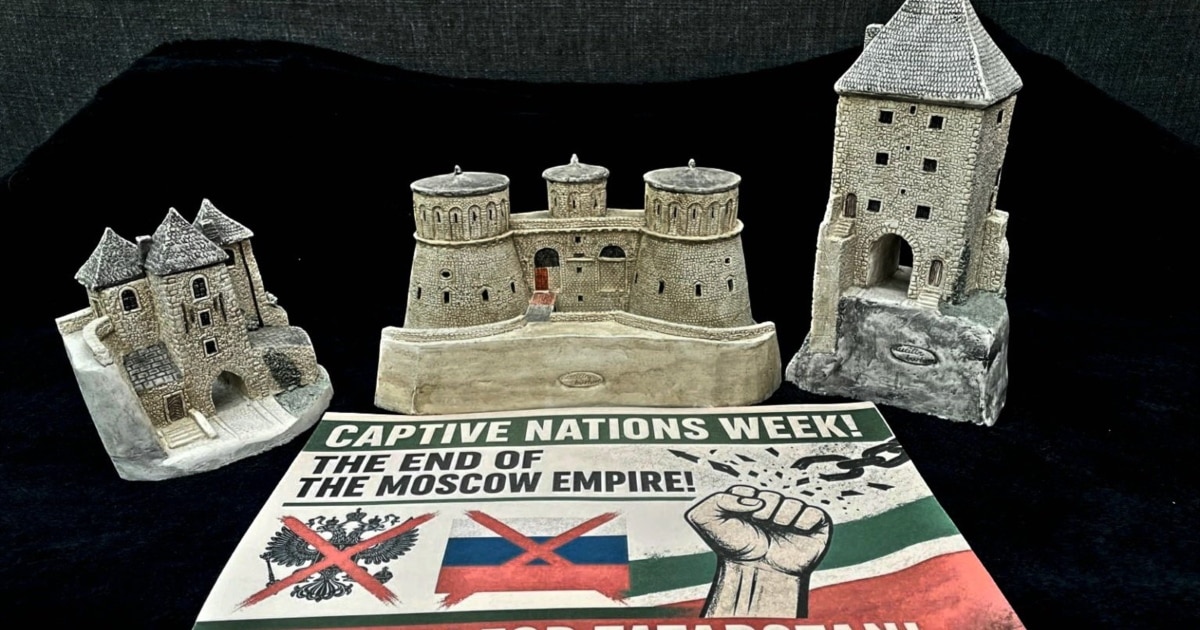
Self-styled 'Government of Tatarstan in Exile' Marks Captive Nations Week; Activist Holds Solo Picket at UN Headquarters
A group calling itself the 'Government of Tatarstan in Exile' organized an event on July 25 as part of Captive Nations Week, reporting solidarity from supporters in the United States, Azerbaijan, Luxembourg and elsewhere. In New York, activist Kamil Sukaev held a solitary picket outside the United Nations, saying the pursuit of human rights and the right of peoples to determine their own futures cannot be limited to one week.
By Christopher Manley
1,046 views
A group that identifies itself as the "Сөргендәге Татарстан хөкүмәте" (Government of Tatarstan in Exile) held an event on July 25 as part of Captive Nations Week, a period declared by the U.S. presidency to highlight the plight of peoples denied freedom and self-determination. According to the group’s Telegram channel, the initiative drew expressions of support from people living in the United States, Azerbaijan, Luxembourg and other countries, who held banners and issued messages of solidarity.
The activity formed part of the week proclaimed by U.S. President Donald Trump for July 19–25, 2026. Captive Nations Week, originally established under President Dwight Eisenhower and codified in a U.S. congressional resolution in 1959, has long served as an occasion for advocacy groups and diaspora communities to draw attention to national liberation, human rights, and democratic freedoms in a range of countries and regions.
In New York on July 25, activist Kamil Sukaev staged a one-person picket in front of the United Nations headquarters. Sukaev used the moment to emphasize the ongoing nature of struggles for rights and self-determination. He told reporters and onlookers in his native language: "Бу атнада милләтләр турында күп сөйләнде. Әмма кеше хокуклары, азатлык һәм халыкларга үз язмышларын үзләре хәл итү мөмкинлеген бирү — бер атна белән генә чикләнә торган тема түгел. Бу — һәр көннең чынбарлыгы," — ди Сукаев.
Sukaev acknowledged that solitary actions can seem limited in impact but argued that meaningful change often begins with individual steps and conversations. He also offered praise for those who defend their culture, language and rights through peaceful means: "Үзләренең мәдәниятен, телен һәм хокукларын тыныч юл белән яклаучы, битараф булмаган кешеләргә рәхмәтлемен," — ди ул.
The Captive Nations Week observance and the July 25 activities are part of a larger historical framework. The 1959 U.S. congressional resolution that underpins the observance lists multiple regions and peoples—ranging from the Idel-Ural and Turkestan to Tibet and the Baltic states—whose aspirations for independence or cultural survival were foregrounded during the Cold War era. Contemporary events invoking Captive Nations Week typically use that legacy to draw attention to current human rights concerns and to mobilize diaspora communities and international opinion.
The group organizing the July 25 action framed its event squarely in those terms, using the week to amplify grievances over cultural and political rights. The organizers’ Telegram postings and images suggested coordinated gestures across several countries, underscoring the transnational dimension of modern advocacy for minority and national rights.
Coverage of these events by outlets such as Azatlyk Radiosy (the local service of RFE/RL) has, however, faced constraints. The reporting outlet notes that its website has been blocked in Russia, complicating access to information for audiences within that country. The intersection of diaspora activism, symbolic observances like Captive Nations Week, and restrictions on independent media illustrates persistent challenges for groups seeking international visibility for issues of self-determination, minority rights and civil liberties.
While Captive Nations Week is formally a U.S. observance, events such as the July 25 action demonstrate how diasporas and oppositional groups use transnational platforms—from Telegram to demonstrations outside international institutions—to keep attention on human rights and political questions that they say are neglected. Organizers and participants stressed that even after the week’s formal end, public attention and civic responsibility toward these matters must continue.
The July activities therefore serve both as a commemoration of historical grievances and as a contemporary call for sustained international engagement on the rights of peoples seeking greater autonomy, cultural preservation or political change. Observers say the impact of such efforts depends on their ability to sustain attention, coordinate across borders, and overcome information barriers imposed by state censorship or digital blocking.