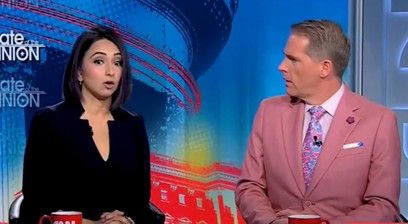
Scott Jennings Rebukes Former State Department Advisor on CNN Over Iran 'Meme War' as Rescue of Downed F-15 Pilot Draws Attention
A heated exchange on CNN erupted after former Obama State Department advisor Nayyera Haq described Iran’s online ‘‘meme war’’ as a significant information campaign, prompting commentator Scott Jennings to ask whether Tehran would prefer its navy back or its memes. The confrontation unfolded against the backdrop of a recent on-ground U.S. rescue of a second F-15 crew member and provocative posts by former President Trump warning Iran about the Strait of Hormuz.
By Cullen Linebarger
1,061 views
A terse exchange on CNN this weekend drew attention after political commentator Scott Jennings pushed back sharply against former Obama State Department advisor Nayyera Haq’s characterization of Iran’s online information operations as an effective ‘‘meme war.’" The back-and-forth occurred amid heightened tensions following the downing of a U.S. F-15 and the subsequent rescue of the jet’s second crew member.
According to prior reporting cited during the broadcast, the second pilot/WSO from the downed F-15 was recovered in an on-ground U.S. rescue mission on Saturday night after the jet was downed on Friday. The pilot was injured after ejecting but was reported as safe following an intense firefight during the recovery operation.
The CNN exchange followed public commentary by former President Donald Trump on the social media platform Truth Social. In a post after the pilot’s rescue, Trump warned Iran that a major operation would occur ‘‘this Tuesday’’ unless the country reopened the Strait of Hormuz. He wrote: "Tuesday will be Power Plant Day, and Bridge Day, all wrapped up in one, in Iran. There will be nothing like it!!!
Open the Fu**in’ Strait, you crazy b*stards, or you’ll be living in H*ll – WATCH! Praise be to Allah." The post circulated widely and was a focal point for discussion on networks covering the developing confrontation.
On CNN, Haq, identified as a former Obama State Department advisor, suggested that Iran’s online messaging and ‘‘meme war and internet propaganda’’ had been effective in shaping public perceptions. "For all the talk on our side of all the people killed in the regime, they have been pushing out images of the American generals and army people…So the way this looks out in the public is not a United States that is locked and loaded and looking in one direction," she said.
Jennings countered directly, asking, "You think the Iranians would rather have their entire navy back or their memes?" The one-line rebuttal was followed by his broader claim, made on air, that U.S. forces had "destroyed 13,000 military targets," a figure he cited to emphasize the scale of military actions against Iranian assets.
The brief exchange was amplified on social platforms, including a clip shared by RNC Research that captured the two commentators’ remarks. The segment highlighted the contrast between discussing information operations and the kinetic impacts of military strikes, a debate that has grown sharper as both sides of the conflict seek to shape domestic and international narratives.
Observers noted the interaction as emblematic of a larger conversation about the relative influence of online propaganda versus traditional military capabilities in modern conflict. The rescue of the downed pilot, Trump’s escalating rhetoric, and the public discussion of Iranian online activity together illustrate how military, political, and informational elements are converging in this episode of U.S.-Iran tensions.
The CNN segment, the Truth Social post, and the rescue operation each contributed to a rapidly evolving story. Officials have detailed the pilot’s recovery and injury status, while media commentary has focused on the message each side seeks to send—whether through weapons, presence, or memes—and how those messages affect international perceptions and policy choices.