Russia's Supreme Court Removes Yabloko from Duma Ballot, Citing Copyright and Foreign-Funding Allegations
On August 10, the Supreme Court of Russia annulled the federal registration of the opposition party Yabloko for the upcoming State Duma elections after a suit by the Rodina party and support from the prosecutor's office. The court cited alleged violations of intellectual property law and irregular foreign financial flows to individual candidates; the decision sparked protests by largely young supporters outside the court and will bar Yabloko from federal-list participation if it stands on appeal.
By Blake Marriott
907 views
Russia's Supreme Court on August 10 overturned the Central Election Commission's recent registration of the Yabloko party's federal list for the State Duma elections, satisfying a suit lodged by the Rodina party and supported by a representative of the General Prosecutor's Office. Twelve days earlier the Central Election Commission had unanimously registered Yabloko's 269 candidates and, on August 5, allocated the party the second position on the ballot. The CEC had approved the final ballot on the morning of August 10 — but the court's ruling removed Yabloko's federal list hours later.
If the Supreme Court's decision is upheld on appeal, these elections will be the first since 1993 in which Yabloko does not participate with a federal list. Opposition politicians and political analysts described the court action as part of a wider squeeze on legal political competition, arguing that authorities and rival factions fear that an authorized campaign could reveal the scale of public support for anti-war positions.
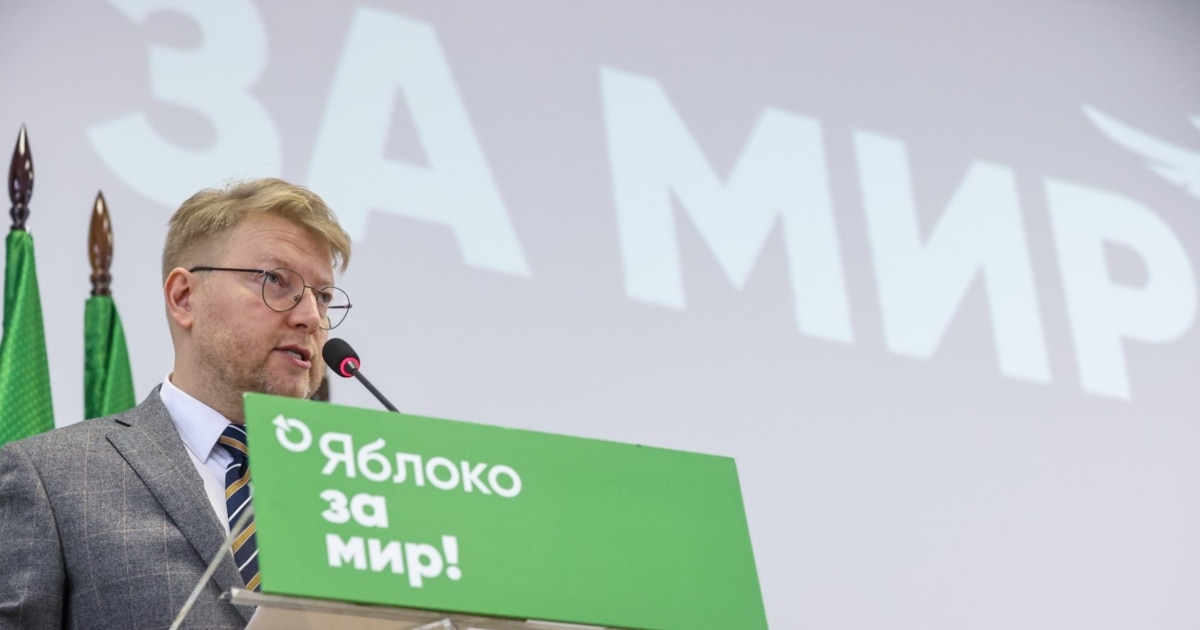
Yabloko's chairman Nikolai Rybakov told the court: "Суть наших разногласий в том, что мы за мир, а они за кровопролитие. Но они понимают, что люди хотят голосовать за мир. И боятся этого. Поэтому хотят снять нас с выборов." Polling showed an unusual degree of potential support: a VCIOM survey from June 26 indicated that 18 percent of respondents admitted they could consider voting for Yabloko — a figure seen by some as higher than the party's typical core rating.
Hundreds of supporters, predominantly young people, gathered outside the Supreme Court on Povarskaya Street as the case was heard. IT analyst Sergey Serov (имя изменено по соображениям безопасности – СР), who spent several hours at the site, said the crowd was overwhelmingly under 25 and that attendees chalked pacifist symbols, apples and slogans on the pavement — including a Ukrainian-language message, "Не маємо страху, маємо любов." The group sang songs such as "Луч солнца золотого," chanted the party's name and, after the court's ruling, shouted "Позор!" while police warned against making noise and threatened dispersal.
Rodina's lawsuit alleged that Yabloko's program and publications contained signs of "extremism," including calls to violate Russia's territorial integrity, materials allegedly designed to incite social, racial, national or religious discord, and content said to "demean national dignity." Among the evidence cited were older materials mentioning Alexei Navalny and organizations associated with him, some published before those entities were legally declared extremist in Russia. Rodina also pointed to alleged unauthorized use of songs, film frames, photographs and AI-generated illustrations on Yabloko's website and campaign materials as violations of intellectual property law.
Yabloko's defense rejected those claims in court. The party noted that its short election program — 43 words long — calls for a ceasefire, diplomacy, prevention of nuclear war, freedom from fear and political repression and "a prosperous democratic Russia," and argued that urging a ceasefire cannot legitimately be equated with a call to violate territorial integrity. Rybakov said in court: "Истец пытается вменить нам в вину сам факт того, что наша программа отличается от программ других партий, что мы критикуем их политический курс и открыто заявляем о необходимости мирных перемен." The party also presented licenses and payment confirmations for some disputed images; relatives of songwriters — including Gleb Oshanin (grandson of Lev Oshanin) and Mikhail Ostrovsky (son of composer Arkady Ostrovsky) — publicly stated they had no objection to Yabloko's use of the song cited in the lawsuit.
Other arguments centered on money flows flagged by Rosfinmonitoring. The agency's report listed foreign inflows to accounts of individuals connected with the campaign; Yabloko and its defenders said those funds went to separate citizens rather than to the party, and of the 2.8 million rubles mentioned only 16.9 thousand were donated to the party. Rybakov added that some recorded transactions reflected the sale of foreign securities that, under Russian law, candidates must dispose of prior to running. Rodina additionally estimated the value of social-media promotion in favor of Yabloko at more than 88 million rubles and accused the party of bypassing election-fund rules; the defense countered that those were unpaid citizen-made posts.
The case also touched on AI-generated imagery: Rodina argued that some illustrations produced with ChatGPT/OpenAI violated rights because Russia is not among territories supported by OpenAI; Yabloko's defense said users hold the rights to outputs and the CEC suggested the issue relates more to terms of service than copyright law. Legal observers, including Ivan Zhdanov, pointed out that copyright complaints are a common technical reason to remove candidates from ballots, though rarely at the scale of a national party list for the State Duma.
After a long hearing the Supreme Court ruled in favor of Rodina, citing unauthorized use of texts, images and videos as breaches of intellectual-property law and referencing the financial materials presented in court. A representative of the prosecutor's office supported the plaintiffs' demand at the hearing. Yabloko said it will appeal and vowed to continue its anti-war stance; supporters vowed to keep pressing for peaceful change. The legal challenge and the court's decision have immediate electoral consequences and broader implications for the space available to opposition parties and anti-war voices in Russia's tightly controlled political landscape.