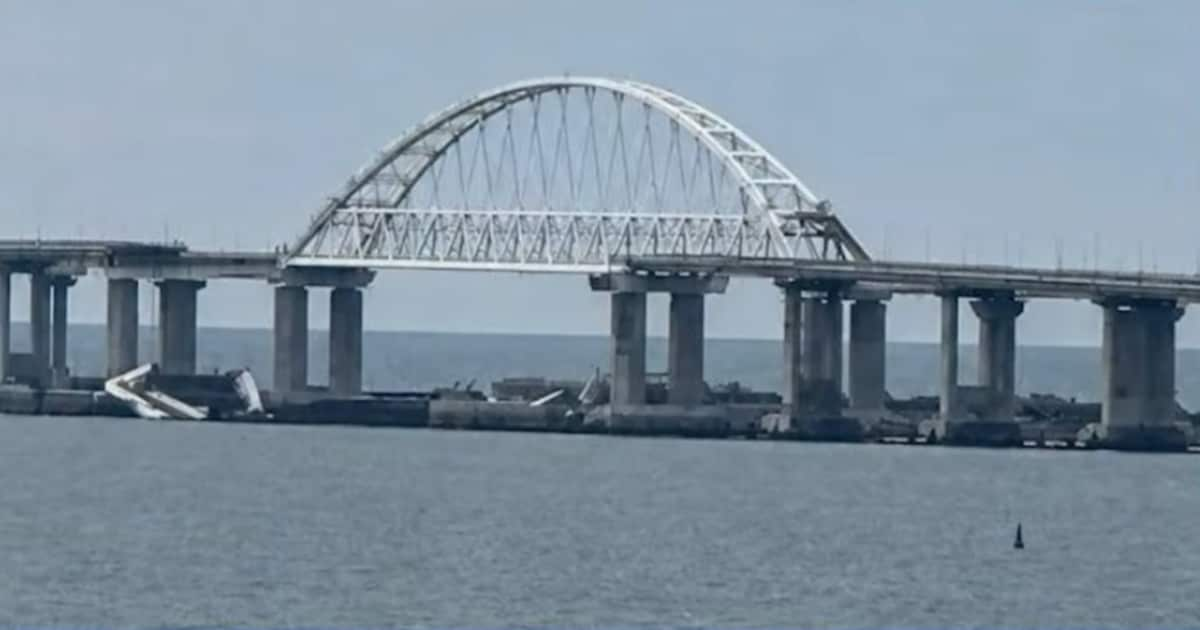
Russian Deputy Prime Minister Says He Cannot Set Timeline for Repairing Damaged Kerch (Crimean) Bridge
Russian Deputy Prime Minister Marat Khusnullin told reporters on November 20 that authorities cannot yet determine when the Kerch (Crimean) bridge will be fully restored after a series of Ukrainian strikes that badly damaged the bridge’s arch and roadway. Satellite imagery and engineering assessments indicate serious damage to both road and rail elements, and experts say restoring automobile traffic alone could take around two years if foundations were not harmed and if reconstruction is not interrupted by further attacks.
By Christopher Manley
1,153 views
Russian Deputy Prime Minister Marat Khusnullin said on November 20 that he cannot yet provide a firm timeline for restoring the Kerch, or Crimean, bridge after it was heavily damaged in a series of strikes. Quoted by the Russian news agency Interfax, Khusnullin told journalists that “our main span beam of the arch bridge is now damaged. The arch itself is damaged,” and that precise repair schedules will only be possible after engineers deliver project solutions.
Ukrainian forces struck the bridge multiple times in mid-November. Radio Free Europe/Radio Liberty’s Russian Service reported that attacks took place on at least three consecutive days — 17, 18 and 19 November — and earlier accounts cite strikes on 16 and 17 November as well. In the second major strike, the road deck and the arch above it collapsed into the water. On the night of 19 November, Ukraine’s General Staff reported another strike that hit the railway deck, saying the attack used shore-based Neptun anti-ship missile systems belonging to the Ukrainian Navy.
Satellite imagery published by Radio Free Europe/Radio Liberty on November 20 showed significant damage to the railway tracks in at least three locations, including at least one attachment point of the surviving portion of the arch. The images and on-the-ground footage circulated by the Security Service of Ukraine (SBU) depict explosions and the collapse of parts of the structure. Moscow’s subsequent claims that train movement had resumed on one rail line have not been independently verified by the reporting outlet.
Engineering experts cited in international reporting say the scale of damage and the complexity of the bridge’s construction complicate repair prospects. Andreas Kappos, a professor of civil and environmental engineering at Khalifa University in Abu Dhabi, told The New York Times that restoring automobile traffic could take around two years — assuming the bridge’s supporting piers were not damaged and reconstruction work is not interrupted by additional strikes. U.S. structural engineer Donald Dusenberry noted that if repair teams must also rebuild or reinforce the supports that hold the arch span, the project becomes significantly more complex and lengthy.
The Kerch bridge’s components were themselves the product of a lengthy construction process: reporting indicates that the steel elements forming the arch were fabricated over several months at a plant in Voronezh and then welded together over about 11 months, underscoring that some elements may be difficult to replace quickly. Khusnullin indicated that authorities need detailed engineering project documentation before they can define a realistic timetable for repairs.
Ukraine’s president, Volodymyr Zelensky, said earlier that the operation to strike the bridge had been prepared over several weeks and involved multiple stages. He described a campaign that targeted Russian air defenses, radar and electronic-warfare systems protecting the crossing, saying Ukrainian forces worked to neutralize those systems before attacking the bridge itself.
The damage to the Kerch bridge has strategic as well as civilian implications. The bridge provides a key land link between Russia and the Crimean peninsula — territory annexed by Russia in 2014 — and its impairment affects military logistics and civilian movement. Russian authorities’ ambitions to restore full rail and road capacity will depend on the extent of structural damage, availability of replacement components, security on and above the site, and whether reconstruction efforts can proceed without being disrupted by further military actions.
Reporting organizations noted that independent confirmation of the bridge’s technical condition and reliable estimates for full restoration remain difficult to obtain. Meanwhile, Russian media regulators have sought to block access to some outlets reporting on the strikes. Roskomnadzor has tried to block the Krym.Realii site inside Russia; Radio Free Europe/Radio Liberty and Krym.Realii have both been designated as “undesirable” organizations in Russia, complicating the domestic flow of independent reporting about the bridge and the wider conflict.
Until engineers can inspect the full extent of the damage and prepare project plans, officials will only be able to set provisional milestones. Khusnullin’s comments reflect both the technical uncertainty facing reconstruction teams and the wider reality that continued hostilities in the area could further delay or derail repair efforts.