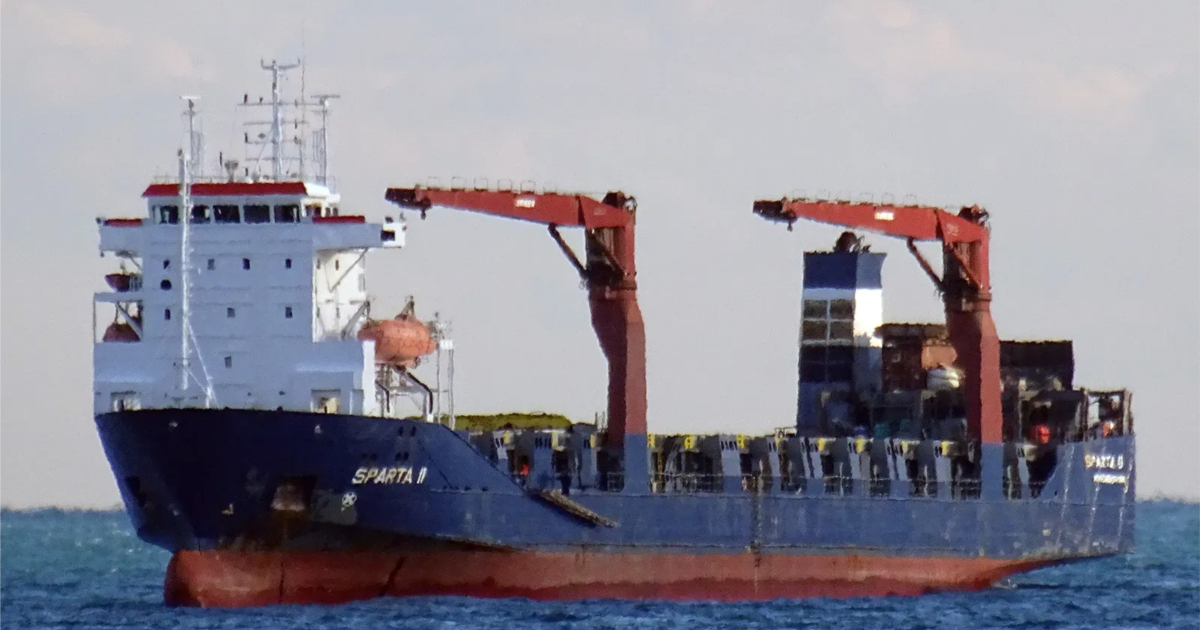
Russian cargo ship Sparta II burns in neutral Gulf of Finland waters; Moscow accuses Ukraine of drone attack
A Russian-flagged dry cargo vessel, the Sparta II, caught fire in neutral waters of the Gulf of Finland, around three nautical miles from Russia’s territorial limit, while heading to Kaliningrad. Russian regional authorities said the ship was hit in an attack they attributed to Ukrainian drones; Estonian border authorities confirmed reports of explosions and said they are monitoring the situation with Finnish colleagues.
By Alexander Walter
652 views
A Russian dry cargo ship, identified as Sparta II, caught fire on Wednesday in neutral waters of the Gulf of Finland roughly three nautical miles from Russia’s maritime boundary, regional authorities said, and Moscow has accused Ukraine of mounting a drone strike on the vessel. The governor of Russia’s Leningrad region, Alexander Drozdenko, said the ship was en route to the Kaliningrad exclave when the incident occurred and that an evacuation of the crew was under way while officials continued to clarify the consequences.
Drozdenko told followers on his Telegram channel that the damage to the cargo ship resulted from what he described as an attack by two Ukrainian drones. He also claimed that Russian forces had shot down some 80 Ukrainian drones over that part of the region. Those assertions have been made by Russian officials and, as of the latest reports, have not been independently verified.
Estonia’s Police and Border Guard Board (PPA) confirmed that it received a report of the fire aboard Sparta II. The BNS news agency, citing the PPA’s coordination centre, said the first report was logged at 09:35 and that explosions were heard on board the vessel. A PPA representative, Andres Tiik, said Estonia was following the situation closely in cooperation with Finnish authorities and would respond if Russia sought international assistance. So far, according to the PPA, there has been no sign of water contamination in the gulf linked to the incident.
Ukraine has not publicly commented on the claims that it targeted the ship. The vessel in question, Sparta II, has been under United States sanctions since 2022. U.S. authorities and other observers have previously linked the ship to the movement of military equipment in the interests of Russia; for example, Sparta II was observed leaving the Syrian port of Tartus in August 2022 carrying S-300 surface-to-air missile systems.
The incident occurs against the backdrop of a protracted and multi-front conflict between Russia and Ukraine that has produced frequent cross-border incidents, maritime tensions and allegations of attacks on civilian and military assets. The original report includes a broader timeline of the conflict, noting the Russian invasion announced on 24 February 2022, subsequent operations and allegations of atrocities such as the mass killings documented in Bucha. It also references major developments since then, including annexations declared by Moscow, mobilization measures in Russia, the transfer of Russian tactical nuclear warheads to Belarus as asserted by Minsk and Moscow, and various offensive and counteroffensive operations through 2025 and into 2026.
The governor’s statement and the PPA’s report leave several questions unanswered: the precise cause of the fire, the extent of damage to the vessel, whether any crew members were injured, and whether the blaze will lead to pollution in the Gulf of Finland. Estonian authorities said they were monitoring the situation and coordinating with Finland. International naval and maritime-safety protocols typically require notification and coordination in incidents at sea, especially when they occur in or near international waters; the PPA said it would act if Russia requested international assistance.
The Sparta II’s sanction designation and previous sightings carrying military cargo underscore the potential security implications of the incident. If the Russian assertion that Ukrainian drones attacked the ship is confirmed, the episode would be another instance of the conflict’s spillover into adjacent maritime areas, raising risks for neutral shipping, regional security and the enforcement of sanctions and arms controls. Independent verification of claims made by parties to the conflict has often been difficult throughout the course of the war, and the available information on this event remains preliminary. Journalists and officials will continue to watch for official confirmations, damage assessments, crew reports and any requests from Russia for international help in containing environmental or security consequences.