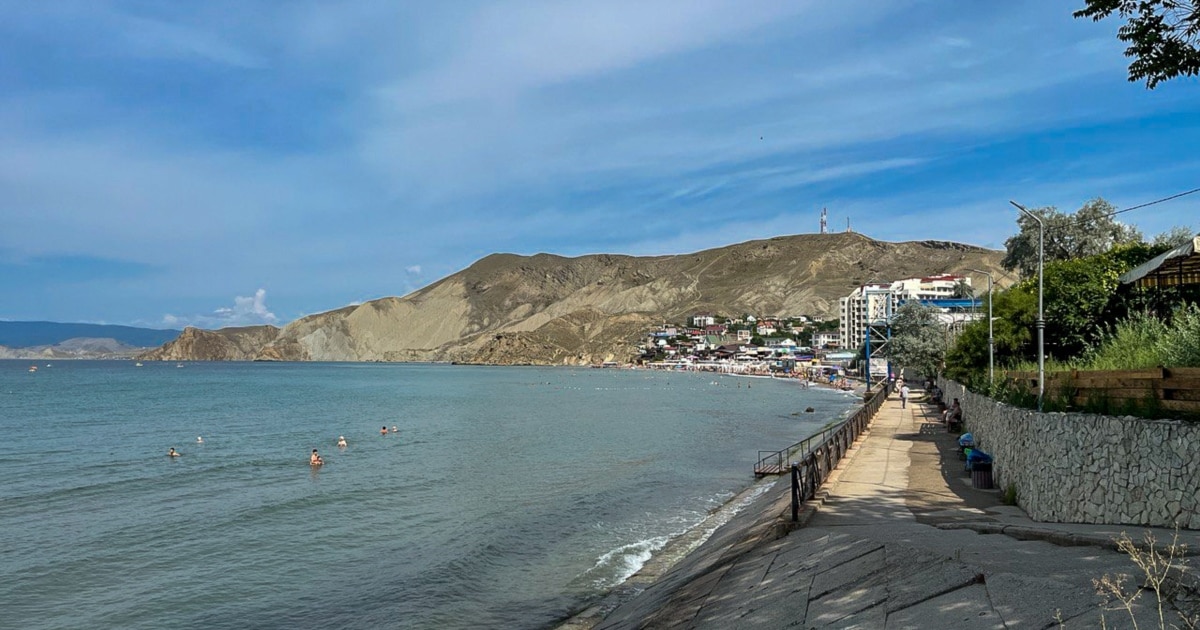
Russia Plans Year-Round Resort Development in Occupied Crimea’s Ordzhonikidze Despite Falling Tourist Numbers
Authorities occupying Crimea have announced a plan to build a year‑round tourist cluster called 'Dvuyakornaya Bay' in the former closed town of Ordzhonikidze, including a four‑star hotel, pools and marina infrastructure. The project, slated for completion in 2029 and backed by a small newly registered local developer, comes amid declining tourism, a contested post‑Soviet industrial legacy and residents’ concerns about landslides and construction.
By Alexander Walter
1,115 views
Russian authorities administering the occupied Crimean peninsula have announced plans to develop a major tourist cluster in the settlement of Ordzhonikidze on Crimea’s south‑eastern coast. The regional Ministry of Housing Policy and State Construction Supervision of Crimea said the project, promoted under the name "Dvuyakornaya Bay," is intended as a year‑round resort combining hospitality, wellness, sports and yachting facilities.
According to the ministry, the proposed cluster will include a four‑star hotel, two swimming pools and a range of recreational, sports and health facilities, together with social and commercial infrastructure. The concept is described as being oriented toward therapeutic and wellness tourism, gastronomic and events tourism, and yacht and sports tourism. Project documentation sets an estimated investment volume of 5.3 billion rubles and a planned completion or realization date in October 2029.
The regional authorities have named OOO SЗ "Eko‑Quartal "Oazis" as the developer. The company was registered in Ordzhonikidze in June 2025 with a statutory capital of 10,000 rubles, according to the announcement. Local reporting indicates the developer is a small, newly formed enterprise, a detail that will attract scrutiny given the scale of the planned investment and the track record of state‑linked projects in the occupied peninsula.
Ordzhonikidze has a contested history that informs the present proposal. During the Soviet period the settlement was a closed town focused on the defense industry. Two military factories operated there: the torpedo plant "Hydropribor," founded in 1914 on the shore of Dvuyakornaya Bay for the assembly and testing of torpedoes, and the "Hydroapparat" enterprise. After the collapse of the Soviet Union both factories ceased major operations and the settlement increasingly pivoted toward tourism.
Following Russia’s annexation of Crimea in 2014, Moscow officials said that AO "Bukhta Dvuyakornaya" (the successor of "Hydropribor") had secured state defense orders and that production would revive. Those claims did not materialize as expected: the formerly secret plant was opened to visitors as an excursion site and later put up for sale. Local media and residents have long described the resort potential of Ordzhonikidze as fragile or illusory, citing environmental and safety concerns.
Residents have repeatedly complained about unregulated construction in neighboring Tikhaya Bay and the risk of landslides in coastal areas. Those longstanding local concerns now intersect with a wider context: a general decline in tourist flows to the peninsula that authorities attribute to the war and associated safety and reputational risks. The new development proposal thus arrives at a moment when demand for trips to Crimea has fallen, raising questions about the economic viability and social impact of large new projects.
The announcement also has a press‑freedom dimension. Krym.Realii (Crimea.Realities), the outlet reporting these developments, notes that Roskomnadzor, Russia’s federal communications watchdog, has attempted to block access to its site in Russian‑controlled areas of Crimea. The outlet advises readers on mirror sites and use of VPNs to access reporting. Restrictions on independent reporting in occupied territories complicate public oversight of large development projects and limit the ability of residents and civil society to scrutinize planning and environmental safeguards.
The proposed Dvuyakornaya Bay cluster raises multiple unresolved questions: the source and stability of the claimed investment, the capacity of a newly registered small developer to deliver a complex coastal project, the environmental and geotechnical risks in a landslide‑prone area, and the social impact for local communities. Given the history of defense‑industry secrecy, the shifting use of industrial sites, and the legal and political context of occupation, the project will be watched by local residents, rights groups and journalists seeking to verify claims and monitor its implementation.
For now, the announcement stands as a case study in the occupied peninsula of how Moscow‑aligned authorities are pursuing infrastructure projects to bolster the image of Crimea as a resort destination while facing declining tourist numbers, local resistance and limits on independent reporting. The combination of these factors underscores wider challenges around accountability, environmental safety and the protection of public information in territories under effective Russian control.