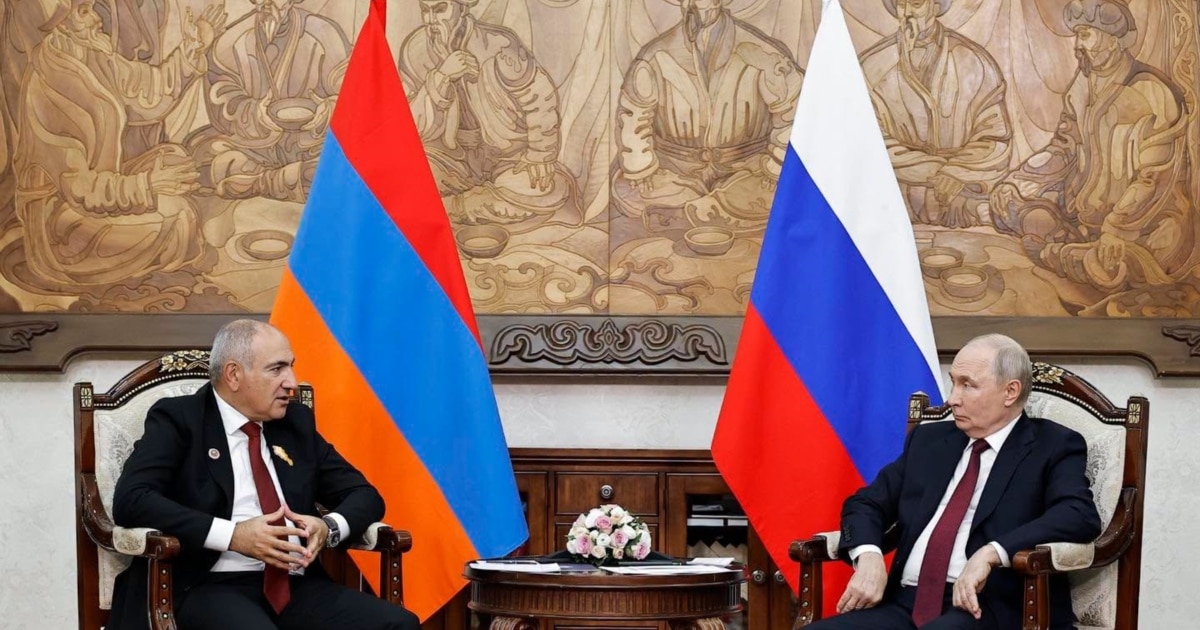
Russia-led CSTO Strips Armenia of Voting Rights After Years of Frozen Participation and Unpaid Dues
Kremlin spokesman Dmitry Peskov announced on November 11 that Armenia has been deprived of its voting rights within the Collective Security Treaty Organization (CSTO/ODKB), and barred from appointing representatives to senior positions in the bloc. The decision follows Yerevan’s suspension of its participation in 2024, a refusal to pay membership fees, and growing tensions with Moscow as Armenia signals closer ties with the European Union.
By Alexander Walter
908 views
On November 11, Kremlin spokesman Dmitry Peskov announced that Armenia has been stripped of its voting rights within the Collective Security Treaty Organization (CSTO/ODKB), a Russia-led military alliance, citing Yerevan’s failure to meet its obligations to the bloc over several years. According to Peskov, the decision — taken in accordance with the CSTO’s charter — also removes Armenia’s ability to appoint representatives to senior posts within the organization. The responsible secretary of the CSTO is expected to make a formal announcement of the measures.
The move follows a series of developments that have effectively frozen Armenia’s participation in the alliance. In 2024, after Azerbaijan re-established control over the Nagorno-Karabakh region, Yerevan suspended its engagement with the CSTO and later signalled an intention to withdraw from the organization. Armenian authorities did not formally declare an exit immediately, but they stopped paying membership fees in 2024. In June 2026, Prime Minister Nikol Pashinyan said Armenia did not intend to resume payments.
Moscow and other CSTO members raised the unpaid-dues issue as grounds for possible action. Russian Foreign Minister Sergei Lavrov previously said that CSTO countries had agreed to consider measures against Armenia over the suspension of its contributions. Peskov’s November announcement represents the first high-profile step taken publicly by the bloc to penalize Yerevan for what it views as non-compliance with organizational obligations.
The decision comes against a backdrop of widening geopolitical strain between Armenia and Russia. Since late spring 2026, Russian authorities have imposed a range of economic restrictions on Armenian imports, including dairy products, vegetables and fruits, flowers, alcoholic beverages, bottled water, and fish. Russian state decisions have also affected energy supplies to Armenia. President Vladimir Putin has publicly pressed Yerevan to clarify its intentions regarding closer integration with the European Union, saying Moscow needs a clearer picture to determine how to develop future relations.
Prime Minister Pashinyan has repeatedly signalled a shift toward deeper ties with the EU. He has stated that Armenia will soon begin the process of submitting an application to join the European Union, a move that Moscow views as a strategic pivot away from Russia’s sphere of influence. Domestically, Pashinyan’s government has maintained significant political support ahead of parliamentary contests, complicating the bilateral standoff by tying foreign-policy orientation to electoral politics.
Analysts say stripping Armenia of voting rights in the CSTO weakens its ability to influence decisions within the security bloc and formalizes a rift between Yerevan and the alliance’s leadership. For Armenia, the measures reduce its leverages in a forum where Russia plays the dominant role in shaping regional security responses, including those related to tensions with Azerbaijan. For Moscow and other CSTO members, the step signals that institutional rules will be enforced when a member state is perceived as failing to fulfil its obligations.
How the situation develops remains uncertain. The CSTO may announce further procedural or political measures, while Armenia appears to be recalibrating its security and diplomatic relationships as it pursues ties with the EU. The outcome will have implications not only for Armenia’s international standing but also for the balance of influence in the South Caucasus, where Russian, Azerbaijani and Western interests intersect and where questions of security guarantees, sovereignty and standards of alliance behaviour are increasingly contested.