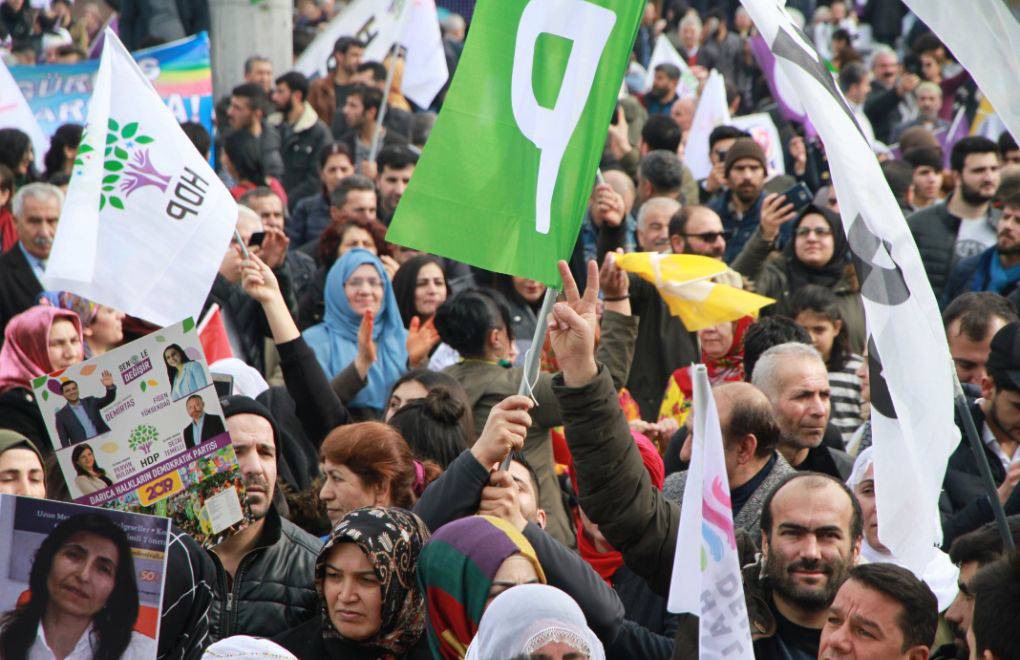
Rebuilding the 'Third Pole': How an alliance of state networks, repression and Kurdish negotiations are reshaping Turkey's political balance
An analysis published in Yeni Yaşam contends that Turkey’s ruling coalition under President Erdoğan has formed a
By Ertuğrul Kürkçü
1,167 views
An analysis first published in Yeni Yaşam and circulated widely in Turkish political commentary argues that President Recep Tayyip Erdoğan’s government has become what the author terms a “Kutsal İttifak” — a collusive alignment of the ruling AKP with the nationalist MHP and older deep‑state networks identified as Ergenekon/Gladio. According to the piece, this constellation fuses visible party politics with entrenched elements inside the judiciary, police, intelligence and military, producing a durable though incomplete process of state consolidation toward a proto‑fascist model.
The article describes how this alliance operates in practice: by opening judicial and administrative spaces to allied actors and, in return, receiving mass‑base support, ideological legitimation — summarized in the Turkish political discourse as “beka” — and practical control over the state apparatus. The author argues that the regime sustains itself through a permanent state of emergency rhetoric — invoking war, conflict and internal and external enemies — because it cannot produce broad popular consent through ordinary economic or legal mechanisms. The effect, the piece contends, is an “istikrarsızlık rejimi” whose fuel is ongoing instability.
The analysis stresses that formal democratic institutions have not simply been abolished but hollowed out: their forms remain while their contents are filled by a new authoritarian practice. The regime is described as a proto‑authoritarian “ara uğrak” rather than a completed totalitarian transformation: it has not yet been able to atomize Turkish society entirely or eliminate parliamentary mechanisms, even as it weaponizes courts and administrative appointments to sideline opponents.
Economic constraints are cited as a limiting factor on full authoritarian transition. The author points to Turkey’s deep integration with global capital and markets — illustrated by a combined public and private foreign debt stock the piece cites as 518.5 billion US dollars — arguing that this dependence prevents the construction of an autarchic war economy akin to historical fascist states. Nevertheless, the regime’s supporters in the military‑industrial complex and allied business networks are described as benefiting from a reallocation of resources toward security and armaments.
On the opposition front, the article traces a fragile balance in which societal blocs remain polarized roughly “yüzde 50/yüzde 50.” It details campaigns against opposition parties and local governments, including a cascade of municipal prosecutions and trustee (kayyımlar) appointments, the imprisonment of thousands of politicians and activists, and targeted legal actions against figures associated with the Republican People’s Party (CHP), including prosecutions tied to Özgür Özel. The piece argues these measures aim to degrade opposition capacity through selective judicialization rather than outright electoral elimination.
A key focus of the analysis is the Kurdish movement’s strategy since 2015. It recalls the large‑scale setbacks of the late 2010s and the movement’s tactical shift toward negotiating from İmralı with Abdullah Öcalan, who is described as emerging from prolonged isolation to promote a “democratic society” framework. The author frames those talks as a pragmatic bid to preserve organizations and municipal gains after years of crackdowns, even as the negotiations have created tensions with secular and radical urban movements in western Turkey — what the analysis calls the “Üçüncü Kutup” or Third Pole.
The article warns that Kurdish engagement at the negotiation table creates immediate tactical advantages but also frays the broader interaction between Kurdish politics and Western urban social movements — Alevi communities, labor and women’s movements, secular middle classes and youth activism — which had been crucial in pushing back against authoritarian trends. Remaining at the table may require Kurdish actors to avoid the most confrontational forms of street politics, weakening the earlier chains of solidarity woven since 2015.
Concluding, the piece argues that a durable alternative to the current trajectory requires a political alliance rooted not in party machinations but in shared experience of state‑driven inequality, militarism and repression. It calls for reconstruction of a broad democratic and social front linking Kurdish aspirations for rights and autonomy with the economic and civil‑liberties concerns of workers, women and urban residents — a coalition the author sees as the best bulwark against further authoritarian consolidation by the “Saray‑MHP” axis.