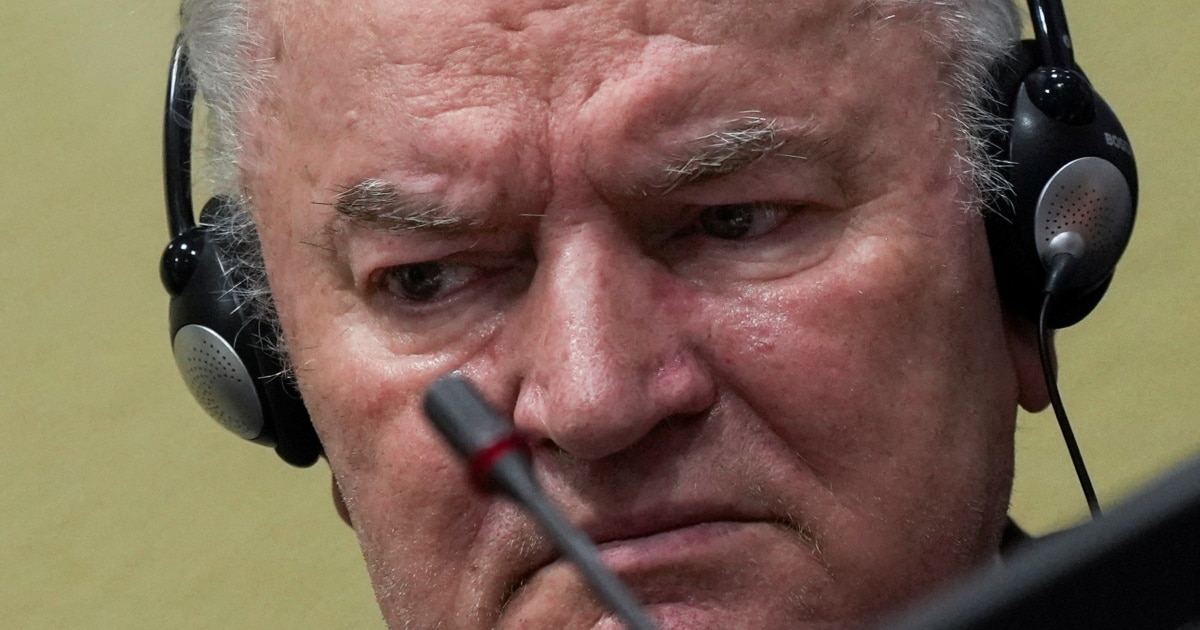
Ratko Mladić, Convicted Over Srebrenica Genocide and Other War Crimes, Dies in The Hague
Ratko Mladić, the Bosnian Serb general convicted of genocide in Srebrenica and multiple other crimes during the 1992–1995 war in Bosnia and Herzegovina, has died in The Hague, according to Radio Televizija RS. Mladić was found guilty on 10 of 11 counts, sentenced to life imprisonment, and had multiple requests for early or temporary release on humanitarian grounds denied by international judicial authorities.
By Clémence Desjardins
1,166 views
Ratko Mladić, the former Bosnian Serb military commander convicted by a Hague-based tribunal for genocide in Srebrenica and other war crimes committed during the 1992–1995 conflict in Bosnia and Herzegovina, has died in The Hague, Radio Televizija RS reported. Mladić had been serving a life sentence imposed by the international court after being found responsible for some of the worst atrocities of the conflict.
The Hague tribunal found Mladić guilty on 10 of 11 charges, including genocide committed against approximately 8,000 Bosniak men and boys in Srebrenica in the summer of 1995, crimes against humanity, and violations of the laws or customs of war. The court also held him responsible for the widespread persecution and forcible transfer of Bosniaks and Croats across Bosnia and Herzegovina, the terrorizing of civilians during the siege of Sarajevo, and for holding United Nations peacekeepers hostage during NATO’s 1995 bombing campaign.
According to the reporting, the trial judgment was pronounced on 22 November 2017 and Mladić was subsequently sentenced to life imprisonment; the Hague court’s final disposition was confirmed after an appeals process. Both the prosecution’s and the defense’s appeals were heard, including an appeals hearing held in August of the previous year, and the appeals chamber ultimately rejected the challenges to the conviction and sentence.
The trial against Mladić began on 16 May 2012 and was long and complex: it stretched across 530 court days, during which 592 witnesses testified and roughly 10,000 items of evidence were submitted. The court also relied on a set of some 2,000 adjudicated facts. While convicitions covered the Srebrenica genocide and numerous other crimes, Mladić was acquitted on charges of genocide in six Bosnian municipalities in 1992 — Prijedor, Sanski Most, Ključ, Kotor Varoš, Foča and Vlasenica.
Mladić was arrested in Serbia on 26 May 2011 after nearly 16 years as a fugitive from international tribunals. Six days following his arrest he was transferred to The Hague to face the long-standing indictments against him; the first indictment had been filed in July 1995. Over the course of two decades, multiple amended indictments were lodged, culminating in a consolidated case often referred to in court records as the “Ratko Mladić” matter (IT-95-5/18-I).
In the later stages of his imprisonment, Mladić’s legal team sought early release on humanitarian grounds, citing deteriorating health and a wish to spend his final days closer to family. The president of the International Residual Mechanism for Criminal Tribunals (referred to in the source as Međunarodni mehanizam za krivične sudove, MMKS), Graciela Gatti Santana, denied the request. In her decision she stated: "Interesi pravde i opšta pravna načela ne zahtijevaju puštanje na slobodu samo zato što se očekuje neposredna smrt. Imajući u vidu nivo i prirodu njege koja je dostupna Mladiću, kao i mogućnosti za kontakt s porodicom, njegov nastavak pritvora neće mu prouzrokovati patnju izvan one koju zatvorska kazna sama po sebi podrazumijeva." She also wrote that, given the penological objectives of sentences for those convicted of international crimes, "Kazna, osim odvraćanja, treba izražavati osudu međunarodne zajednice zbog predmetnog ponašanja i njenu nespremnost da toleriše ozbiljna kršenja međunarodnog humanitarnog prava i ljudskih prava" and that his preference to die in Serbia "predstavlja preferencu, a ne ishod koji zahtijevaju interesi pravde i opšta pravna načela."
Mladić’s death brings to a close the long legal and public reckoning over one of the most notorious figures of the Yugoslav wars. Born in 1943 in Božanovići near Kalinovik, Mladić trained at the Belgrade Military Academy and served in the Yugoslav People’s Army (JNA). He rose through the ranks in the early 1990s, being promoted to general-major and later to general-lieutenant as the conflicts engulfing the former Yugoslavia began. In May 1992 he was appointed commander of the Main Staff of the newly formed Army of Republika Srpska, a position he held until December 1996.
The international community and victims’ groups have long viewed the convictions in the Mladić case as a critical moment in the pursuit of accountability for mass atrocities in the Balkans. While some measures of justice have been achieved through these trials, the legacies of mass killings, sieges and ethnic cleansing continue to shape politics and intercommunal relations in Bosnia and Herzegovina and the wider region. Further comment and official statements from governments, victim organizations and the courts can be expected following confirmation and formal announcements from authorities in The Hague.