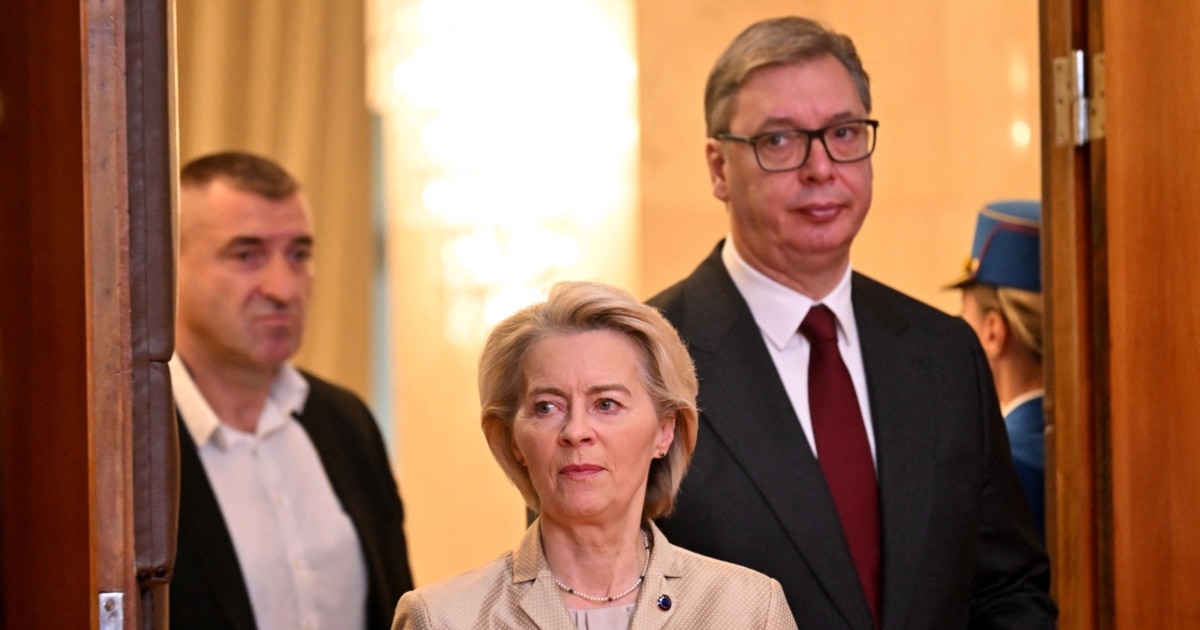
Rade Veljanovski and Oliver Tošković: Why Is Brussels Turning a Blind Eye to Repression in Serbia?
Radio Free Europe/Radio Liberty's Most programme brought together Rade Veljanovski and Oliver Tošković to probe the apparent disconnect between reports of repression in Serbia and the responses from Brussels. The conversation focused on whether President Aleksandar Vučić's government has consolidated control after more than a year of student and civic protests, and explored the broader implications for human rights, media freedom and EU-Serbia relations.
By Clémence Desjardins
842 views
Radio Free Europe/Radio Liberty’s Most programme recently devoted an episode to one of the region’s most pressing questions: why, some commentators argue, Brussels appears to be overlooking signs of repression in Serbia. The episode convened Rade Veljanovski and Oliver Tošković to assess whether the government led by President Aleksandar Vučić has succeeded in consolidating power following more than a year of sustained student and civic protests, and what that might mean for human rights, press freedom and democratic governance in Serbia.
The conversation on Most framed the issue as part of a broader debate about the European Union’s political conditionality and the extent to which EU institutions should press member and candidate countries on democratic standards. Participants examined the apparent tension between geopolitical and strategic considerations and the EU’s stated commitments to human-rights norms. The programme raised questions about whether concerns voiced by activists, journalists and civil-society groups are receiving commensurate attention from Brussels.
Central to the discussion was the trajectory of domestic political dynamics in Serbia following a prolonged period of public mobilization. The episode asked whether the protests — described as student and civic in nature — had prompted meaningful reforms or whether state institutions and governing actors had instead managed to reassert control. The panel also explored how shifts in the domestic media environment and pressures on independent outlets affect the capacity of civil society and journalists to hold authorities to account.
Speakers on the programme pointed to the stakes involved for EU-Serbia relations. If allegations of repression and democratic backsliding are not robustly addressed, the credibility of the EU’s enlargement and conditionality framework could be undermined, with implications both for rights protection in Serbia and for the EU’s influence in the region. The episode considered how diplomatic engagement, monitoring mechanisms and public pressure might be calibrated to better protect civil liberties and pluralism.
The Most episode also touched on the practical consequences of an environment in which civil liberties and press freedom are perceived to be shrinking. Panelists discussed how diminished space for independent reporting and public protest can curtail scrutiny of government actions, erode public trust, and weaken the institutional checks that underpin democratic systems. They explored the ripple effects on vulnerable groups and on the broader civic ecosystem that supports human-rights advocacy.
While the programme centered on policy and institutional questions, it also emphasized the lived reality for individuals who participate in protests or work in independent media. The conversation highlighted the need for continued documentation, legal support, and international attention to ensure that allegations of rights abuses are recorded and addressed. At the same time, it underscored the complexity of balancing diplomatic priorities with principled advocacy for rights and freedoms.
The Most episode joins a series of RFE/RL productions examining political and human-rights developments in the Western Balkans. By bringing together analysts and commentators to scrutinize both domestic trends in Serbia and the international response, the programme sought to deepen public understanding of why questions about repression, accountability and the EU’s role remain central to the future of democracy in the region.
The broadcast did not provide definitive answers but instead mapped the contours of a continuing debate: whether Brussels’ approach to Serbia reflects a pragmatic compromise, a strategic oversight, or a gap between rhetoric and action. For rights defenders, journalists and policy-makers alike, the episode reaffirmed the importance of sustained scrutiny and engagement on issues of repression, freedom of expression and democratic integrity.