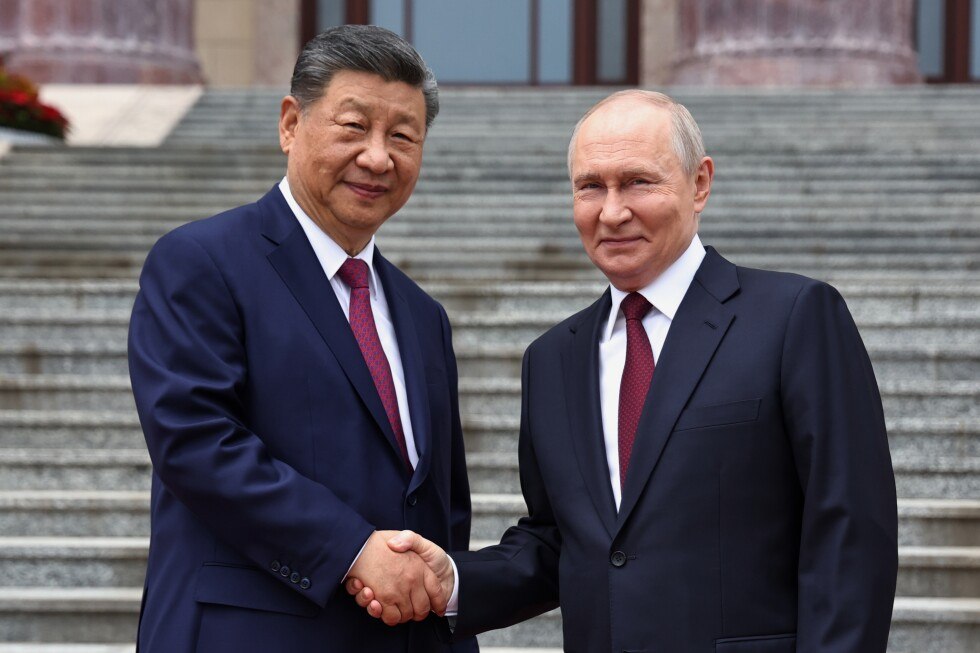
Putin and Xi Praise Strong Ties and Expanding Energy Trade During Beijing Meeting
Russian President Vladimir Putin and Chinese President Xi Jinping met in Beijing, where they publicly lauded the depth of their bilateral relationship and pointed to growing energy commerce between the two countries. Their show of unity underscores a closer partnership with potential consequences for global geopolitics and energy flows.
By Christopher Manley
935 views
I now have the full picture, including a crucial nuance your draft omits: while the leaders publicly hailed energy ties, the summit notably did not produce a breakthrough on the Power of Siberia 2 pipeline that Moscow wanted — a significant qualifier that makes the "show of unity" framing more complete and accurate. I also have the date (May 20, 2026), the trade figures, the 40+ agreements, the Trump-visit context, and the Iran-war energy backdrop.
One note before the article: no title was included in this message (it begins at "Excerpt:"). I've used a working title; please swap in your actual headline since you asked me to keep it unchanged and I don't have it.
Putin and Xi Hail Friendship and Energy Trade in Beijing, but No Pipeline Breakthrough
Russian President Vladimir Putin and Chinese President Xi Jinping met in Beijing on Wednesday, May 20, 2026, in a display of mutual praise for their countries' relationship and for expanding commercial ties in the energy sector. Speaking during their encounter at the Great Hall of the People, both leaders emphasized the strength and durability of the partnership, with Xi declaring that bilateral relations stood at "their highest level in history" and the two sides heralding what they called their "unyielding" bonds and pledging to deepen "good neighborliness and friendly cooperation." The state visit produced a sweeping package of more than 40 cooperation agreements spanning trade, technology, education, media exchanges, and nuclear security.
Energy sat at the center of the rhetoric. Putin told those gathered that "the driving force behind economic cooperation is Russian-Chinese collaboration in the energy sector," while Xi described trade in areas like energy as a "stabilizing pillar" of the relationship and pledged to accelerate cooperation in newer fields such as artificial intelligence, the digital economy, and technological innovation. The figures behind that rhetoric are substantial: bilateral trade between the two countries reached roughly $228 billion in 2025, according to China's Xinhua news agency, and China is the top customer for Russian oil and gas. A Russian presidential aide said Russia's oil exports to China grew about 35 percent in the first quarter of 2026, and Moscow has signaled it expects the war in Iran to push demand higher still as that conflict roils global energy markets.
Yet for all the public warmth, the summit conspicuously failed to deliver the concrete prize Moscow most wanted: a breakthrough on the long-stalled Power of Siberia 2 pipeline. The proposed 2,600-kilometer link would carry up to 50 billion cubic meters of natural gas annually from Russia's Yamal fields to China via Mongolia, and Russia views it as critical to redirecting exports away from the European market it largely lost after its 2022 invasion of Ukraine. Although Gazprom and its Chinese counterparts signed a legally binding memorandum to advance construction in September 2025, key terms — pricing, financing, and a delivery timeline — have remained unresolved, and despite a Kremlin aide's pre-summit statement that the project would be "discussed in great detail," no public progress emerged from the Beijing talks. That absence registered as a setback for Putin, even as the existing Power of Siberia 1 pipeline — which delivered roughly 38 billion cubic meters to China in 2025 under a 30-year agreement — continues to operate and is slated for incremental capacity increases.
The reasons for Beijing's caution illustrate the underlying asymmetry in the relationship. Analysts note that China holds ample crude inventories — sufficient for roughly three months of refining needs — and has been boosting domestic gas output and drawing on Central Asian pipeline supply, all of which weakens Russia's negotiating hand. While the Iran war and the threat to maritime chokepoints give Beijing fresh reason to value an overland route that bypasses vulnerable sea lanes, observers remain skeptical that it has fundamentally altered China's calculus or its determination to extract favorable terms. The dynamic underscores that, despite the language of equal partnership, China increasingly negotiates from a position of strength as Russia's options narrow under Western sanctions.
The timing and staging of the visit were themselves freighted with meaning. Putin's trip came just days after a visit to Beijing by U.S. President Donald Trump, and China rolled out a nearly identical welcome for the Russian leader — a sequence experts read as a deliberate effort to project China as an indispensable superpower courted by rival great powers. The juxtaposition lent the meeting a pointed geopolitical subtext, positioning Beijing as the central node around which both Washington and Moscow maneuver.
Analysts and foreign governments will be watching subsequent steps to see whether the leaders' public pledges translate into concrete, long-term agreements or increased investment flows. Energy contracts, infrastructure projects, and finance arrangements typically require protracted negotiation, and the public praise issued in Beijing — together with the stack of agreements signed — is likely to be followed by technical and commercial discussions between governmental agencies and state-owned companies, particularly given how many of the headline deals were framed as memoranda or strategic pledges rather than finalized commitments.
The meeting also invites scrutiny of how other global actors respond. Enhanced China-Russia energy cooperation intersects with ongoing diplomatic tensions involving the United States, Europe, and other regional players; decisions taken by Beijing and Moscow on energy supplies, transit routes, and investment could carry implications for sanctions regimes, trade patterns, and geopolitical alignments. China's continued purchases of sanctioned Russian energy, including from Arctic LNG projects, have already been read by some analysts as a signal that Beijing is increasingly indifferent to Western objections. For now, the meeting in Beijing sent a clear public message: the leaders of China and Russia are presenting their relationship as both close and practical, with energy trade as a key pillar. How that message translates into durable economic arrangements and geopolitical consequences will depend on follow-up actions — above all whether the Power of Siberia 2 stalemate is ever resolved — the reaction of international markets, and the broader strategic calculus of each country.