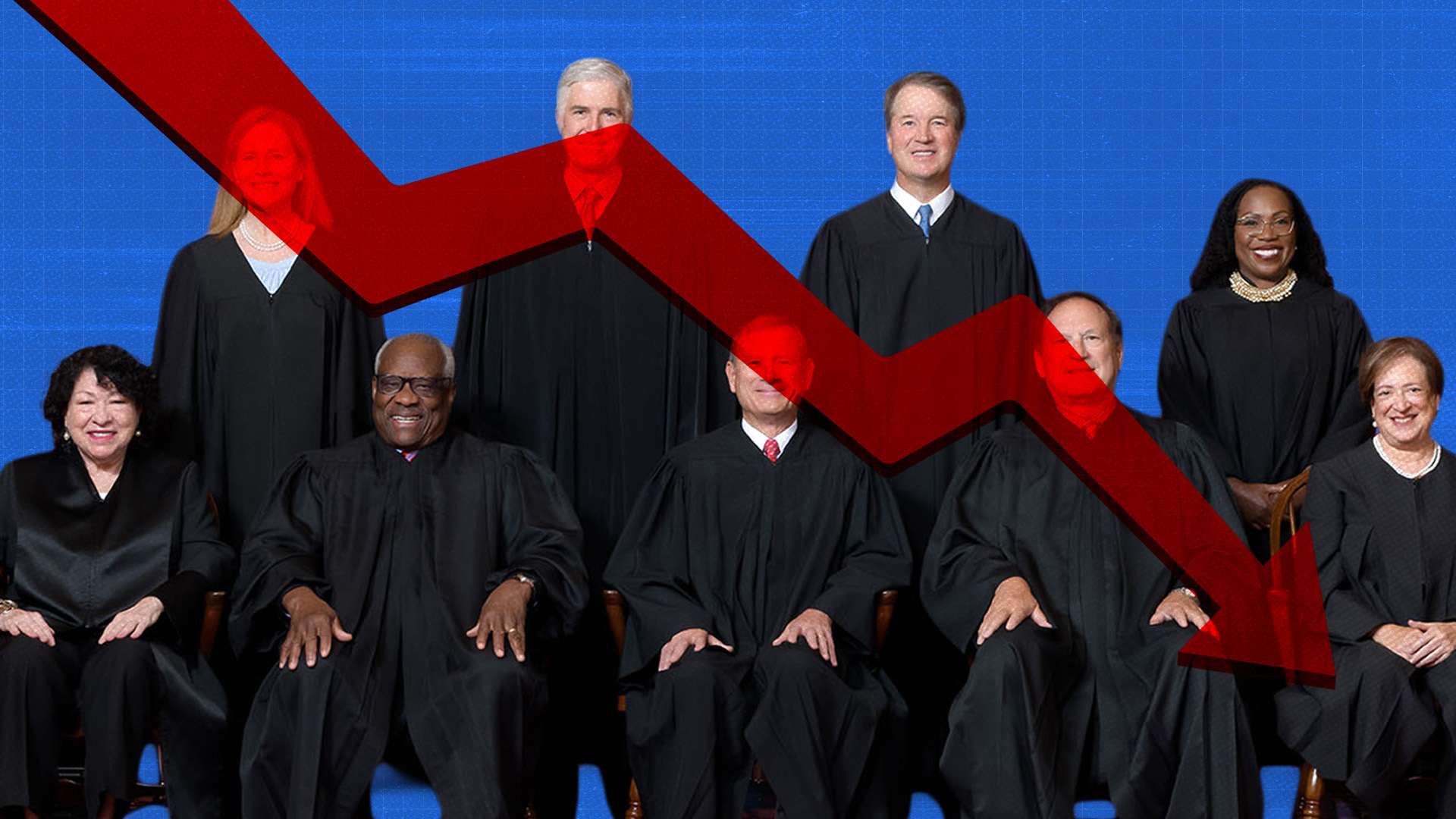
Public Confidence in the Supreme Court Hits New Low, Raising Questions About the Court’s Authority
A new NBC News poll reports that only 22% of registered voters express a "great deal" or "quite a bit" of confidence in the U.S. Supreme Court, marking a new low for public trust in the institution. Partisan shifts since 2024—declining Republican confidence and a small uptick among Democrats—have prompted renewed debate about whether falling approval ratings could affect the Court’s practical authority and the willingness of other branches to comply with its decisions.
By Damon Root
1,097 views
A recent NBC News poll has found that public confidence in the U.S. Supreme Court has fallen to its lowest recorded level, prompting questions about whether declines in approval matter for the Court’s real-world authority. According to reporting by NBC’s senior Supreme Court correspondent Lawrence Hurley, just 22 percent of registered voters said they have a "great deal" or "quite a bit" of confidence in the high court. Another 40 percent said they had "some" confidence, while 38 percent reported "very little" or "no" confidence.
The poll’s findings represent a deeper erosion of trust than the previous low recorded after the Supreme Court’s 2022 decision that overturned Roe v. Wade, when 27 percent of respondents expressed a high level of confidence. The new numbers are especially noteworthy for the partisan shifts they reveal. In 2024, 53 percent of Republicans reported a high degree of confidence in the Court; in 2026 that figure fell to 35 percent. Among Democrats the change ran in the opposite direction, albeit from a much lower base, growing from 4 percent in 2024 to 9 percent in 2026.
Observers note that specific court decisions appear to be driving some of the swing in public opinion. Damon Root of Reason points to the Court’s recent ruling rejecting President Donald Trump’s illegal tariff regime as an example that may have slightly improved Democrats’ impressions of the Court while reducing Republican confidence. The article also raises the possibility that future rulings—such as a forthcoming case over Mr. Trump’s birthright citizenship order—could further alter partisan attitudes toward the justices.
Beyond the immediate partisan calculus, the drop in approval has reinvigorated debate about what negative public sentiment means for a branch of government that was deliberately insulated from popular currents. Root cites Alexander Hamilton’s Federalist No. 78, which argues that lifetime tenure for federal judges was designed to safeguard judicial independence from "the effects of those ill humours which the arts of designing men, or the influence of particular conjunctures, sometimes disseminate among the people themselves." Hamilton acknowledged that judges might be unpopular, but that the insulation provided by lifetime appointments was essential to allow them to render judgments free of electoral pressure.
Yet Hamilton also warned that the judiciary lacks the "force" and "will" of the other branches and must ultimately rely on the executive to carry out its decisions. That tension—between a court intended to resist transient public opinion and a court that depends on other institutions to implement its rulings—lies at the heart of contemporary concerns about what happens if both major political parties come to distrust the Court’s judgment.
Root outlines several possible consequences if distrust becomes broadly bipartisan. A deeply unpopular Court could face increased pressure from presidents tempted to ignore or defy its orders, or from Congressmen seeking structural changes to the judiciary, such as court-packing or other reforms designed to reshape judicial influence. While such scenarios are speculative, the argument is that severely eroded public confidence could make aggressive political responses to the Court more feasible.
The piece does not suggest any immediate constitutional crisis, but it underscores how public legitimacy matters indirectly for the Court’s capacity to function within the constitutional system. Federal judges do not face reelection and typically remain on the bench for life, but the Court’s effectiveness ultimately depends in part on broader political acceptance of its role and rulings. Whether recent declines in approval will lead to tangible challenges to the Court’s authority remains an open question, one that will likely be influenced by forthcoming decisions and the reactions of political actors.
Reason’s commentary situates the poll results within this larger institutional debate, asking whether the Court’s shrinking reservoir of public confidence will translate into practical vulnerabilities. As partisan attitudes continue to shift in response to specific rulings, the long-term implications for the Supreme Court’s legitimacy—and for the balance between judiciary independence and political accountability—will be watched closely by scholars, politicians, and the public alike.